Follow Us on Google
By Arc. Chukwudi Ezenwa
A good deal has been written in recent days about the airport rising at Orumba North, much of it confident and little of it informed.
The objections deserve an answer, and it is best given in three parts: whether the Southeast can accommodate another airport at all, whether the arithmetic offered as proof that it cannot hold up, and what the state is in fact planning for, which is the question the criticism never reaches.
PROXIMITY AND AIRSPACE
Let us start with the simplest of them. Closely spaced airports are entirely normal and Nigeria already runs Lagos, Ibadan, the Ogun cargo airport, Benin, Akure, Escravos, Forcados, Omagwa, the joint-use Port Harcourt domestic field, Bonny, Eket, Uyo, Calabar, Obudu, Enugu, Ebonyi, Owerri, Asaba, Osubi and Anambra. All of them work.
More than one airport in a state is normal rather than the exception, for instance, Delta runs both Asaba and Warri; Kaduna runs both Kaduna International and Zaria; Port Harcourt is served by the international field at Omagwa and a joint-use domestic field
beside it; Lagos operates two parallel runways together with a second terminal; Kano, Niger, Taraba and others maintain further runways and airstrips alongside their principal field. None of this has ever been treated as duplication.
Their movements do overlap, but managing overlap is what controlled airspace exists to do. Each of those fields sits inside a structure of sectors, procedures and separation standards built so that simultaneous operations stay safe.
This is routine engineering, performed continuously, in every aviation system on earth. Far denser arrangements like the six international airports serving London function without difficulty, with numerous smaller fields between and around them.
South Africa also maintains several hundred aerodromes and airstrips. Against that background, an
additional field at Orumba North introduces no hazard to Nigerian civil aviation and no difficulty for route planning or airport operations. It sits within federal aviation planning rather than at odds with it.
THE TABLE OF FLIGHT TIMES
The critique leans hardest on a list of flight times between existing airports. Those figures deserve a closer look, because they are not what they appear to be. Distance in nautical miles is a fixed quantity, but time in the air is not. It depends entirely on what is flying. Put a Boeing 737-800 across thirty-five nautical miles and the cruise portion is brief. Send a turboprop over the same gap and it takes noticeably longer. Send one of the
light Cessnas or Beechcrafts that in practice work many of these fields, and the difference multiplies several times over.
A single figure quoted for a route conceals the aircraft that
produced it, and without the aircraft the figure carries no meaning. There is a second omission. Airborne time is only one component of a journey.
Push-back, taxi, departure sequencing, climb, descent, approach spacing and landing all consume the clock, and none of them appear in the numbers presented. What is offered as a journey time is a fragment of one. The larger difficulty is that the calculation answers a question nobody asked.
No one intends to operate a service between Enugu and Orumba North. Whether two existing fields lie minutes or an hour apart tells you
nothing about whether a region requires a freight gateway. Airports are justified by the trade they carry and the economy they sit inside, not by their spacing on a chart.
THE 2070 QUESTION
Now to the matter that actually decides this, which the article never reaches. Prof. Chukwuma Charles Soludo, CFR, has been consistent about his planning horizon from the first day of his administration, which is the “Vision 2070”. Projections for that year
put Anambra’s population at roughly 38.5 million. While the figure currently stands at 8.5 million, it projects thirty million additional people on one of the smallest and most densely settled landmasses in the federation. And that landmass is shrinking; flooding and gully erosion take ground from Anambra every season, and what erosion does not take, unplanned settlement will.
Every hectare that must carry the state’s future has to be identified, secured and laid out before it is lost to one or the other. This is the constraint the governor has been working against, and it is why the livable and prosperous smart mega city he has set out to build must be sited and planned now rather than argued over into the next decade.
Confront that figure honestly and the conclusions follow on their own. You cannot house, employ and move a population of that size on infrastructure scaled to the present one. You cannot assemble the land for it afterwards once settlement has spread and prices have followed. Whatever will be needed in 2070 has to be set out while open ground still
exists on which to set it out. That is the entire case, and it is a case about timing rather than about airports.
The African Dubai, Taiwan and Silicon Valley formulation Mr Governor has advanced since 2006 describes what such a state must become: a place where goods enter and leave the continent, a place where things are manufactured, a place where ideas are commercialised. All three depend on physical connection to world markets. Dubai’s
transformation began with aviation capacity installed well before traffic justified it.
Taiwanese manufacturing turned globally competitive because high-value output could be flown out overnight. Even an economy built on software still has to move engineers, components and equipment.
The site the Government selected reflects exactly that reading. Orumba North sits at the demographic and industrial centre of gravity of the Southeast, within twenty minutes to two hours by road of Onitsha, Nnewi, Awka, Enugu, Okigwe, Orlu, Owerri, Asaba and Aba alike. The feasibility work places an estimated 12.5 million people within a hundred
kilometres of the site, spanning six states, one of the densest commercial populations on
the continent.
The design follows from that, because the region is known for its trade and industry, and the pharmaceuticals, the spare parts and the manufacturing already originate here. It is why the landside is being built ahead of the airside. The warehousing, the free trade and export processing zone, and the more than eight hundred kilometres of road now under construction with the major axes dualised together consolidate cargo from across the region, and they begin capturing value before the first aircraft lands.
Those volumes migrate onto direct operations as the Anambra Mixed-Use Industrial City rises around them. The advantage sits in that ground network, and a ground network cannot be relocated.
What the Anambra State Government has designed and planned at Orumba North follows directly from that reasoning.
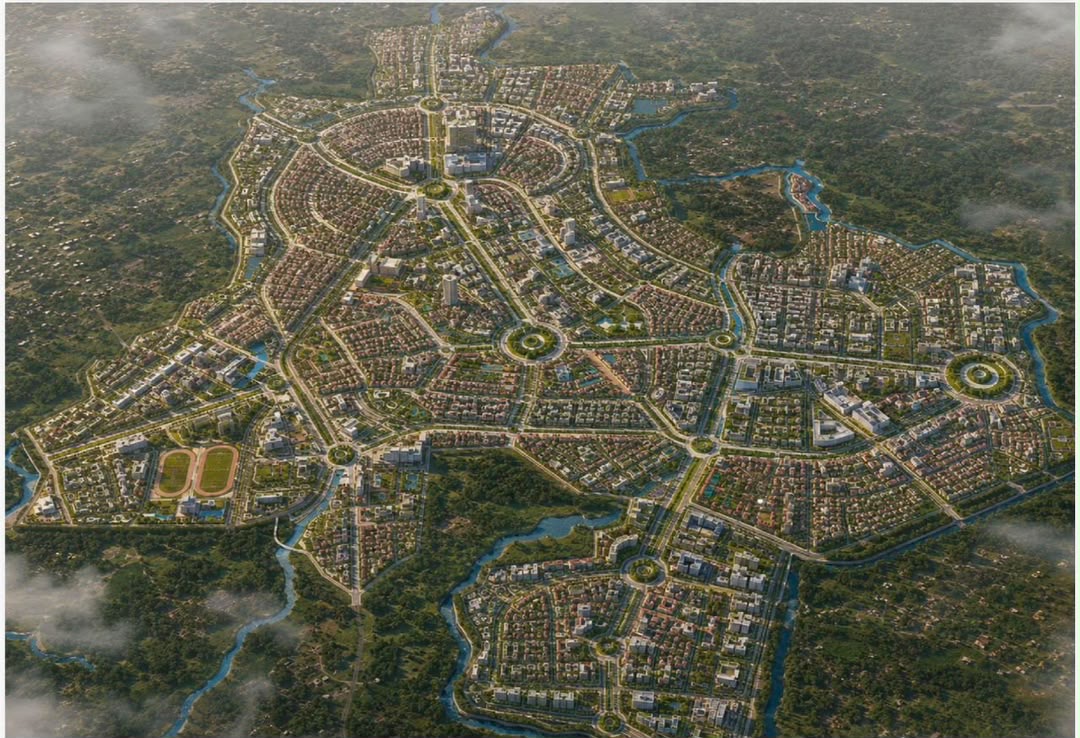
Roughly 12,700 hectares are being laid out as a single planned entity comprising the aerodrome, the Anambra Mixed-Use Industrial
City, an Agro-Industrial Park, a Pharmaceutical Hub, and zones for logistics, commerce, housing and recreation. Free trade zone status from the Nigeria Export Processing Zones Authority already covers much of the ground, and work has begun. Customs-bonded storage, export incentives and cold chain capacity for agricultural produce belong to the original layout rather than to later additions, consistent throughout with Anambra Vision 2070.
The intention is a settlement, not a terminal. Somewhere people establish businesses, manufacture, take employment, raise families and remain. Prof. Soludo is building it now because the alternative is to begin in 2070, by which point the land will be occupied and misused. The best time to secure the future is now.
•Ezenwa writes from Awka