Follow Us on Google
By Juliana Taiwo-Obalonye
It goes without saying that the informal sector in Nigeria significantly contributes to the national economy, accounting for a sizable portion of employment and national gross domestic product (GDP).

The informal sector in Nigeria contributed 65 percent of GDP in 2017, according to the International Monetary Fund (IMF). Nevertheless, despite the informal sector’s strategic importance and contributions to national economy, particularly smallholder businesses, the sector faces numerous developmental obstacles such as a lack of an efficient policy framework that would have the government and, to a large extent, the private sector, aim to develop the sector. Where such policies are present, they fall short of what the establishments are really about. Inadequate capital investment, a lack of competent labour, and other obstacles are further factors affecting the sector’s development progress.

The Federal Government, at various times and through different administrations, initiated policies and programmes that, in some cases, led to the creation of agencies with the aim to address the myriad of challenges, obviously, concerned by the sector’s backwardness and the need to revitalise and revamp it for efficiency and effectiveness in order to set standards that would be of immense benefit to individual operators of the sector and the country at large.
These efforts were made notwithstanding the failure or little success of previous administrations’ attempts to address these issues with the goal of raising Nigerians’ standard of living and improving their socioeconomic wellbeing through policy formation.
In spite of this, President Muhammadu Buhari’s administration established the National Social Investment Programme (NSIP) in 2016 to address both short-term and long-term socio-economic imbalances and inequalities in order to reduce poverty and promote faster economic growth.
One may argue that the NSIP is the largest and most comprehensive social security and poverty eradication programme ever implemented by a Nigerian government. It was specifically designed to offer safety nets in tackling the short- and long-term socio-economic issues encountered by the poor and disadvantaged in society with the goal of providing assistance and raising their standard of living.
Millions of Nigerians have benefited and continue to benefit directly and indirectly from the various clusters of the NSIP, which is housed in the Federal Ministry of Humanitarian Affairs, Disaster Management, and Social Development, since its creation. Through Conditional Cash Transfer (CCT), many people who were previously poor or unable to provide for their own needs have been pulled out of poverty; many of them now run small enterprises, greatly enhancing their quality of life.
The CCT programme, which aims to give Nigerians financial incentives to improve their capacity in their chosen trades, provide learning opportunities and job experience, as well as income for startups of economic transforming initiatives for a more meaningful life, is another element of the NSIP that has had a significant positive impact on the lives of many Nigerians, especially the youth who desperately needed a push to actualize their dream and unleash their potential.
In order to reduce poverty and ensure the quick development of these sectors, the NSIP activities focus on important socioeconomic areas like education, healthcare, agriculture, and smallholder companies. In this context, it is instructive to notice that the intervention’s impact is tangible in a variety of ways. The programme has directly benefited and continues to directly benefit numerous households and individuals.
Agriculture, which continues to be Nigeria’s largest employer of labour and a significant contributor to the GDP but regrettably experiences neglect and backwardness, is one of the areas that the NSIP positively benefited. Despite the fact that Nigerian agriculture primarily focuses on subsistence farming, the impact of NSIP suggests that mechanised large-scale farming may become more viable, especially in light of the beneficiaries of the CCT and N-Power programmes, whose businesses have experienced rapid and unheard-of growth.
There are numerous instances of smallholder farmers who benefited from the NSIP scheme and still do. One of these recipients is the rice farmer Amarachi Okafor whose capacity to produce increased as a result of receiving a CCT from the NSIP.
Amarachi, who lives in southeastern Nigeria, narrated how her occupational and economic lifestyles changed for the better by the FG’s CCT programme.
In an exclusive interview posted on the SHIP’s official YouTube page BETTER LIFE NG, Amarachi described how the CCT programme helped her realise her dream by transforming her fortunes from a smallholder farmer to a large-scale farmer.
In her testimony, a now-happily-fulfilled Amarachi recalled with nostalgia how she had been unable to participate in earlier government intervention programmes, until the start of the NSIP, which transformed her experience from one of exclusion and alienation to one of inclusion and integration.
She said: “I have been a rice farmer for quite a very long time, and I never benefited from any government package before now. But since I enrolled in this programme (CCT), I have benefitted a lot.”
She added that the programme had altered the way she perceived government intervention programmes, of which she had previously had little faith in her ability to take advantage.
She stated that when she registered in the NSIP’s CCT, she typically received the stipend on time, frequently and when due, saying “they paid us money, they trained us in many things. So, I’m happy that I enrolled in the NSIP programme.”
Amarachi said she had little prospects of accomplishing the feats until she encountered the CCT programme, noting that farming enterprise improved her story: “I used the money they gave to me in buying fertiliser and chemicals, which I added to what I had and took to my farm; this has greatly helped me in making tremendous progress in my rice farming business.
“The intervention really helped me, because the money came at the time I needed it the most”, adding that “the fertiliser and the chemicals really helped me to increase my yields this year. At least, I have 30 bags of 100 kg of rice.”
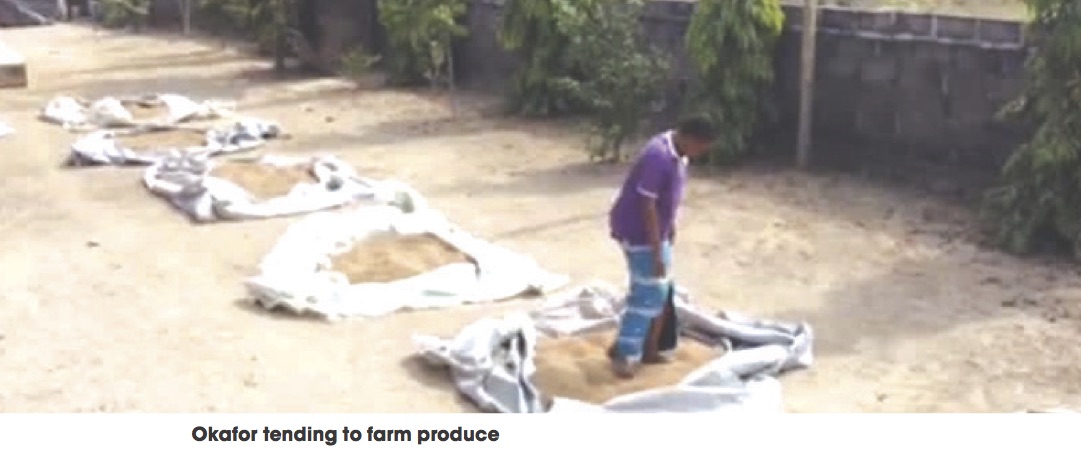
Amarachi’s rice farming business has improved, leading to an enormous increase in output, which has allowed her to expand her annual harvest to 3,000 kilogramme bags of rice—a task she never imagined she would be able to achieve on her own in the past.
A visit to Amarachi’s farm and house demonstrated how life-altering initiatives like the CCT can make hopes come true. Her family members were observed helping with the drying and packaging of the harvested rice at the house, which was littered with bags of rice that had been gathered from her farm.
Her home and farm have both evolved into sources of work for her family and neighbours, who utilise their involvement to supplement their daily income. Additionally, Amarachi has started to make money off of the company. The multiplier effects of the intervention are felt throughout the community, particularly among the youth who make up the programme’s primary target audience, as well as in many homes and among other age groups who, up until this point, either lacked sufficient income or had no reliable source of stable income for sustenence.
Indeed, the tale and experience of Amarachi capture the very heart of the NSIP, where the underprivileged and needy are raised from the grass to grace. Consider the Amarachi farming industry without CCT intervention. Indeed, it is easier to envision the detrimental effects of such an involvement in Amarachi’s firm.
Amarachi, a smallholder farmer who is now a better farmer, is one of the more than one million Nigerians who directly benefit from the CCT plan of the Federal Government and who are assisting in the socioeconomic development and expansion of the country. In order for Nigeria to compete favourably in the global race for socioeconomic development and to achieve overall national development and claim its proper place in the committee of nations, it is hoped that the NSIP programmes will be maintained and adjusted, where necessary.