Follow Us on Google
•Politics, undercurrents that defined emergence of Oba Owoade
By Oluseye Ojo
Fresh facts have emerged on the reasons Oyo State governor, Seyi Makinde did not endorse the candidate proposed by majority of members of Oyomesi, the Oyo kingmakers to occupy the revered throne of Alaafin of Oyo, opting instead for the choice of the Ifa oracle, then Prince Akeem Owoade.
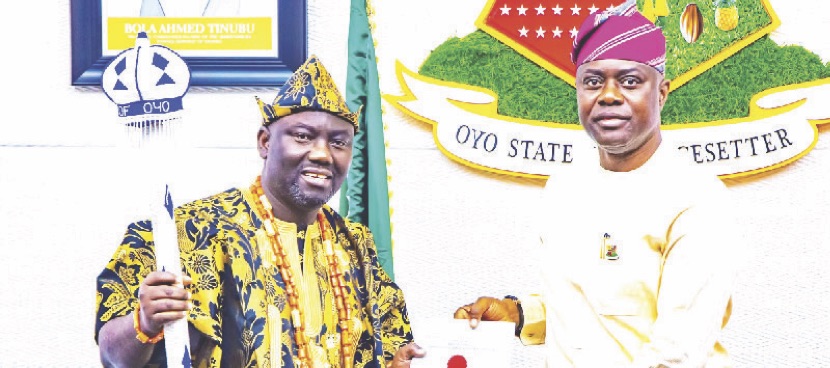
Nearly three years after the demise of the 45th Alaafin of Oyo, Oba Lamidi Adeyemi 111, Oyo State governor, Seyi Makinde penultimate Friday presented the staff of office to Oba Owoade as the new monarch of Oyo Kingdom.
The governor’s choice was strongly rejected by the Oyo kingmakers.
The Alaafin Chieftaincy Declaration of 1967, like other chieftaincy declarations in the state, showed that after the selection of candidates or a candidate by the kingmakers (Oyomesi), the names or name would be forwarded by the kingmakers to Oyo East Local Government, which would in turn forward the documents to the Ministry of Local Government and Chieftaincy Matters for transition to the sitting governor.
Available records showed that the Oyomesi had nominated a candidate and forwarded his name to the government. But the state government did not approve the kingmakers’ candidate. The government asked the kingmakers to restart the process of nominating again for another prince to emerge. The government said it had credible intelligence that the kingmakers had been massively compromised financially by the particular candidate. The governor insisted that the Oyo throne was too important for Oyo State and the entire Yoruba race to be handed over to the highest bidder. But majority of the kingmakers insisted that there was no other candidate to be presented.
The government argued that there was internal wrangling within the Oyomesi over the sharing formula for the alleged bribes. Some of the kingmakers reportedly withdrew their assent over the purported lopsided sharing formula.
Some of the kingmakers had approached the court to defend their nomination, but they lost at the High Court. They have since proceeded to the Court of Appeal.
Highly credible sources in the Oyo State government told Saturday Sun that left to Governor Makinde, the matter would have just been left to continue in the courts until all litigations on the matter were finally determined. One of the sources noted: “You would recall that Governor Makinde raised the alarm on the influx of bandits fleeing from military bombardment in the North West, to the South West some days ago. The governor said he was at Fashola Farm Settlement in Oyo town on his birthday, which was December 25, 2024. He said he saw a camp of bandits not far from the farm settlement.
“This is Yorubaland and the governor has responsibility to ensure security of lives and property. Oyo town needs to have the Alaafin in place to complement the effort of government in the provision of security.
“Let me tell you, one of the contestants was linked to paying allegiance to a traditional ruler in the North. He was said to have pledged that religion would be prioritised over the culture and tradition of Oyo and Yorubaland. I am not mentioning any name.
“The security agencies should find out who are the promoters of the launch of Sharia Court in Oyo town. It is in furtherance of the preference for the religious agenda of the said traditional ruler in the North.
“The throne of Alaafin is not for only Oyo town. It is also for the entire Yorubaland. The sanctity of the Alaafin traditional institution must be protected. An Alaafin must not be subservient to any traditional ruler, whether in the North or anywhere. Nobody should use religion to deceive us and cunningly implement land conquest war in Yorubaland. “The person that will become Alaafin must be committed to the promotion of Yoruba culture and tradition. An Alaafin is not just an ordinary king in Yorubaland. No governor would allow the sacredness of the throne to be tampered with in his time.”
Involvement of Prof Wande Abimbola
The search for an Alaafin that would not bastardise the culture and traditions of Oyo town and those of Yorubaland got the state government to contact a prominent Ifa priest, Awise Agbaye, 92-year-old Prof Wande Abimbola, a former Vice Chancellor, Obafemi Awolowo University (OAU), Ile-Ife, Osun State.
Prof Abimbola led the divination that produced Oba Abimbola Akeem Owoade, the 46th Alaafin of Oyo. But the Oyomesi has expressed discontent with the state’s intervention, citing it as a usurpation of their rights.
Amendments that reshaped chieftaincy authority in Oyo State
On Friday May 26, 2023, Governor Seyi Makinde of Oyo State signed into law the legislation granting the governor the authority to bestow beaded crowns and coronets directly to traditional chiefs. The key development arose from the amended Chiefs Law, Cap. 28, Laws of the Oyo State of Nigeria, 2000, passed with unanimous support from the state House of Assembly.
Speaking during the signing of the amended laws, Makinde explained the implication of laws: “First, we have a law in Oyo State that allows the smooth running of the Traditional Council, which is important.
“Before I came in, the Traditional Council was non-functional, but now they can function.
“And with that (previous) law, you remember that the previous administration tried to reform the traditional system, especially in Ibadanland and the government gave coronets out to some high chiefs.
“One of the high chiefs went to court and the Oyo State court decided that the previous administration did not follow their laws.
“Now, we have amended the laws and we will follow our laws and there is no one that can go to court and succeed.”
Analysts have contended that with the new law, the governor has been empowered legally to exercise the discretionary right and sole authority to specify those to wear beaded-crowns.
With the power conferred on the governor by the Laws of Oyo State, observers have said, it might be difficult to win against the state government after a king has been installed, unless the law is tinkered with again.