Follow Us on Google

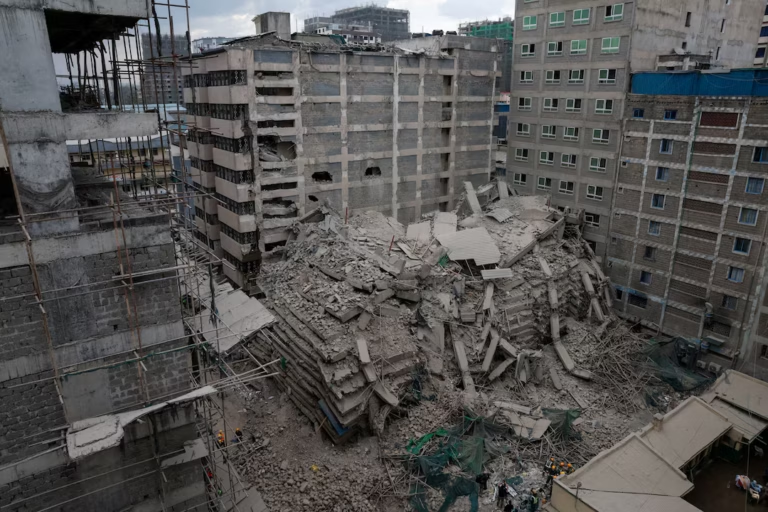
Construction Act advocate, Abiola Aderibigbe, has once again called for renewed national action on building safety following Monday’s collapse of a four-storey school building in the Aguda area of Ogba, Lagos.
The building, which housed Yemco Nursery, Primary and Comprehensive College at 11 Adudatu Street, behind County Hospital, reportedly came down shortly after students and staff were evacuated, averting what could have become a major tragedy.
Reacting to the development, Aderibigbe said the incident should be seen not simply as a narrow escape, but as another reminder that Nigeria must move from sympathy to systemic prevention.
“This was a tragedy narrowly avoided, and we must thank God that lives were spared,” he said.
“But we must also be honest: Nigerian children, teachers and families should not have to rely on last-minute evacuation or good fortune for their safety. These recurring collapses show that the country still has serious work to do in strengthening building safety, enforcement and accountability.”
Aderibigbe, who has led public advocacy for a Nigerian Construction Act, said his intervention was not about blaming government officials, but about encouraging leadership at both state and federal level to build on existing concerns and turn them into lasting reform. His wider advocacy has previously been covered across several national outlets, with a recurring focus on safe buildings, unified regulation and stronger accountability in the construction sector.
According to him, the governor of Lagos State Babajide Sanwo-Olu had already made an important intervention by publicly calling for a unified building code in 2025, and that position deserves to be commended and advanced further via the Nigerian Construction Act.
“His Excellency Governor Babajide Sanwo-Olu was right to raise the need for a more unified and enforceable framework “Aderibigbe said.
Other News
“That was an important and constructive intervention. What is needed now is to carry that momentum forward into enacting a Nigerian Construction Act which would implement practical systems that prevent distress from becoming disaster, especially where schools and other public-facing buildings are concerned.”
Governor Sanwo-Olu said in August 2025 that a unified building code that is adaptable, accessible and enforceable would help reduce the rate of building collapse, while also urging stronger compliance and collective action in the built environment.
Aderibigbe also appealed to President Bola Ahmed Tinubu to support building-safety reform as part of the administration’s broader national development programme.
“I also respectfully call on His Excellency, Asiwaju Bola Ahmed Tinubu, GCFR, to consider building safety reform as part of the Renewed Hope Agenda,” he said.
“A Nigerian Construction Act tailored to put the lives of Nigerians first is exactly what the nation requires. Nigeria can be saved from many of these preventable collapses if we treat safe construction, proper oversight and institutional accountability as part of national development. Safe schools, safe homes and safe commercial buildings are fully consistent with the promise of renewed hope.”
Federal statements on the Renewed Hope Agenda have repeatedly linked it to visible improvements in communities and to infrastructure as a core part of national development.
Aderibigbe maintained that the answer lies not only in public outrage after each incident, but in a coordinated framework; the 5 co-equal pillars developed as part of the Nigerian Construction Act which would cover standards, enforcement, professional discipline, and stronger institutional responsibility.
“We do not honour near-misses merely by being relieved,” he said. “We honour them by reforming the systems that allowed the risk to exist in the first place.”
He added that while Lagos has shown leadership in raising the issue, the wider problem is national and should be treated as such.
“This is bigger than one street, one school, or one state. It is a Nigerian issue. And with goodwill from state and federal leadership, it is one Nigeria can address more seriously and more successfully than we have done so far.”