Follow Us on Google
• List poor testing labs, costly certification for SMEs, funding constraints as challenges
By Merit Ibe
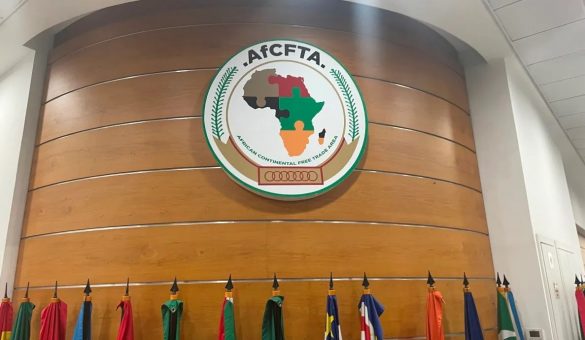
Six years after Nigeria signed onto the African Continental Free Trade Area (AfCFTA), the debate is no longer about whether the deal is historic. It is. However, the real question on the lips of stakeholders is whether Nigeria’s economy is truly ready to compete in a single continental market.
While the Minister of Industry, Trade and Investment, Dr Jumoke Oduwole has taken strategic steps in fine-tuning modalities, experts are raising red flags that Nigeria could unwittingly become a dumping ground for inferior imports from neighbouring countries with cheaper operating costs, if long-standing structural flaws persist.
They point to inadequate testing laboratories, high certification costs for SMEs, weak standards enforcement, high cost of funding for manufacturers, porous borders and poor infrastructure as vulnerabilities that may leave local industries exposed.
Though AfCFTA offers vast export opportunities, stakeholders warn that without urgent investment in quality infrastructure and regulatory oversight, Nigeria’s manufacturers may struggle to compete, tilting the balance toward rising imports and deepening strain on already fragile productive sectors.
The Director General, Centre for the Promotion of Private Enterprise (CPPE), Dr Muda Yusuf, told Daily Sun that energy costs have to crash for manufacturers to compete.
He also pointed to fixing logistics (ports, roads, transport systems); reducing duties on intermediate/raw materials, among others.
Despite these challenges, Daniel Dickson-Okezie, SMEs expert and member of the Lagos Chamber of Commerce and Industry (LCCI), said Nigeria must stay the course, even if preparation remains shaky.
“Well, for the AfCFTA, we are trying, but to say we are prepared, I don’t think so. “Despite concerns about preparedness, Nigeria must remain committed. Withdrawing is not an option”, he said.
According to him, the advantages are enormous: expanded market access, increased trade opportunities, industrial growth and job creation.
But he warned that tariffs are only one part of the equation.
“AfCFTA opens markets across Africa, but if it costs more to move goods from Lagos to Kano than from Ghana to Togo, Nigerian manufacturers may struggle to compete,” he noted.
He said on paper, trade is being liberalised, but in reality, the journey of a container from a factory in Lagos to Apapa Port or across the Benin border is where the real costs accumulate. He added that heavy traffic congestion, multiple checkpoints, informal payments to unauthorised actors, high truck haulage fees, port delays and demurrage charges inflate prices long before goods leave Nigeria’s shores.
He noted that non-tariff barriers, logistics inefficiencies, documentation bottlenecks and border delays threaten to cancel out the benefits of tariff reductions.
Quality standards, Dickson-Okezie observed, are not new in Nigeria.
He said it was soothing to know that enforcement is tightening as the Standard Organisation of Nigeria (SON) has strengthened certification under the Mandatory Conformity Assessment Programme (MANCAP).
He added that SON is expanding digital documentation systems and aligning with AfCFTA Rules of Origin, just as the National Agency for Food and Drug Administration and Control (NAFDAC) has intensified crackdowns on fake and substandard goods.
He added that Nigeria has also elected to guide businesses on compliance, while training exporters on packaging, labelling and international standards in ongoing.
“But challenges remain. Poor testing laboratories in some sectors, high certification costs for SMEs, weak enforcement in informal markets and infrastructure gaps that affect product preservation.
Beyond infrastructure, there He revealed the general fear that Nigeria could become a dumping ground in AfCFTA’s early years as stronger African economies with lower production costs may flood the domestic market if Nigeria does not scale up industrial capacity quickly.
Other News
He, however, listed bright spots as industrial clusters in Aba, Kano and other hubs demonstrate resilience.
“With improved power supply, access to finance and export facilitation, these producers can compete regionally”, he said.
For John Isemede, former Director-General of the Nigerian Association of Chambers of Commerce, Industry, Mines, and Agriculture (NACCIMA), the bigger concern is private sector readiness.
“The agreement was signed in 2019. What has the private sector done since then?
“The government may be ready, but the private sector is not ready. Most Nigerians are not even aware of the agreement”, he stated.
He lamented the absence of structured export training and professional export managers.
“If you approach a bank for a loan and you don’t know your raw materials, equipment or market, you are doomed to fail,” he said.
Nigeria, he argued, cannot continue as a mono-economy reliant on oil.
He said export development is “paramount to the development of the economy.”
Yet, he questioned performance metrics: “How many containers in six years of AfCFTA have left our shores? Industrialisation is not a child’s play”, he added.
David Etim, Project Lead of the Calabar and Gulf of Guinea Municipal and Trade Centre Limited by Guarantee, believes the opportunity is real, but bureaucracy is the decisive factor.
“AfCFTA is an opportunity, not an exposure risk. But our bureaucracy is either the trigger that sends us to the moon or the cement bag that sinks us.”
He cited port inefficiencies and excessive administrative delays. “Clearing a single 20-foot container in Nigeria can cost exponentially more than in neighbouring countries due to delays, unofficial charges and logistics breakdowns.
“Nigeria has land, water, population, market and private capital.
“What is holding us down is bureaucracy. If we declutter it and focus on ease of doing business, within five years, we can turn this economy around”, he said.
Sector-specific experts echo similar caution.
Professor Eguahide Oaikhinan, a ceramics specialist, noted that AfCFTA offers Nigerian manufacturers access to a 1.3 billion-person market.
Ne noted that without competitive pricing, energy efficiency and infrastructure upgrades, cheaper imports from North and Southern Africa could undercut local producers.
He said Nigeria’s AfCFTA journey is neither doomed nor guaranteed. The market is vast. The potential is undeniable. But policy declarations must translate into factory-floor competitiveness.
AfCFTA is not a conference agenda. It is a practical trade regime.
For Nigeria, the verdict will not be written in communiqués, but in containers shipped, factories powered, jobs created and bureaucracy dismantled.