Follow Us on Google
By Oluseye Ojo
In a bid to ensure a significant economic transformation, Oyo State has forged a unique path by becoming the first sub-national government in Africa to launch a comprehensive implementation strategy for the African Continental Free Trade Area (AfCFTA).
The initiative, celebrated in a high-profile gathering in Ibadan, the state capital recently, is aimed at redefining the economic landscape of the state and enhancing its competitive edge within the greater African market.
At the forefront of the historic move is Governor Seyi Makinde, whose strategic vision for economic development aligns seamlessly with the aspirations of the AfCFTA.
The AfCFTA is a trade pact among African Union (AU) member states to create a single continental market for goods and services, aiming to boost intra-African trade, promoting industrialisation, and deepening economic integration across the continent.
It was launched in 2021 by the AU, and it connects over 1.3billion people and aims to eliminate trade tariffs and non-tariff barriers, facilitating the free movement of goods, people, and capital.
The launch was met with enthusiasm from esteemed dignitaries, including Wamkele Mene, the Secretary-General of AfCFTA, who lauded the effort, stating, “Oyo State is the first sub-national not only in Nigeria but across the entire continent to develop and launch an implementation strategy for the AfCFTA.”
Former Vice Chairperson of the African Union, Monique Nsanzabaganwa; Rwanda’s High Commissioner to Nigeria, Christophe Bazivamo; and Sierra Leone’s Deputy High Commissioner to Nigeria, Major-General Dauda Fred Alpha (retd) were among dignitaries hat witnessed the launch of the AfCFTA in Ibadan.
Mene declared that though the initiative is a continental agreement, which is expected to be guided by Federal Governments of member states, sub-nationals like Oyo State would play undeniably important roles by driving intra-Africa trades and bringing the ambitions of AfCFTA to reality.
He described Oyo as the first of the 591 sub-nationals in Africa to launch an AfCFTA implementation strategy. He explained that sub-nationals are quite strategic to AfCFTA, as productions, agriculture, and trades happen at the sub-national levels.
He equally lauded Oyo’s implementation strategy, which according to him, has the overarching objective of promoting industrialisation, diversifying export markets and scaling up productive activities.
He added that the strategy recognised that the economic future of Africa lies in value addition rather than raw export of agri-produce, processing of the abundant minerals in the state, and encouraging productive capacity enhyhancement.
Vision for Economic Transformation
The implementation strategy, as gathered, signifies a pivotal moment for Oyo State, as it sets the stage for enhanced intra-African trade and sustained economic growth.
Wamkele Mene listed the crucial role that sub-national entities play in driving the execution of AfCFTA. He emphasised that local governments are vital in translating the continental agreement into tangible benefits for their communities.
At the launch, Mene articulated a clear vision for Oyo’s involvement in the AfCFTA.
“The economic future of Africa lies in value addition rather than raw export,” he noted.
He communicated a shared understanding with Governor Makinde about the necessity of focusing on boosting local productivity, industrialisation, and diversifying export markets.
Reflecting on Oyo State’s comparative advantages, Mene pointed out the abundant opportunities in agriculture, manufacturing, and digital transformation. He reinforced that the sectors hold the potential for significant economic advancement through AfCFTA participation.
Governor Makinde, in his response to Mene’s optimism, declared the importance of the AfCFTA implementation strategy. “This is not just a document; it is a commitment to economic transformation,” he said.
Makinde expressed eagerness to elevate Oyo State as a preeminent destination for trade, investment, and innovation within Africa.
He continued: “We are now proactively preparing our institutional frameworks, improving infrastructure, and creating investment incentives to benefit from the AfCFTA.”
Strategic Focus on Key Sectors
Critical stakeholders have said a deliberate focus on key sectors expected to drive economic growth is ventral to Oyo’s implementation strategy.
Governor Makinde elaborated on the impending improvements for small and medium-sized enterprises (SMEs), enumerating their important role in enhancing the state’s export readiness.
He projected that through targeted support and training, SMEs would achieve compliance with international standards on packaging and certifications with a view to boosting their competitiveness.
It was further revealed that in an effort to pragmatically align the state’s initiatives with the objectives of the AfCFTA, the strategy outlines specific priority sectors, including agriculture, manufacturing, and creative industries.
The peep into the framework of the strategy showed that it aims to leverage Oyo State’s rich agricultural resources, such as cassava, maize, and livestock, and encourages local industries like textiles and food processing to access broader markets across Africa.
Commenting on the potential for economic diversification, Makinde emphasised the long-term implications of the AfCFTA.
“In the long term, this strategy will attract foreign direct investment and give our local businesses access to a single African market of about 1.4 billion people,” he stated.
He added that his vision extends beyond mere production; it includes creating comprehensive value chains that elevate the overall productivity of the state.
Infrastructure Development as a Catalyst
Governor Makinde, in recognition of the fact that robust infrastructure is crucial to realising the benefits of the AfCFTA strategy, mentioned some significant developments that would make the implementation plan to thrive in the state. He stated that they include the ongoing upgrade of the Samuel Ladoke Akintola Airport to international standards.
Mene also remarked: “Oyo’s upgrading of its airport is a considerable step toward unlocking regional market integration.”
In addition to aviation improvements, the ambitious road infrastructure projects throughout the state have also been considered to serve as vital enablers for economic transformation.
Makinde explained that the infrastructure development would reduce travel times and improve logistics, which would position the state to create a conducive environment for businesses to thrive and enhance both domestic and cross-border trade.
Partnership for Success
Governor Makinde, during the launch of the implementation plan, asserted a commitment to engaging with the AfCFTA Secretariat for ongoing support during the implementation phase.
He emphasised that access to trade finance remains essential in transitioning the AfCFTA strategy from a policy document into a workable framework.
Also, the Director General of AfCFTA, Mene, noted the critical nature of trade finance, particularly for informal traders, smallholder farmers, and young entrepreneurs.
“These actors must be included in this strategic implementation as they form the bedrock of Oyo’s economy,” Mene said.
It was further gathered that the partnership approach signals a progressive strategy that integrates various stakeholders, and ensure that economic benefits are equitably distributed across the populace.
Relevance of AfCFTA to the Ordinary Citizen
Prof Musibau Babatunde, the Commissioner for Budget and Economic Planning in the state, elaborated on the practical implications of Oyo’s AfCFTA venture for everyday citizens.
He articulated how both small-scale farmers and urban entrepreneurs stand to gain from the agreement
Other News
He explained: “The AfCFTA aims to create a single continental market, allowing traders in Oyo to access other African markets easily.”
He provided a relatable example: “For someone producing ádìre (traditional Yoruba fabric), being covered under AfCFTA means that when their goods cross borders, they can market them competitively due to lower tariffs. This opens up avenues for exportation that were previously inaccessible.”
Babatunde added that the AfCFTA has potential to empower local producers and businesses by creating a larger, integrated market for their goods, thereby improving livelihoods across the state.
Future Prospects and Aspirations
As Oyo State strides confidently into a new economic era with the AfCFTA, the vision is said to extend far beyond immediate trade gains. Governor Makinde’s administration, as gathered, is focused on establishing institutions and frameworks that would sustain economic development long after his tenure.
The governor, In a testament to the foresight, listed the state’s strategies to build human capital, develop skills, and execute policies that would promote job creation and economic prosperity.
“Knowledge and productivity must be combined with natural resources to take any state or country out of poverty,” Makinde said..
He added that the potential of the state to emerge as a West African trade and investment hub is encompassed in its ambition to attract regional headquarters, processing centers, and logistics hubs.
The development, as observed, has brought a palpable sense of excitement and optimism in the air, as the state embraces its identity as a pacesetter in African trade.
Precedent for other sub-national entities in Africa
The launch of Oyo State’s AfCFTA implementation plan in September 2025, stakeholders said, is not only redefining its economic narrative, it is also setting a precedent for other sub-national entities in Africa.
The deputy governor of the state also said the project symbolised a bold commitment to harnessing the opportunities inherent within the AfCFTA framework, in order to ensure that Oyo State capitalises on its strengths to drive economic growth and sustainable development.
According to stakeholders, with the right policies, frameworks, and partnerships in place, the trajectory is clear for the state to become a central figure in Africa’s trade landscape, paving the way for a prosperous and interconnected future for all.
Oyo State’s vision for economic advancement is encapsulated in Governor Makinde’s declaration: “We will continue to lead by example. We are, after all, the Pacesetter State.”
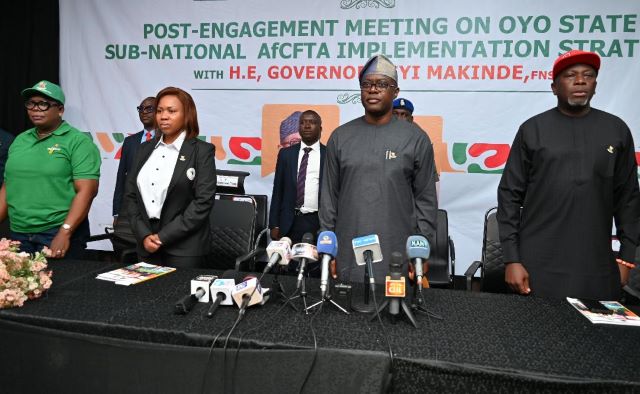
Post-Engagement Meeting on AfCFTA Implementation
A post-engagement meeting on AfCFTA implementation was held in Ibadan some days ago, which was presided over by Governor Makinde.
The event was attended by key officials, including Otunba Segun Ogunwuyi, Chief of Staff; Mrs. Olubunmi Oni, Head of Service; Kazeem Adeniyi Bibire, Deputy Chief of Staff; Chief Bayo Lawal, Senior Executive Assistant to the Governor on General Duties; and Tilewa Folami, Director-General of the Oyo State Public Private Partnership Agency, among other dignitaries.
Makinde, in his address, stated: “The state’s vision of unlocking prosperity, creating employment, and boosting trade volume is well on course with the launch of the AfCFTA sub-national implementation strategy in the state.
“The launch of the strategy would enhance the administration’s agenda for the sustainable development of the state.
“Our administration became emboldened to engage in the agreement given the sheer size and population of the state and the huge investments it has made on infrastructure development.
“The agreement would culminate into massive employment creation, opportunities for entrepreneurs and business owners, and boosting trade volumes.
“We want to be remembered as an administration that put in place institutions and structures that would enable the state’s smooth transition into the future. We have not only been investing in rebuilding infrastructure and implementing policies that improve the standard of living of Oyo State residents for today, but we have also saved about US$6million in the Sovereign Wealth Fund, focusing on the future of the state.”
The governor added, “I want to situate the efforts of Oyo State placing itself right in the middle of the African Continental Free Trade Area Agreement. We have seen things happen here. We know that in the African Growth and Opportunity Act, Nigeria missed out, but for the AfCFTA, thankfully, sub-nationals are able to run their own course.
“That is why Oyo State said, ‘look, we’re not going to wait for the Federal Government, since the agreement itself gave an allowance for us as a sub-national to take our own destiny in our hands,’ and that’s exactly what we have done in Oyo State.
“Natural resources alone will not take anybody out of poverty. They have to be backed by knowledge and productivity. You have to be productive. And, after being productive, you need a channel to ensure that you can earn foreign exchange for all those efforts. Oyo State is well on that path.”
Ms. Neo Theodore Tlhaselo, Special Adviser to the Governor on AfCFTA and International Trade, drew attention to the governor’s visionary leadership.
“The governor’s visionary leadership has led to massive economic development in the state. The post-launch engagement is a statutory administrative process that follows the launch of the implementation strategy, which pronounced Oyo State as a party to the AfCFTA to engage within the African continent on the agreement’s framework,” she said.
Tlhaselo stated further that the implementation strategy would position the state as a capable partner to many African countries, enabling the state to leverage its competitive advantages, create gainful employment opportunities for its youth, and earn foreign exchange through infrastructure development
Governor Makinde also added: “We have areas of competitive advantage, which we will go after in our implementation of the AfCFTA strategy. If our teeming youth can find gainful employment and we are able to earn foreign exchange following our investment in infrastructure development, then we would be able to move our people from poverty to prosperity in line with the vision of the administration.
“So, we have from day one, opportunities that we will go after. And if we can have our youth, our graduates coming out to be gainfully employed, we would have gone a long way in solving some of the poverty issues that we have faced.
“So, we want to take the opportunity to reach out first to neighbouring countries — West and Central Africa, and the rest of Africa.
‘In our airport, we recently landed a wide-bodied A330. It is exactly the same aircraft that Virgin Atlantic uses to service their Lagos-London route. So, we can go anywhere in the world from Ibadan airport.
“We have done all the hard work. So, our vision for sustainable development of our state is well on the way. We believe that being part of the African Continental Free Trade Agreement as a sub-national and the first sub-national on the continent of Africa to achieve that, will give us access to great economic opportunities.”
The Special Adviser to the governor on AfCFTA and International Trade, Ms Tlhaselo, stressed that the governor’s visionary leadership has led to massive economic development in the state.
She explained that the post-launch engagement is a statutory administrative process that follows the launch of the implementation strategy, which pronounced Oyo State as a party to the AfCFTA to engage within the African continent on the agreement’s framework.
Tlhaselo added that the implementation strategy is a legal instrument that would allow Oyo State to engage with other states globally in trading with access to bilateral relations and international trade agreements, thereby positioning it as an able partner to many African countries.
FG eyes 40 per cent GDP growth by 2030
The Federal Government of Nigeria has set a target of achieving 40 per cent growth in the country’s Gross Domestic Product (GDP) by 2030, leveraging the AfCFTA to expand exports, attract investments, and boost industrial productivity across key sectors. Oyo state is expected to contribute significantly to the GDP growth via AfCFTA.
The government, in order to achieve the goal, has begun strengthening the technical capacity of trade institutions and private-sector players to drive effective implementation and position Nigeria as a major force in intra-African trade.
The National Coordinator of the Nigeria AfCFTA Coordination Office, Mr. Olusegun Awolowo, stated that the government has stepped up implementation through an advanced training initiative on the Rules of Origin, a vital component that determines goods’ eligibility for preferential treatment under AfCFTA.
The initiative, he said, is part of a strategic partnership with the World Customs Organisation (WCO) under the EU-WCO Rules of Origin for Africa Programme and is being facilitated by the Nigeria Customs Service. Awolowo noted that the training reflects the Tinubu administration’s determination to make AfCFTA work for Nigerian manufacturers, exporters, and service providers.
According to Awolowo, effective implementation of AfCFTA could increase Nigeria’s GDP by as much as 40 per cent by 2030 if the right structures and human capacity are developed.
The programme, he added, aims to empower Nigerian enterprises to master product-specific rules, enhance compliance with trade requirements, and gain greater access to markets across the continent.
A representative of the WCO, Faith Mathenge, reiterated the importance of human capital development in unlocking AfCFTA’s full potential. She stated that the WCO and the European Union are providing technical assistance and continuous training to bridge knowledge gaps in Rules of Origin and customs procedures.
The senior trade expert, Mr. Olusegun Olutayo, reaffirmed that a deeper understanding of Rules of Origin would help local industries reduce dependence on imports, expand production, and compete favourably in the continental market.