Follow Us on Google
There are men who merely occupy offices, and there are men who define the institutions they serve. Arthur Mbanefo belonged firmly to the latter category. When I sat with him for my book, 50 Nigeria’s Boardroom Leaders—Lessons on Corporate Governance and Strategy, I was not simply interviewing a former diplomat, accountant, corporate titan, or traditional nobleman. I was encountering a philosophy — a philosophy rooted in independence, clarity of role, restraint, and uncompromising accountability. He was not loud, not flamboyant, and not given to posturing. Yet he spoke with a calm authority that came from deep conviction. He did not waste words, and he certainly did not tolerate nonsense.
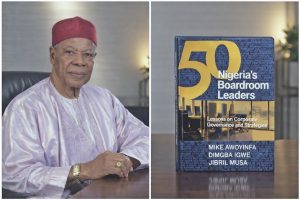
One of the most defining episodes of his boardroom career was his resignation from the board of Citibank Nigeria as an independent director. When he narrated the story to me, it was in his characteristically measured tone. The Central Bank had issued a directive that effectively treated bank directors as staff members. To many, it might have seemed like a routine regulatory development. To Mbanefo, it was a fundamental contradiction. He posed a simple but profound question: how could he serve as an independent director — standing apart to ensure balance and accountability — and at the same time be classified as staff? In his view, independence was not ornamental. It was functional and essential to the integrity of governance. An independent director could not supervise management while being administratively absorbed into the very structure he was meant to oversee. That, to him, was incompatible. And so, without drama or bitterness, he resigned. That act was not merely procedural; it was philosophical. It was governance expressed in action.
Mbanefo believed deeply that a board exists for business. He explained that while enterprises are often created by individuals acting alone, the moment a founder brings in external capital, he must also share power. With shared power comes accountability. He illustrated this with a proverb: he who takes money from somebody should be wary that he who pays the piper dictates the tune. Within that observation lies the essence of corporate governance. For Mbanefo, a board was not a ceremonial appendage to management. It was a supervisory body, created to provide direction and ensure accountability. He worried that many Nigerian businesses failed because founders never internalised this discipline. Too often, authority remained concentrated in one individual, and opacity replaced transparency. In such environments, institutions become fragile, vulnerable to collapse once the founder exits the scene. Mbanefo had seen enough, both in corporate Nigeria and in public service, to understand the cost of weak governance.
Another enduring lesson he shared with me was the importance of knowing one’s role. During his service as Chairman of a university council and as Pro-Chancellor, he made it a point to understand the limits of his authority. He had no business interfering in academic curriculum or promotions; those were matters for the university Senate. His responsibility lay elsewhere — in finances, administration, contracts, and broad oversight. He warned that the first mistake of a Pro-Chancellor ignorant of his responsibilities is to confront the Vice-Chancellor with the mindset of superiority, barging in to impose decisions. Such interference only breeds conflict and weakens institutions. Governance, he insisted, was about structure, not ego. The board was not management, and oversight was not execution. When roles blur, institutions suffer. His clarity on this point was refreshing in a society where titles are often mistaken for omnipotence.
In describing the qualities of an effective chairman, Mbanefo offered what amounted to a masterclass in leadership. A chairman, he said, must be knowledgeable, though not necessarily immersed in the technical details of the business. He must understand organisation and motivation, and above all, he must listen. The chairman directs meetings, but he does not dominate them. Every member invited to serve on a board has been selected for a reason, and their contributions must be heard. The chairman should take note — mental or written — of what is said and ensure that discussions remain relevant and productive. He must know the limits of his authority and resist the temptation to gather everyone “under his own armpit or wings,” as Mbanefo memorably phrased it. Leadership is coordination, not domination. He likened a good chairman to a father — firm yet humble, decisive yet attentive. When meetings spiral out of control, he believed it is often because someone failed to listen properly.
Mbanefo’s authority in the boardroom was undergirded by a formidable professional background. Trained as an accountant at Akintola Williams & Co., he accumulated extensive board experience across major corporations, including UAC, Mobil Oil Nigeria, and Citibank Nigeria. He chaired institutions and represented Nigeria at the United Nations. His analytical depth was widely acknowledged. International figures such as Kofi Annan recognised his capacity to dissect issues to their core, while respected Nigerian corporate leaders like Ernest Shonekan attested to the seriousness he brought into every boardroom he entered. Yet for all his global exposure, Mbanefo retained a strong local conscience. He was concerned about the failure to entrench boards properly within Nigerian enterprises and lamented the tendency of businesses to collapse because governance structures were never institutionalised beyond the founder.
Other News
What made Mbanefo particularly remarkable was his refusal to indulge in theatrics. He did not court publicity or cultivate controversy. He simply did his work with discipline and integrity. His resignation from Citibank remains, in my estimation, one of the clearest demonstrations of principle in Nigerian corporate history. He could easily have rationalised compliance with the directive and remained on the board. Many would have done so. But he weighed the matter against his understanding of independence and found it wanting. That clarity defined him.
As Nigeria continues to grapple with governance challenges across banks, universities, public corporations, and private enterprises, Mbanefo’s insights remain profoundly relevant. He insisted on separating ownership from management, on respecting board independence, and on institutionalising succession. These were not abstract theories to him; they were practical necessities for survival. In my years chronicling Nigerian leadership across various sectors, I have encountered charisma and brilliance in abundance. What I found in Arthur Mbanefo, however, was steadiness — steadiness of mind, principle, and conduct. He was anchored in structure rather than swept away by trends.
Looking back at our conversations, I am struck by how consistently he returned to the theme of independence. Governance, to him, was about protecting systems rather than occupying seats. Authority had limits. Independence had to be real, not cosmetic. Institutions had to outlive individuals. His life reads like a manual for a country still learning how to build structures stronger than personalities.
As we bid him farewell, we must ask ourselves whether we have absorbed his lessons. Have we truly embraced independent directors in spirit, or only in title? Have we respected the boundary between oversight and interference? Have we built institutions that can endure beyond their founders? Arthur Mbanefo did not merely sit on boards; he interpreted, disciplined, and dignified them. His departure is therefore not simply the loss of a man but the loss of a conscience in our corporate life.
Adieu, Arthur Mbanefo, the no-nonsense boardroom guru. You demonstrated that resignation can be an act of principle and that leadership need not be loud to be effective. In the quiet firmness of your decisions, you left behind a template for governance that Nigeria would do well to study and emulate. May your legacy continue to instruct boardrooms long after your voice has fallen silent.