Follow Us on Google

“Right actions in the future are the best apologies for bad actions in the past.”
—Tryon Edwards
By Cosmas Omegoh
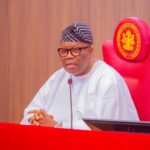
Nigeria’s Minister of Power, Chief Adebayo Adelabu, last Tuesday threw up his hands in surrender, admitting failure to provide power to Nigerians.
The admission came against the backdrop of the current administration’s inability to resolve the country’s lingering electricity sector crisis.
Earlier, President Bola Tinubu had declared to Nigerians during his electioneering that: “If I do not provide steady electricity, and I come back for second term, don’t vote for me, unless I give you adequate reasons why I couldn’t deliver.” Now, that promise seems to be in the past.
When, therefore, Adelabu told Nigerians that the problem of power supply had gone beyond his ministry to handle, regretting that many businesses had been ruined as a result of the crisis, not many were surprised.
Speaking last week he said: “I want to apologise to Nigerians, officially now coming from me as the Minister of Power, for this temporary issue that is leading to (the) hardship being experienced especially during this dry season, where there is so much heat everywhere.
“Businesses are being affected; schools have been affected, and industries have been affected. It is not our wish to find ourselves in this situation, but it is due to some factors that are actually beyond our control.”
Then at a different forum, Adelabu shocked Nigerians when he said that to fix electricity, Nigeria needed a humongous $100million. That the government envisaged that 20,000 megawatts would cost about $30 billion, based on an average of $1.5 billion for each 1,000MW plant.
He said put together, he was talking of over $100 billion of investments in the upstream, midstream, and downstream of the power sector value chain.
The words of Minister Adelabu came to Nigerians as a rude shock, given that huge sums of money had over the years been sunk into the power sector without any tangible results. Only stories by moonlight were heard. Not a few believe that more of such investment will end up in the same cesspit.
Already, Nigerians’ hope that someday soon improved power will be made available seems to be waning.
Those who took President Tinubu’s promise in 2022 to provide power had believed that the appointment of Chief Adelabu was an absolute belter.
But how would anyone doubt the competence of Chief Adelabu, 55, a first class degree graduate of Accounting from Obafemi Awolowo University – an accountant and seasoned banker who rose to become Deputy Governor, Operations of the Central Bank of Nigeria – a man well-schooled and successful in various genres of businesses: hospitality, entertainment, and agriculture and real estate?
His circle of friends had celebrated when he was handed the power portfolio in 2023, assuring that he was the best man for the job.
Right now, people still have their fingers in the air, celebrating what they judge to be his many successes in the power ministry: that he scored top marks through his peak generation of 5,801 MW of electricity in early 2025 up from 4,100 MW. And then, there is this talk about his astuteness in driving the implementation of the Electricity Act 2023 sector decentralisation, which now sees states and private concerns playing in the power chain.
It is still being said of him that he drove major metering initiatives that target 3.5m people with pre-paid meters under the Presidential Power Initiative to reduce estimated billing, even though that idea seemed to be on paper alone.
Other News
Then, there is this talk that his watch had witnessed the commissioning of the 700 MW Zungeru Hydroelectric Power Plant and a focus on rehabilitating existing power facilities and the synchronisation with the West African Power Pool (WAPP).
Adelabu himself insists he has had to increase electricity access from 59 per cent in 2023 when he took office, to 64 per cent in 2024.
But that seems to be where everything stops, as other Nigerians, who are looking at him with a separate lens, see nothing but failure.
Many believe that Tinubu made a bad pick in Adelabu whom he handed such a hefty portfolio as power.
Not long ago, for instance, the Nigeria Labour Congress (NLC) flayed Adelabu, describing his claim that 150 million Nigerians now enjoy an “adequate electricity” supply of 5,500 megawatts as “a joke taken too far.”
NLC’s President, Joe Ajaero, had to describe the minister’s claim as “outrageous,” adding that the “wild assertion is not only pretentious, but also a bad joke on a people daily confronted by grinding darkness, outrageous electricity tariffs, and a power sector manipulated for private profit at the expense of national progress.”
In the meantime, many Nigerians are taken aback that under Adelabu’s watch, his principal, President Tinubu’s Aso Rock Villa exited from the national power grid, preferring solar technology as an alternative source of power, while abandoning the rest of Nigerians to their fate.
For a fact, many Nigerians interpret Adelabu’s last Tuesday’s apology for failing to provide power as not only a clear admission of failure, but an expression of guilt.
Those who know him insist that he is disinterested in the job he was appointed to do, accusing him of preferring to chase a ticket to become the next governor of Oyo State.
Adelabu’s critics cannot understand why Tinubu is still keeping him – and many others like him – whereas he has very little or no deliverables to show for his stewardship.
For Adelabu in particular, people have not ceased to wonder what went wrong with his wealth of scholarship, chains of academic laurels, and the solid acumen he had garnered in the business space.
Without any iota of doubt, Nigerians are badly reeling under his incompetence. The business community too is feeling strangulated without electricity.
Same for the Manufacturers Association of Nigeria whose members are lamenting that between 35 and 40 per cent of their production expenses now goes to energy alone. Indeed, they have never had it so bad.
Adelabu’s claim of increasing power supply last year is currently being rubbished by a report that last month alone, 16 out of the 33 power plants in the country were supplying little or no power at all, thus leaving electricity supply plummeting to a mere 3,705 megawatts.
Besides, stakeholders are worried to the bone about frequent grid collapses which the minister, till this moment, has not been able to halt, amid claim by the Transmission Company of Nigeria that at some point, it had had to spend a total sum of N29.3bn to repair 266 electricity towers alone.
To some industry watchers, Adelabu gets his flowers if only he can go beyond adding 700 MW to the national grid through the Zungeru Hydroelectric Power Plant. They point him to what some other African nations are currently doing, urging him to benchmark Nigeria’s electricity generation with Egypt’s 39,400 MW to 59,000 MW output and South Africa’s installed capacity that generates above 63,000 MW.
Critics, therefore, maintain that Nigeria’s 5,000 MW offering to more than 200 million Nigerians is clearly shameful and utterly unacceptable.
Adelabu is also taken to the cleaners for failing to resolve the problem of incessant poor gas supply to thermal plants in the country, obsolete infrastructure and vandalism, which are easily the cause of constant power outage in the country. The development, they say, is not good music to the ears.
Then of course, Nigerians might be hard put to forgive Adelabu for engineering a scheme that classified electricity consumers into “Band A, B, and C,” a plot NLC describes as a rip off, “enabling the discos to rake in over N700 billion from helpless consumers while power supply remains epileptic, erratic, and inaccessible to the majority.”
Yet in the face of the said humongous exploitation, generation companies still claim they are owed about N6.8 trillion. And here, Nigerians feel betrayed wondering who to believe. To them, for failing to provide power as the current administration promised, Adelabu does not need apologies but to resign. Only that is acceptable.