Follow Us on Google
From Idu Jude, Abuja
Members of the 10th National Assembly, including Senator Enyinaya Abaribe, who represents Abia South Senatorial District, and Honourable Sir Sam Onuigbo, member of the South East Governing Board and Chairman of the Committee on Climate Change, have called on the Federal government to explore the implementation of the Climate Change Act, through Nature-Based Actions.
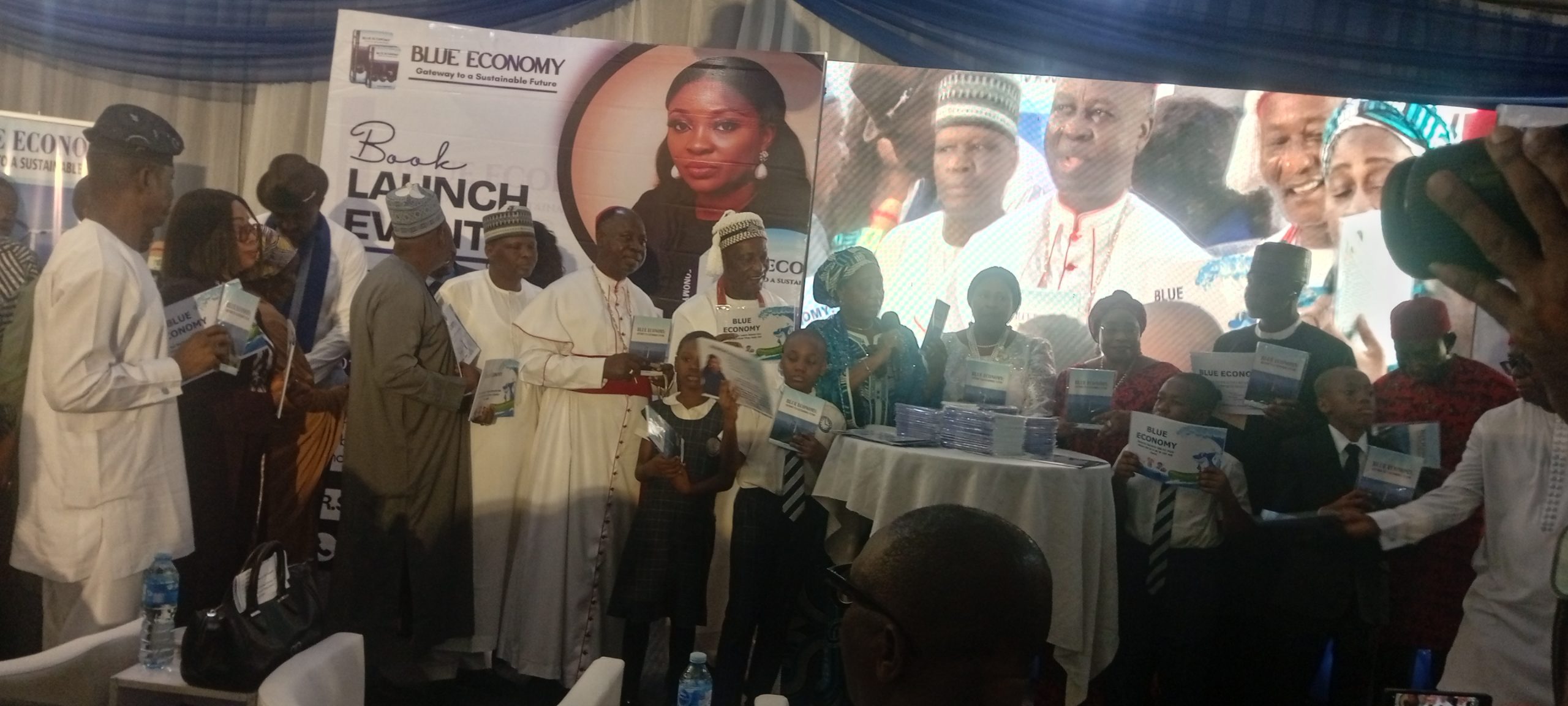
Speaking during a book launch on the Marine and Blue Economy authored by Dr. Chika Chukwudi in Abuja, Senator Abaribe highlighted that the government needs more enlightenment programs to educate the Nigerian people on the enormous benefits of the Marine and Blue Economy.
He said, “The book we are launching today titled ‘Marine and Blue Economy, gateway to sustainable future’, has defined our collective interests and more especially the Presidential initiative on developing the Marine and Blue Economy project to grow the economy. The author discovered the need to harness the diverse opportunities in the Nigerian waters and needs to give her the support. To that end our children would have opportunities oto understandthe new vista for economic development”
On his part, Hon. Sam Onuigbo stated that the publication comes at a defining moment in Nigeria’s developmental journey, when sustainability is no longer aspirational but foundational to its economic resilience, environmental stewardship, and inter-generational prosperity.
“As the sponsor of Nigeria’s Climate Change Act, 2021 the legal fulcrum for coordinated, cross-sectoral climate action involving public institutions, the private sector, civil society, and development partners, I remain deeply conscious that Nigeria’s future hinges on how effectively climate action is embedded in all sectors of the economy”.
Meanwhile, Onuigbo, has said that President Bola Ahmed Tinubu made this clear when he stated, “The fight against climate change is not merely an environmental necessity but a global economic opportunity.”
He noted that it is within this robust legal, policy, and institutional framework that the blue economy finds its strongest expression as a catalyst for sustainable growth.
“As a futuristic legal framework, the Climate Change Act acknowledges the importance of nature-based solutions by clearly providing for it in Section 27 thus: “The Council shall adopt and promote nature-based solutions to reducing GHG emissions and mitigating climate change issues in Nigeria”.
Interestingly, he observed that President Tinubu’s administration has demonstrated commendable resolve in implementing the Climate Change Act as a guiding light for national climate action. He stressed that a key initiative that stands out among these is the establishment of the Federal Ministry of Marine and Blue Economy.
The ministry in his view is strategically designed to enhance the country’s ocean resources while promoting sustainable economic growth by maximizing Nigeria’s 853 kilometres of coastline and an expansive maritime area of 46,000 square kilometres.
Hon. Sam, explained that the Ministry aims at sustainable use of ocean, sea, coastal, and inland water resources for economic growth, improved livelihoods, and job creation, while preserving the health of aquatic ecosystems.
“It reflects a deliberate policy shift toward recognizing marine and aquatic resources as central to sustainable national development. Through this dedicated ministry, the government created a focused framework for managing and developing sectors, such as maritime transport, fisheries, aquaculture, coastal tourism, offshore energy, and inland waterways in a coordinated and sustainable development programme.
However, he informed that the Climate Change Act 2021, particularly with its emphasis on nature-based solutions, as well as integrating Natural Capital Accounting, is a forerunner in the establishment of the ministry. By recognizing ecosystems, such as mangroves, wetlands, oceans, and coastal habitats as essential tools for climate mitigation and adaptation, the Act underscored the need for institutional structures capable of managing these natural assets sustainably. In Section 29(1), the Act stipulates that the Council shall collaborate with and equip the National Bureau of Statistics for developing Nigeria’s Natural Capital Accounts.
Other News
“Other remarkable initiatives of the current administration include; the National Carbon Market Activation Policy (NCMAP) which aims at generating $2.5–$3 billion annually by 2030 in line with Section 4(i) and (j) of the Act; the National Carbon Registry to strengthen emissions reporting and transparency; the Operationalization of the Climate Change Fund as stipulated in Section 15 of the Act; the Presidential Committee on Climate Action and Green Economic Solutions; the updated Nationally Determined Contributions (NDC 3.0) targeting a 32% emissions reduction by 2035; the Climate-Resilient Livelihoods Empowerment Programme, a 10-year $250 million intervention; Nigeria’s engagement at Abu Dhabi Sustainability Week (2026) to unlock $25–$30 billion in green finance; participation in the Mission 300 Africa Energy Summit to electrify 300 million Africans by 2030; and engagement on climate-induced mobility through the Rabat Process.
“The blue economy, therefore, represents far more than the sustainable use of marine and aquatic resources—it is a gateway to economic diversification, climate resilience, job creation, and long-term national competitiveness.
“The author’s work speaks powerfully to these imperatives, offering timely insights that will enrich policy formulation, guide industry practice, and advance academic and professional discourse.
“I wish to call on the Federal Ministry of Education to explore avenues to implement Section 26 of the Act, which mandates the integration of climate change into the various disciplines and subjects across all educational levels”.
Speaking also the author Dr. Chika Chukwudi, explained, “When I began my PhD research in the field of the Blue Economy, the concept sounded unfamiliar even distant to many. Today, through visionary leadership, sustained policy direction, and stakeholder engagement, it is steadily becoming a household conversation in Nigeria.
“The Blue Economy represents a profound opportunity for our nation to unlock long-term financial and economic value through the sustainable use of ocean, coastal, and inland water resources. “Globally valued at over three trillion dollars annually, this sector positions Nigeria by virtue of our coastline, inland waterways, and maritime assets—to benefit immensely from fisheries and aquaculture, maritime transport, port services, marine tourism, renewable ocean energy, marine biotechnology, and inland waterway logistics.
Beyond revenue and investment, the Blue Economy offers transformational employment opportunities across technical, professional, entrepreneurial, and research-driven fields”.