Follow Us on Google
By Henry Udutchay
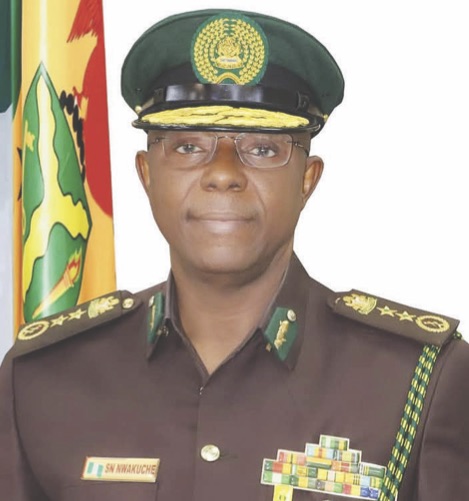
On 23rd April 2026, the Nigerian Correctional Service (NCoS) pauses to celebrate a significant milestone, which is the first anniversary of the appointment of Sylvester Ndidi Nwakuche, MFR, mni, as the substantive Controller General of Corrections (CGC). Though his stewardship effectively began earlier, when he assumed office in acting capacity on 14th December, 2024, his confirmation on 23rd April 2025 marked the formal beginning of a new chapter in the evolution of correctional administration in Nigeria. One year on, the imprints of his sterling leadership are visible across the Service, and they are quietly transformative, purposeful and deeply human in orientation.
There is no doubt that the appointment of Nwakuche stands as a testament to the foresight and commitment to institutional renewal demonstrated by the President and Commander-in-Chief of the Armed Forces of Nigeria, Bola Ahmed Tinubu, GCFR. In selecting a seasoned correctional professional whose career has been defined by discipline, integrity and reform-mindedness, the President has affirmed his administration’s resolve to strengthen the nation’s security and justice institutions. The decision has proven to be both timely and strategic, as the Nigerian Correctional Service continues its transition from a purely custodial system to one rooted in corrections, proper reformation, rehabilitation and reintegration.
Equal commendation must be extended to the Honourable Minister of Interior, Dr. Olubunmi Tunji-Ojo, whose dynamic leadership and steadfast support have provided the policy environment within which the Controller-General has been able to operate with clarity and purpose. The synergy between the Ministry and the Service has strengthened institutional coordination and created renewed momentum for reforms that place professionalism, accountability and measurable impact at the centre of correctional governance.
Within this one year of substantive leadership, Nwakuche has pursued a reform agenda that speaks both to the welfare of his personnel and the transformation of correctional practice. One of the most widely appreciated milestones has been the regularisation of promotion processes and the prompt payment of promotion arrears which is an issue that had historically weighed heavily on staff morale. By ensuring that officers receive not only their deserved promotions but also the financial recognition attached to them without undue delay, the Controller-General has reaffirmed a fundamental leadership principle, heralding that the strength of the Service lies in the dignity and motivation of its workforce.
Beyond internal administration, the Controller-General has also widened the horizon of stakeholder engagement. Under his watch, the Service has deepened partnerships with relevant MDAs, civil society organisations, development partners, faith-based institutions and philanthropic bodies. These collaborations have brought renewed attention to reformatory and rehabilitation programmes, educational opportunities for inmates, skills acquisition initiatives, and reintegration support. In this expanding network of partnerships, the Service is increasingly being seen not merely as a place of confinement but as a critical arena for social transformation and behaviour modification.
Equally noteworthy has been his vigorous advocacy for the implementation of non-custodial measures as provided for under the Nigerian Correctional Service Act 2019 and other extant regulations.
Through sustained engagement with the judiciary, legal practitioners and justice institutions, the Controller- General has championed alternatives such as parole, probation, community service and restorative justice frameworks.
This advocacy is gradually shifting the national conversation toward smarter sentencing practices that reduce overcrowding while promoting accountability and rehabilitation.
Indeed, the past year has revealed a leadership style that is both pragmatic and visionary. Nwakuche has demonstrated that correctional administration is not merely about managing correctional facilities; it is about nurturing hope within walls that often appear hopeless. It is about reminding society that those who have erred can still be restored, and that a humane correctional system ultimately strengthens the fabric of public safety as well as national security.
Like a steady lighthouse guiding vessels through uncertain waters, his administration has provided clarity of direction at a time when correctional services around the world are grappling with questions of relevance and reform. Under his watch, the Nigerian Correctional Service continues to evolve nay patiently, deliberately and with an eye toward global best practices.
As the Service commemorates this first anniversary of his substantive appointment, the moment is both celebratory and reflective. It is a
time to acknowledge the strides already made while renewing
commitment to the journey ahead. For institutions, like nations, are
Other News
shaped by the character of those who lead them.
In the person of Sylvester Ndidi Nwakuche, Nigeria has found a leader
whose calm resolve, administrative discipline and reformist spirit are
gradually writing a new story for criminal justice in the country. And if
the first year is any indication, the chapters yet to come promise even
greater progress geared
towards a correctional service that is firm in justice, compassionate in
reform, and unflinching in service to the nation.
Chief Henry Udutchay,
Public Affairs Analyst,
Abuja. 0809111125
• Chief Udutchay, Public Affairs Analyst, Abuja.