Follow Us on Google
Book review
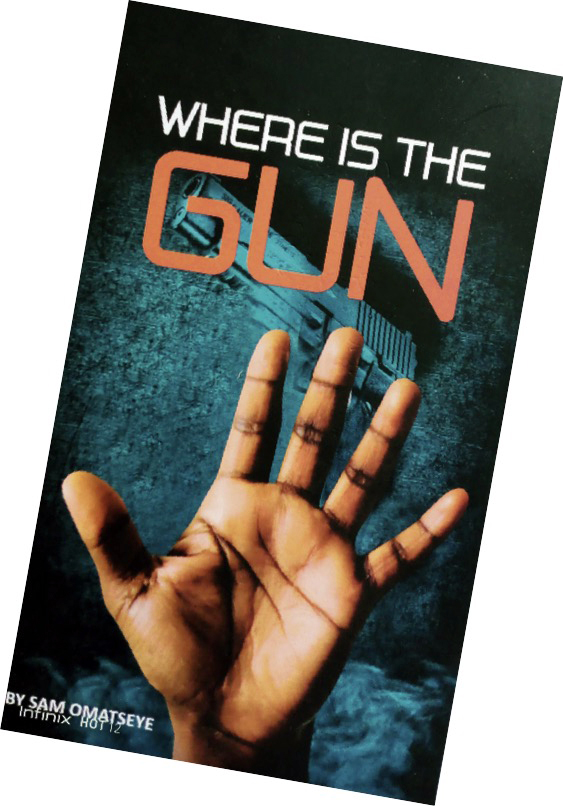
Title: Where is the Gun?
Author: Sam Omatseye
Publisher: Sunshot Associates, Nigeria
Year of Publication: 2024
Pagination: 84
Reviewer: Henry Akubuiro
The poet bids his time in multiple verses and stanzas, and the joy of reading comes in snatches, unlike the circus ringmaster. Sometimes reading a poem ends with a wry face. In this part of the world, the poet has more social obligation towards a derailed society. Perhaps there is no other place in Africa than in Nigeria where this is more pronounced. The Nigerian poet is not solely preoccupied with dazzling the audience with florid diction, meters or rhymes. The stakes are higher in a dysfunctional society, where he is domiciled and where the ruder is in near comatose. And the poet isn’t immune to the vagaries of life, unchecked power, violence and related inanities. His job isn’t well cut out like the puppet master, who chiefly manipulates marionettes with strings or rods to make us clap or nod our heads.
The Nigerian poet understands the intersection between poetry and social critique, and, in his poetic project, he tries as much as possible to be on the side of the masses in exploring social ills, hoping that his message would resonate on many bothers to elicit the much needed change in different spheres of life. Sam Omatseye functions as an eclectic man of letters versed in journalism, fiction, poetry, and drama. His published works include Crocodile Girl, My Name is Okoro, and Juju Eyes (novels); Mandela’s Bones and Other Poems, Dear Baby Ramatu, Lion Wind and Other Poems, Scented Offal, Friday with Leah (Poetry); Obito and The Siege.
Other News
Omatseye is aware of the place of man in the cosmos and how the physical and spiritual centre of the world has been tainted by humanity. These failings are sometimes on a comical scale, and the poet might be sanguine about the future, but his bounden literary duty intimates him he has a role to play in how we remodel the infinite void. Omastseye’s Where is the Gun? speaks with candour to our troubled souls, asking a pertinent question like: How did we get here?
Hence, the title poem of the collection, which is the second poem in the collection, looks at an unappreciative society, who receives all the good things of life without so much of a ‘thank you’ to their benefactor. With their insouciant attitude, they don’t consider it a necessity to protect themselves, even when they are provided with guns. But everything changes when “He gave them a belief/; Then they learned a language/; A new song and built a new place/ Where they clapped, kindly and bowed /To him/ They turned to him, / And asked, where is the gun” (p.6). The gun here denotes an instrument of rebellion, a rude awakening.
In some of his poems, Omatseye deploys vignettes to say so much in a few words. Take for instance, “Makoko”, an informal, squalid, floating setting across the Lagos Third Mainland Bridge. But in the poem, Omatseye uses only five lines to capture the fragile state of existence in a secluded backwater of the metropolis: “I am feverish and cold/ Like Makoko/ In May/ Inviting worms and preys/ In the rain.” The poet also depicts an insecure state of man that approximates to the vagaries of the weather in an insecure environment typified by the stilts and unhealthy ambience of Makoko.
The mystery of witchcraft echoes in “Witches”. Though it sounds like a joke, beneath the joke is the shared experience of many in search of the fruit of the womb, where conventional medicine fails to provide a solution to barrenness. In the poem, the witches attest to locking the womb of a woman and seizing the sperm sac of the male victim, making it difficult for the couple to procreate. The poem also finds a resonance in the boardrooms of offices and high places, where brilliant ideas end in stillbirth due to the presence of rivals and enemies of progress.
“Almajiri” revisits one of Nigerian most nagging social issues. The culture of child-begging imposed by religious doctrine in Muslim-dominated parts of Nigeria is abhorred by the poet, though the voice in the poems seems to relish the latitude to scavenge on society, ironically. Omatseye verses here are sold with a mordant wit and piquancy: “In this bowl lies my pride and boon/ from the day mother weaned/ me/ my father’s palms cradled a pan/ in the fashion of his forefathers. The almajiri holds his bowl in keeping with the family tradition of “noble beggary”. For this beggar, he is recognised in heaven and earth. He is happy that nobody calls them slaves. He is also satisfied they beg and sound as a refrain of the city’s daily choir.
Written in five cantos, this is, no doubt, one of the best poems in Where is the Gun? Omatseye traces the metamorphoses of the almajiri from an innocent street beggar to a man with many responsibilities and visage. He is no longer comfortable living in a beggar’s paradise, where he is doing the work of God; he graduates to carrying “the gift of manhood”, “a revolutionary gift” – the gun – to become a dreaded bandit feared by all as he goes on the prowl. With his gun, he can get anything he wants. Little wonder, he earns a university certificate. The poet, therefore, exposes the society that breeds the almajiri as the harbinger of bandits, terrorists, and nefarious activities.
Deploying images and innuendoes, Omatseye, in “A Thousand Demons”, draws attention to the corruption in high places, especially the oil sector, by the power elite, who guide it jealously. While we condemn the bandit in the forest, the oil bandits to go scotfree, leaving a
flamboyant lifestyle. Omatseye is capable of jocularity in his poetry. One of such poems is “To My Lord,” where the poet speaker says he won’t forgive Jesus if he finds out that he was fake while he lived. He even threatens to give a priest a bloody nose. Do you remember Okuama? This unknown village was caught on the wrong side of history in 2024 when the military, while responding to a crisis between Okuama and Okolobia communities in Delta State, were attacked, leading to the loss of 17 soldiers.
But, in the “Okuama” poem in this collection, Omatseye reminds all about the spirituality of Okuama and celebrates the village shrine where the mighty grovel on her feet. However, he makes a passive reference to the setting’s recent history, where blood flowed: amid “the conflicts of tribe”. Readers are invited to explore the length and breath of Omatseye’s poetic project. Here is a poet who writes with flourish without losing sight of the scribal routine of a committed poet – one who assiduously interrogates social disequilibrium and society’s amorphous incongruities.