Follow Us on Google
By Damiete Braide
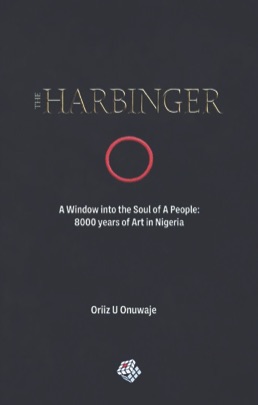
The Harbinger, Oriiz U. Onuwaje, Crimson-Fusion, 2024, pp. 81
Long before Nigeria became a country, its people were already telling stories in clay, bronze, fibre and line.
The Harbinger: A window into the soul of a people: 8,000 Years of Art in Nigeria, reminds readers of a truth often ignored in mainstream narratives, Nigerian art did not begin with colonial contact nor did it pause because of it. Instead, it has continued, quietly, defiantly, intelligently, across centuries.
Oriiz in this work positions Nigerian art not as nostalgia or archaeological curiosity but as living evidence of a people who have always used creativity to understand power, spirituality, identity and survival.
The book reads like a cultural witness statement, connecting ancient traditions to contemporary artistic expressions seen in today’s galleries, studios and global exhibitions.
From Nok to Ife, the Intelligence of early art journey begins with the Nok civilisation, whose terracotta sculptures date back over 2000 years. Far from crude or accidental, these works show
intention, symbolism and advanced visual thinking. Enlarged eyes, composed postures and stylised forms reveal a people already thinking deeply about the human condition and the unseen world.
From Nok, the narrative moves to Ife, where naturalistic bronze and terracotta heads challenge long-held colonial myths about African art.
The realism of Ife was not imitation but philosophy, an aesthetic rooted in balance, destiny and inner truth. These works quietly but firmly dismantle the false idea that technical mastery arrived in Africa from elsewhere.
Oriiz takes a look into Benin art as historical and a powerful force the Benin bronzes stand at the centre of the book’s argument on continuity.
Created to document kingship, ceremonies and political authority,Benin art functioned as history books cast in metal. The 1897 British invasion, which led to the looting of these works, is presented not only as cultural theft but as an attempted erasure of memory.
Yet, as the book makes clear, Oriiz opines that Benin art did not end in 1897. Its influence lives on, in royal guilds, contemporary political art and ongoing global debates about restitution and ownership.
The bronzes are not frozen relics; they are active voices in today’s conversations about justice and identity.
Colonial rule disrupted traditional systems of art production but failed to silence Nigerian creativity. Instead, artists adapted.
Western materials and training were absorbed, reworked and often challenged. With independence came a renewed urgency to define Nigerian identity through art.
Artists such as Aina Onabolu, Ben Enwonwu, Uche Okeke and Bruce Onobrakpeya led this re-statement of self. Through what became known as Natural Synthesis, they proved that tradition and modernity could coexist. Their work laid the foundation for modern Nigerian art as both global and deeply local.
Other News
Oriiz in his book firmly rejects the idea that contemporary Nigerian art is disconnected from its past. Today’s artists, working in photography, installation, painting and digital media continue the same questions their ancestors asked: Who are we? What do we remember? How do we respond to power?
From El Anatsui’s monumental installations to Njideka Akunyili Crosby’s layered domestic scenes and Peju Alatise’s symbolic storytelling, modern Nigerian art emerges as a memory in motion rather than a departure from tradition.
The Harbinger is timely. As Nigerian art gains global attention through auctions and biennales, the book insists on authorship, on Nigerians telling their own stories, on their own terms.
It argues that visibility without understanding is incomplete. Written in clear, confident language, the book is accessible without losing intellectual weight. It will appeal to students, collectors, artists and everyday readers curious about Nigeria’s cultural depth.
The book is volume one of a four- part landmark project. It is not a documentation of objects but it is a declaration of lineage. Volume one prepares the gaze for the full four-part series, which culminates in : A Window into the Soul of a People: 8000 years of Art in Nigeria
In the end, Oriiz makes one thing clear: Nigerian art did not survive history, it is history, still unfolding. Yet, as the book makes clear, Oriiz opines that Benin art did not end in 1897. Its influence lives on, in royal guilds, contemporary political art and ongoing global debates about restitution and ownership.
The bronzes are not frozen relics; they are active voices in today’s conversations about justice and identity.Colonial rule disrupted traditional systems of art production but failed to silence Nigerian creativity. Instead, artists adapted.
Western materials and training were absorbed, reworked and often challenged. With independence came a renewed urgency to define Nigerian identity through art.
Artists such as Aina Onabolu, Ben Enwonwu, Uche Okeke and Bruce Onobrakpeya led this re-statement of self. Through what became known
as Natural Synthesis, they proved that tradition and modernity could coexist. Their work laid the foundation for modern Nigerian art as both global and deeply local.
Oriiz in his book firmly rejects the idea that contemporary Nigerian art is disconnected from its past. Today’s artists, working in photography,
installation, painting and digital media continue the same questions their ancestors asked: Who are we? What do we remember? How do we respond to power?
From El Anatsui’s monumental installations to Njideka Akunyili Crosby’s layered domestic scenes and Peju Alatise’s symbolic storytelling, modern Nigerian art emerges as memory in motion rather than a departure from tradition.
The Harbinger is timely. As Nigerian art gains global attention through auctions and biennales, the book insists on authorship, on Nigerians telling their own stories, on their own terms. It argues that visibility without understanding is incomplete.
Written in clear, confident language, the book is accessible without losing intellectual weight. It will appeal to students, collectors, artists and everyday readers curious about Nigeria’s cultural depth.
The book is Volume one of a four- part landmark project. It is not a documentation of objects but it is a declaration of lineage. Volume one prepares the gaze for the full four-part series, which culminates in : A Window into the Soul of a People: 8000 years of Art in Nigeria
In the end, Oriiz makes one thing clear: Nigerian art did not survive history, it is history, still unfolding.