Follow Us on Google
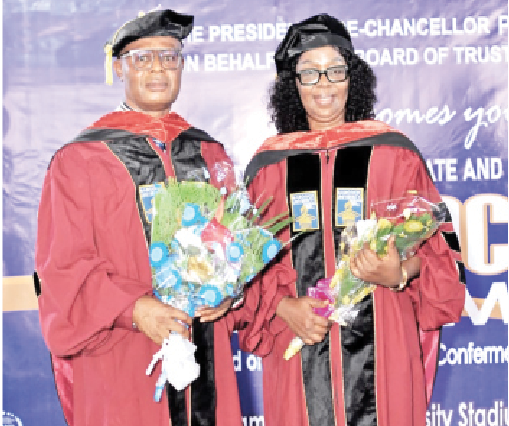
•Both bag doctorate degree at BU, same day, same dept
By Gabriel Dike
The 23rd convocation ceremony of Babcock University (BU), Ilishan-Remo, Ogun State, has come and gone but for Dr. and Dr. (Mrs.) Arthur and Ngozi Abaneme, it would forever remain memorable, a day etched on their hearts as both, on that day, bagged PhD in the same Economics Department.
The Abanemes were among the 217 who bagged doctorate degrees.
The couple spoke with Daily Sun.
Husband’s background
My name is Arthur Anyalewechi Abaneme, a native of Umuobiala in Isuikwuato LG, Abia State. I was born to the Late Mr Job Echerenwa Abaeneme and the Late Mrs. Comfort Ahiaku Abaeneme nee Okoroafor both indigenes of Isuikwuato. I am married to Dr Esther Ngozi from Amodu, Awkunanaw, Enugu State. The Abanemes have four children. Currently, I reside in Lagos State. I am into private business.
Education
My primary school education was at Umuobiala Central School, Umuobiala. After which I proceeded to Boys High School, Isuikwuato, formerly known as Annunciation Secondary School, and presently, Isuikwuato High School. I studied at University of Nigeria, Nsukka where I graduated with Bsc (Hons) in Economics in 1989.
PhD journey in Economics
Honestly, obtaining a PhD was not my priority over the years. Although, I would concede the fact that several years ago, I did usually imagine putting the prefix ‘Dr’ and relish the satisfaction such accomplishment could give me. Those years, my priority was to attain some level of financial stability and freedom, and I worked very hard at it.
However, down the years, I started paying attention to my wife’s prompting of attaining a PhD level, as that was one of her life desires. One of the days she took our daughter to school (BU), she casually asked one of the lecturers she met there if it was possible for her to return to school for a postgraduate degree after 25 years of graduation. The lecturer answered in the affirmative. So, at the auspicious time, we started. The rest, as it is always said is history.
We started our Masters programme in September 2018. Let me mention here that, when we started, five members of the family were at different levels of their programmes at Babcock University. We started our PhD in 2021.
Thanks to Covid-19 pandemic. The physical presence at classroom reduced but the online lectures were very intense, rigorous and demanding. We barely had time for anything else.
Studying in the same department with wife
It was not strange and there was nothing extra ordinary. Most people especially our lecturers did not know that we were a couple, although we were always together. The programme was not easy frankly speaking.
It is important to note that we were full time regular students living in Lagos. We had 7am lectures and finished sometimes late in the evening. And we were having three to four lecture days every week. So for two years, we were always on the road leaving Lagos as early as 5am and getting back late to Lagos very late.
You will appreciate the enormity of the challenge if you recall that Lagos-Ibadan Expressway was under rehabilitation with high traffic congestion at that time. Ikorodu- Sagamu Road that would have provided an exit relief was a nightmare. Our resolve to accomplish the goal kept us going despite the daunting challenges.
PhD thesis impact
Trade Openness, Export Incentives and Non-Oil Revenue in Nigeria. Revenue generation is a major issue to every government, especially, developing countries. The level of development and funding infrastructure expenditure depends on the revenue resources the country is able to generate (not money printing).
One of the underlying key issues of most developing countries is reliance on natural resource to fund their operations. Unfortunately, they do not have control over the price and sometimes production levels. While developed economies do not rely on natural resource revenue but on non- resource taxes. So, non-oil revenue generation is critical for economic development of Nigeria.
The major finding is that trade openness is non-tax responsive because of the nature of our economy and the peculiarities of the Nigerian system. Therefore, trade openness had not elicited the desired impact on non-oil tax revenue. This is manifested in poor non-oil revenue contribution to GDP.
The productive sector is eclipsing instead of thriving, and non-oil export is low indicating failure of export policy and implementation. The empirical evidence shows the need for comprehensive review and reset as well as alignment of macroeconomic environment. The thesis provides robust recommendations in line with the findings.
Managing home front
With proper planning and synergy, it is possible to achieve goals no matter the obstacles. As at 2018, five of us were at BU, while one was in a boarding school. But by 2021 when we started the PhD programme, the entire family members were at different levels of our programmes at different universities.
To say the least, it was not easy in every way. But the Lord enabled and provided all that we needed to pay the children fees and attended to other family responsibilities that arose from time to time.
Duration of PhD
We commenced our PhD in September 2021, and completed our defence in May 2025. So we spent four years approximately. We actually finished our course work in 2023/2024. The research part of the programme stretched to 2024/2025.
Reading together and sharing ideas
We do when occasions warrant it, but generally we rarely read together, although sometimes. We could ask each other questions just for clarity purposes. The truth is that our reading patterns are different. Domestic and work-related commitments affected our ability to read precisely the same thing at the same time.
Secondly, we have independent mind-sets and opinions that we rarely want to interrupt each other’s views and understanding. But in all, we align in most of the issues.
Let me mention also that our area of interest differs. While my interest was more in international economics, monetary and public finance, my wife is highly interested in human capital, income inequality and development economics.
Children’s reaction of both enrolling for PhD
The children were very supportive. Besides, they were all in school pursuing their respective careers. But they really encouraged us and had at several times and periods told us that they are proud of our achievements and resilience. We have indeed become a source of inspiration to them. That it is possible to achieve ones’ goal no matter the odds.
Wife’s background
I am from Amodu Awkunanaw in Nkanu, Enugu State, born to the family of the late Mr. Joseph Ogbu and Mrs. Lovelyn Ogbu. I am married to Dr. Arthur Abaneme and we are blessed with four children.
I had my primary and secondary education in Auchi, Edo State, and earned a B.Sc. in Economics with honours from the University of Nigeria, Nsukka, in 1992.
For 25 years after graduation, I was self-employed to dedicate time to raising my children. During this period, I managed a lesson centre, rental service business, boutique and fashion school. In 2018, with my children grown and in university, I returned to academia to pursue an M.Sc.
PhD journey
I am a resilient individual who pursues every goal to completion. Determined to earn a PhD in Economics, I followed through despite starting from a background where education wasn’t prioritised because both of my parents were uneducated.
My motivation came from the ambitious peers I surrounded myself with in school, who believed in achieving success through academic excellence. After completing my MSc, I enrolled in a PhD programme in 2021.
The journey was rigorous, marked by intensive coursework, frequent presentations, time-bound assignments, and the challenge of meeting strict publication requirements, which were; at least two articles in top-tier journals before qualifying for the Viva. Delays in receiving thesis feedback, financial strain, and health challenges added to the pressure. Yet, I stayed committed, believing it’s never too late to fulfil one’s dreams.
Relevance of PhD thesis
My thesis, titled “Human Capital Investment and Inclusive Growth in Nigeria: The Role of Institutions,” found that while government spending on health promoted inclusive growth, institutional intervention had little impact. Hence highlighting the weakness and ineffectiveness of Nigeria’s institutions.
Same class with husband and younger classmates
My husband and I were in the same class, taking the same courses as independent students. We maintained mutual respect with our classmates, and they treated us with the same courtesy.
Managing the home front
Balancing my roles as a wife, mother, and PhD student was challenging. However, as an economist, I applied the principle of scale of preference, prioritising pressing responsibilities and eliminating non-essential engagements.
Relationship with lecturers
Most of our lecturers were unaware we were a couple, as we were identified by our matric numbers. When they did find out, they often commended our decision to pursue the programme together. We were treated with respect, just like every other student, with no preferential treatment.
Studying PhD at the same time
We believed there was no better time to pursue our PhDs than when we did. That is going for it while our MSc experience was still fresh and we could manage the financial demands. Despite the challenge of having all our children in school pursuing their BSc or MSc degrees at the same time, we managed to cope. Today, we have all graduated in our respective fields, except one who will be finishing soon.
Children’s support
Our children fully supported our decision to pursue PhDs. They were our biggest cheerleaders and are proud of our achievement today; often sharing our story with others.