Follow Us on Google
From Scholastica Hir, Makurdi
No fewer than 8,950 smallholder farmers across eight Local Government Areas (LGAs) of Benue State have benefited from agricultural extension training services and support provided by the Sasakawa Africa Association (SAA) with support from The Nippon Foundation (TNF).
The intervention, being implemented in collaboration with the Benue State Bureau of Agricultural Development and Mechanization, (BENARDA), is aimed at strengthening the productivity, income and resilience of smallholder farmers through improved agricultural practices and market-oriented farming.
The project is implemented in Gwer-East, Gboko, Tarka, Guma, Ushongo, Vandeikya, Buruku and Konshisha LGAs, where farmer groups comprising of men and women, youth and People with Disabilities (PwDs) cultivated soybean, maize, rice and horticultural crops, including onions, tomatoes, amaranthus and pepper.
Speaking during the 2026, media field trip, the organization’s Country Director, Godwin Atser, represented by the Technical Coordinator, Climate Resilient and Sustainable Agrifood Systems (CRAS) Mr Nathaniel Otene, said Sasakawa Africa Association’s agricultural initiative focuses on sustainable and climate smart regenerative agriculture, with the long-term goal of enabling farmers to maintain productive and healthy soils for many years rather than depending heavily on inorganic fertilizers.
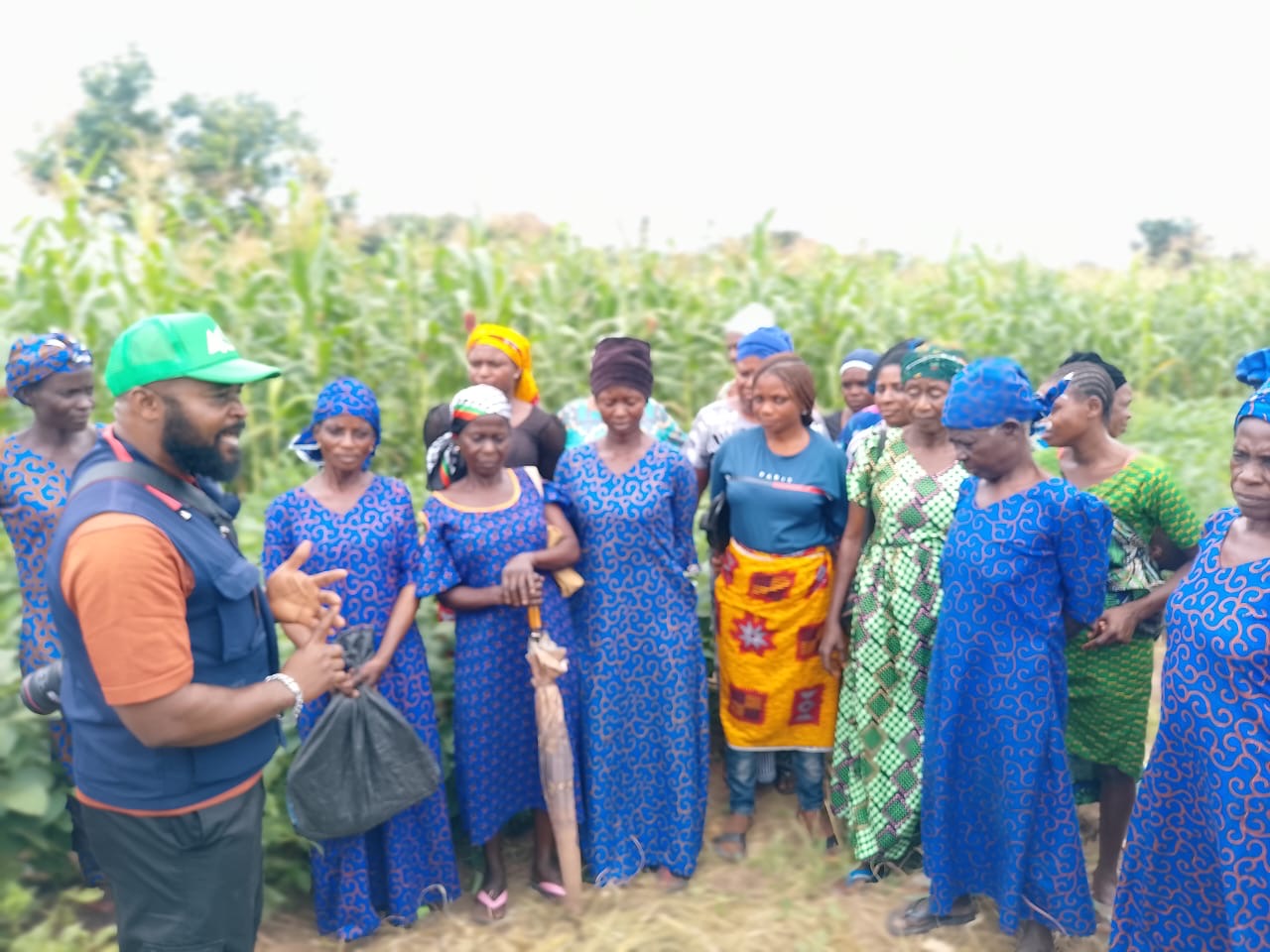
Otene, who led newsmen on a field work to the demonstration farms in Cheedu community in Gwer East and Luga in Gboko LGAs on Monday, explained that farmers receive improved and climate-resilient seeds, technical training, extension support and practical demonstrations on proper planting, spacing, crop population and other modern farming techniques.
He said farmers were trained to use biochar and compost to improve soil fertility, water retention and nutrient availability. They are also encouraged to use locally available materials such as animal manure, leaves and plant residues to produce compost and reduce dependence on synthetic fertilisers.
According to him, the programme promotes intercropping of maize with soybean and crop rotation because soybean, as a legume, helps fix nitrogen in the soil adding that combined with quality seeds, proper spacing, compost, biochar and appropriate fertiliser use, the approach is designed to increase yields while preserving soil fertility.
He explained that the communities contribute land and labour for Community Demonstration Plots, while extension agents guided farmers through the technologies.
The technical coordinator, Safe, Adequate and Nutritious Food Systems, Dr Moshood Suleiman explained that Sasakawa established a cassava processing centre in Cheedu, Gwer East LGA, after a needs assessment showed that farmers produced cassava and garri but lacked processing facilities and reliable water source within the community.
The centre has cassava graters, pressers, fryers and a solar-powered borehole while local operators were trained in machine operation, maintenance and minor repairs to promote sustainability and reduce dependence on outside technicians.
Also, the Program Officer, Inclusive Markets and Agri-business Development, Jonathan Yassah explained that the intervention also focuses on inclusive markets and agribusiness, involving women, youths, Persons With Disabilities and other community members. He said farmers previously received improved cassava planting materials, including the high-yielding variety, which increased production but created a need for adequate processing capacity.
He said the processing centre is intended to turn cassava production into a profitable business through value addition and market linkages. He said the organization has secured off-takers for the products with demand currently exceeding its processing capacity while the centre also has created employment for eight young people and provides processing services to other farmers.
In their testimonies some of the farmers, Mary Ukamave, Patience Kwaghgba and Richard Aondofa, appreciated Sasakawa Africa Association for their intervention which they said has provided them with skills on climate-resilient production, regenerative soil management, improved inputs, processing, value addition, market access and agribusiness development as well as increased yields and income.
Patience Kwaghba, chairlady of a farmers cooperative society, said Sasakawa taught farmers good agronomic practices, how to produce and apply manure and fertiliser, control pests and properly manage crops such as maize and soybeans among others.
Kwaghgba said the new methods have dramatically increased productivity, with farmers now obtaining more crops from smaller areas of land. She said Sasakawa also changed their perception of agriculture by teaching them to regard farming as a business and a source of income and not just for sustainance.
She added that Sasakawa provided farmers with improved seedlings, USG fertiliser and other inputs free of charge. She expressed confidence that they can conviniently cultivate their crops with the trainings received.
In a project factsheet covering the 2025 implementation year and multi-year results from 2023 to 2026, 1,366 farmers were mobilized and sensitised in newly entered communities, while 8,950 farmers were reached through step-down extension training.
The training focused on helping farmers move from subsistence production towards commercial agriculture under the “Grow to Sell” approach, with emphasis on group formation, collective produce aggregation, record-keeping and improved access to markets.
SAA said the intervention was designed to respond to challenges confronting smallholder farmers, including climate change, flooding, drought, declining soil fertility, limited access to agricultural inputs and finance, weak extension services and poor market access.
Under its Climate-Resilient Agrifood Systems programme, the organisation established 1.5 hectares of Community-Based Seed Multiplication (CBSM) plots, comprising one hectare of soybean and 0.5 hectares of maize, involving 75 smallholder seed producers.
The project also promoted technologies such as Urea Deep Placement, Integrated Soil Fertility Management and Integrated Pest Management, alongside improved agronomic practices intended to increase productivity while reducing production costs and environmental pressures.
Farmer groups also received inputs for maize demonstration plot, including NPK fertiliser, Urea Deep Placement inputs, herbicides and insecticide, to demonstrate good agronomic practices and strengthen the group’s production capacity.
The project also conducted gender and family economic planning training, with 50 women farmers and their spouses participating in activities designed to improve joint household financial decision-making, farm planning and management of farm income.
To strengthen financial inclusion, 17 Community Savings and Internal Lending Association executives were trained in financial literacy, loan administration, savings mobilisation and record-keeping, with groups encouraged to work towards annual savings targets of N500,000 while also facilitating agreements with input dealers and service providers, as well as commercial partnership arrangements with produce off-takers, aimed at improving linkages between farmers, input suppliers and markets.