Follow Us on Google
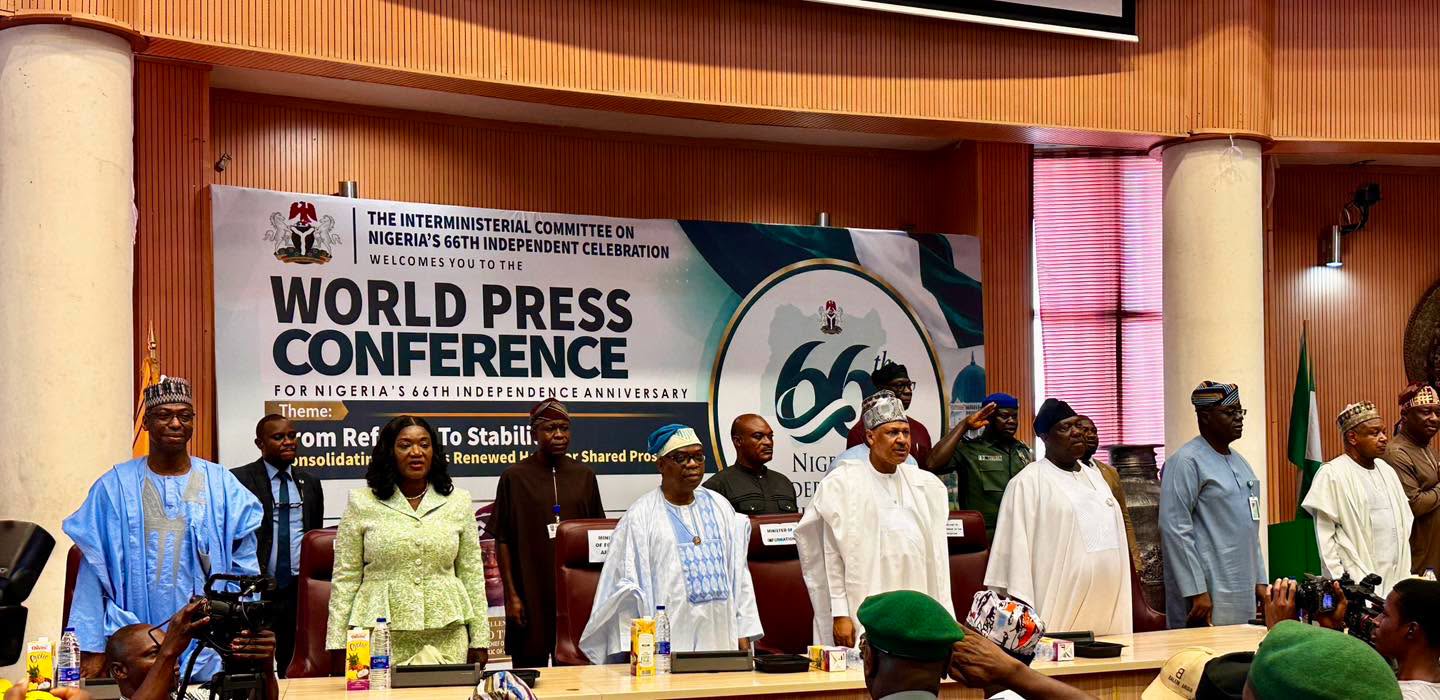
The Federal Government has assured Nigerians of its commitment to consolidating the reforms of President Bola Ahmed Tinubu.
The government said it would translate emerging economic gains into improved living standards for Nigerians.
The Minister of Information and National Orientation, Mohammed Idris, stated this at a world press conference in Abuja to commemorate Nigeria’s 66th independence anniversary.
Idris said the anniversary was an opportunity to reflect on Nigeria’s journey, recognise the resilience of its people and renew commitment to building a more prosperous, secure and united country.
“Independence Day occupies a special place in our national life. It reminds us of the sacrifices that brought us here, the resilience that has sustained us, and the responsibility every generation carries to strengthen the country it inherited,” Idris said.
Idris further explained that President Tinubu inherited significant structural and fiscal challenges, but chose to confront long-standing distortions, despite the difficult adjustments involved.
“Those decisions were difficult, and Nigerians have borne real costs. Today, however, Nigeria is moving from the difficult work of reform and stabilisation towards a new phase of growth, production and shared prosperity,” the minister also said.
Idris further said Nigeria’s real GDP grew by 4.43 per cent in Q2 2026, up from 4.23 per cent in Q2 2025, while foreign reserves, domestic refining capacity, investment and productive activity strengthened.
Idris also cited Nigeria’s delisting from the FATF Grey List and return to the JP Morgan Emerging Markets Bond Index after 11 years.
“Our external position has strengthened, foreign reserves have risen, domestic refining capacity has expanded, and investment and productive activity are gaining momentum,” he explained.
While saying that there was progress to acknowledge, challenges to overcome and more work ahead, with the ultimate responsibility being to leave future generations a stronger country, Idris said: “Our responsibility is to hand the next generation a Nigeria that is more prosperous, more secure, more united and more confident than the one we inherited.”
In the area of security, Idris acknowledged that challenges remained but said the Federal Government had strengthened security operations through increased investment in equipment, intelligence, personnel and inter-agency coordination.
Other News
“Now, does it mean that we have solved all the security challenges in this country? No, and there is so much progress,” he added.
Also speaking, the Secretary to the Government of the Federation, George Akume, said Nigeria’s 66-year journey had recorded significant milestones, including uninterrupted constitutional democracy since 1999.
He called for consolidating reform gains and better opportunities for ordinary Nigerians. “The task before us today, as leaders and citizens, is consolidation. We must ensure that the gains from reform translate into better opportunities for ordinary Nigerians,” Akume said.
Akume said the Federal Government is mobilising revenue, improving public finances and implementing interventions across infrastructure, agriculture, education, health and social protection, while emphasising the need to protect vulnerable Nigerians.
“The guiding principle is that while we reform our economy, we must protect those who are already struggling. No one in poverty should be forgotten,” Akume said.
The SGF further said the administration would continue strengthening security, supporting the private sector and promoting national cohesion to ensure that economic opportunities reach communities across the country.
“From reforms, we have built stability. From stability, let us deepen growth and opportunity, and from growth, let us extend shared prosperity to every corner of Nigeria,” Akume also said.
Speaking during the question-and-answer session, the Minister of Budget and Economic Planning, Abubakar Atiku Bagudu, said the reforms were designed to make deliberate policy choices that would build a larger and more inclusive economy.
“We are not yet where we want to be. What is important is to identify what are the choices that we need to make so that we can go to where we want to be,” Bagudu said.
On his part, the Minister of Agriculture and Food Security, Abubakar Kyari, said improved access to farmlands in previously affected areas, alongside government support for fertiliser and improved seeds, was contributing to increased agricultural production.
“We have seen a lot of areas in the centre; 70 per cent of those places that were hitherto under security have been liberated. We have seen an increase in production today,” Kyari said.