Follow Us on Google
By Moses Akaigwe
President Bola Tinubu’s broadcast, in which he unfolded government’s plans to inject 3000 units of compressed natural gas-powered, 20-seater buses into the road transportation system across the country, has been commended by auto industry stakeholders.

The President had in the July 31 broadcast to the nation announced that provision had been made to invest N100 billion between now and March 2024 to acquire the 3000 units of 20-seater CNG-fuelled buses as part of interventions to cushion the pains of petrol subsidy removal.
To the auto industry analysts and stakeholders, the initiative is a welcome development which, if implemented patriotically, especially by procuring the buses locally, would have a positive impact on the sector.
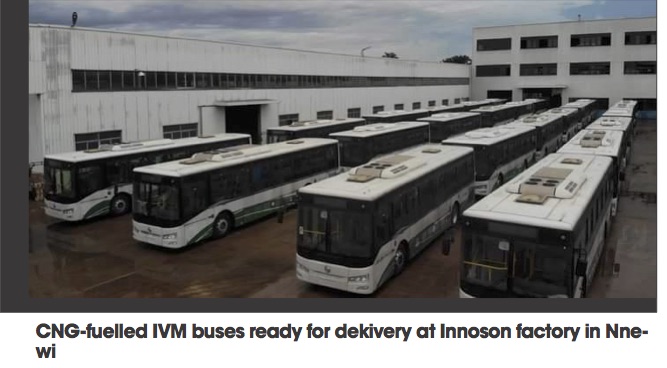
They argue that with companies like Innoson Vehicle Manufacturing Company Ltd (IVM), Nnewi, having large stocks of sundry buses running on CNG and LPG (liquefied petroleum gas); and others like Lanre Shittu Motors Ltd having invested heavily in the production of autogas and electric vehicles (EVs), the domestic auto industry has the capacity to supply the 3000 buses satisfactory.
The stakeholders, therefore, urged the government to depart from the usual resort to importation, by strictly ensuring that all the vehicles to be purchased by all tiers of government are from the auto plants in Nigeria.
Commenting on the “very laudable” development, a renowned economist and immediate past Director General of the Lagos Chamber of Commerce and Industry (LCCI), Dr. Muda Yusuf, lauded the decision by the Tinubu administration to acquire the 3000 CNG buses.
Dr. Yusuf, who is the founder of the Lagos-based Centre for the Promotion of Private Enterprise {CPPE}, however, stated, “But in order to optimise the benefits of this spending for the economy, the local vehicle assembly plants should be engaged to produce the buses. I believe they have the capacity to do so.”
He explained that placing the orders for the vehicles with the automakers in Nigeria would have a significant impact on job creation and other multiplier-effects in the domestic economy.
“In addition to transport companies, the transport unions across the country should be involved in the distribution process.
This is important to ensure inclusion,” Yusuf advised.
Similarly, commending President Tinubu for the intervention, the Managing Director of Lanre Shittu Motors, Mr. Taiwo Shittu, made a strong case for all the major automakers in the country to be tasked with producing the CNG buses, even as he insisted that importation of even one bus unit is not an option that should be considered.
Looking inwards for all the vehicles to be used in the intervention across the country, Shittu stated, is in line with the goals of the Nigerian Automotive Industry Development Plan (NAIDP).
The Lanre Shittu MD recalled, “They urged us to set up assembly plants, and we have done so. Therefore, we should be encouraged by buying our vehicles and not importing fully built products. Government is the biggest buyer of vehicles in Nigeria. So, if they don’t buy made-in-Nigeria, who will buy?”
He assured that automakers in Nigeria have the capacity to produce the 3000 and more within the time frame, adding “Lanre Shittu alone can produce 1000 units out of the 3000.”
Another key player in the domestic auto industry, Mr. Olufemi Olafunmiloye, also applauded the plan by government to counter the effects of fuel subsidy withdrawal with CNG-fuelled buses for mass transit.
Olafunmiloye, who is the Managing Director/CEO of the Akure-based Lafbart Innovations & Consulting Ltd, remarked, “Finally, the big decision we have been clamouring for is here. Transitioning to CNG-powered vehicle is a step in the right direction. This we have spoken about on several occasions.
“What is even more important is government’s decision to drive the availability in the market. Critical to having a successful programme is to patronise local manufacturers and assemblers.”
Like Shittu, he hinted that placing the orders for the production of the buses lpcally would help revive sustainable activities in the various Nigerian plants involved, in terms of job creation, and capacity utilisation, among other gains.
“Apart from the obvious positive economic gains; job creation and circulation of money in the system, it will build capacity. It is worthy of note that the CNG system is a specialised field that must be done right.
“Empowering manufacturers instead of traders, to push this scheme will ensure the whole chain is fully understood by the manufacturers, hence rolling out safe vehicle,” the Lafbart Innovations & Consulting Ltd MD counseled.
Reacting to the initiative by the Federal Government, the Deputy Managing Director of CFAO Motors Nigeria, Mr. Kunle Jauyesimi, added another dimension to the issue by appealing to the government to ensure conducive atmosphere in the Nigerian auto industry in order to attract some big global automakers currently reluctant to invest in auto manufacturing in the country.
“The Federal Government should put a good and workable investor-friendly policy in place for these brand owners to listen to our plea and agree on our setting up assembly plants in Nigeria,” Jauyesimi stated.
Another auto industry key player that has urged the Tinubu administration and the state governments, to ensure that all the vehicles to be acquired for cushioning the hardship resulting from the removal of fuel subsidy come from auto companies in Nigeria, is the Managing director of BKG Exhibitions Limited, Mr. Ifeanyichukwu Agwu.
Agwu, whose company organises the Lagos Motor Fair/Africa Autoparts Expo, as well as the Abuja International Motor/Nigeria Autoparts Expo, advised that only auto companies in Nigeria that have visible dealerships and presence in the country, that should be saddled with the responsibility of producing the buses
Giving this advice in a chat with newsmen, Agwu noted that injecting the money into the Nigerian automotive industry would spur more activities in the sector with the attendant socio-economic benefits to the people and economy of Nigeria.
“We have companies in Nigeria that could meet up the demand as well as subsequent ones,” he said.
The BKG MD noted that the sector has suffered serious setbacks for over a decade owing to the poor attention paid to it by the government, especially regarding the NAIDP “which is in its 10th year of epileptic implementation.”
“No doubt, low sales and lack of clear-cut policy direction, amongst other factors, have been plaguing the industry which is in dire need of life support. Therefore, injecting the funds for the purchase of these vehicles will go a long way in restoring life and vibrancy to the industry,” Agwu said.
Procuring these vehicles from sources that are not playing big in the Nigerian market, according to him, “will only end in more capital flight out of the country and worsening the precarious state of the nation’s economy. More jobs will be created in the benefiting economies while unemployment persists in Nigeria. “
.
In his broadcast, the President had explained that the 3000 buses would be shared to major transportation companies in the states, using the intensity of travel per capital.
“Participating transport companies will be able to access credit under this facility at 9 percent per annum with a 60 months repayment period.”