Follow Us on Google
-
Promises to leave INEC better electoral umpire
-
Defends failure to overhaul election technology
________________________________________________________________________
The chairman of the Independent National Electoral Commission (INEC), Joash Amupitan, has made a fresh passionate appeal to the Federal Government to release the final tranche of the commission’s budgetary allocation for the conduct of next year’s general elections.
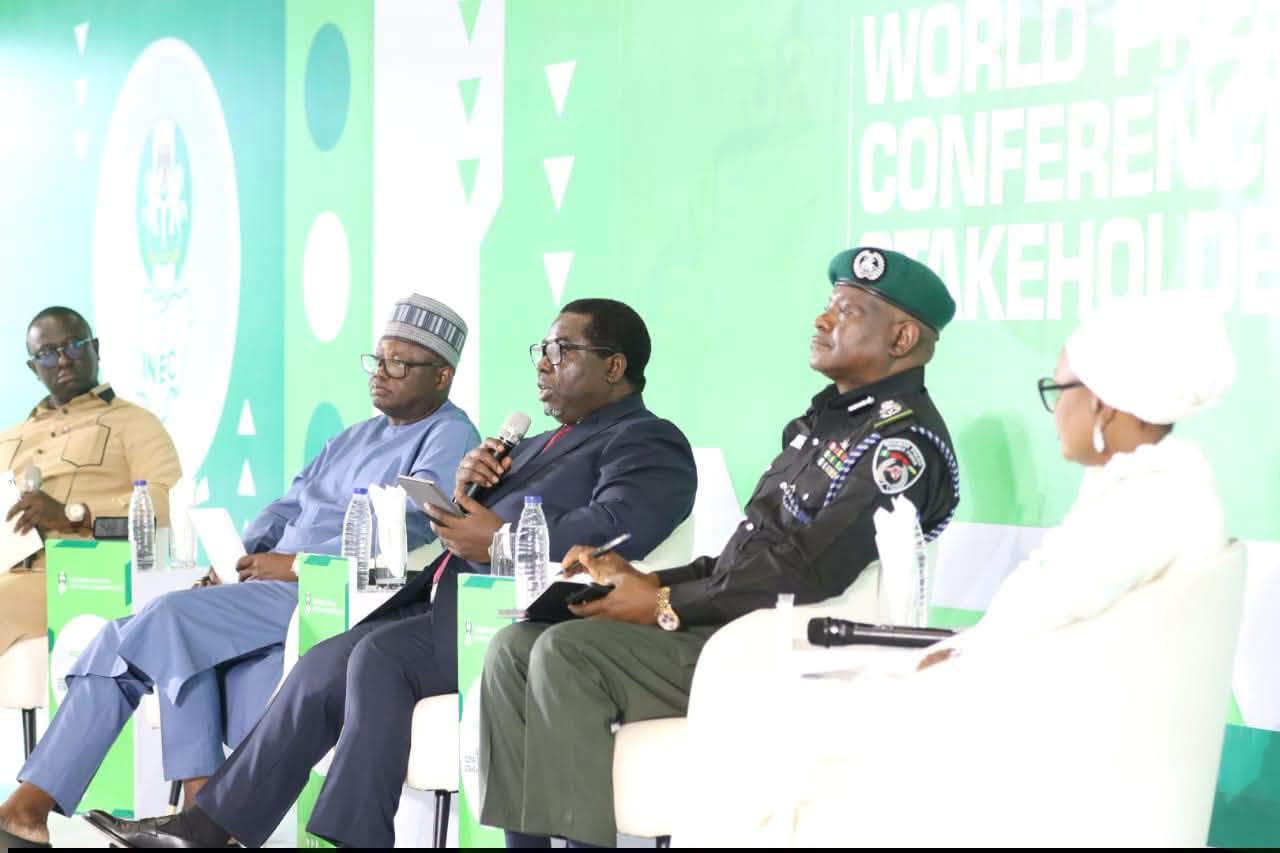
Joash made the disclosure at the world press conference and national stakeholders’ meeting marking 100 days to the 2027 general elections on Tuesday in Abuja.
He explained that operating under a framework of transparent fiscal management, the funds have enabled them to meet international vendor obligations, finance the production of critical election technology, upgrade physical infrastructure, and sustain multi-stakeholder operational deployments nationwide.
Promising to leave the commission a better umpire after the transparent conduct of the 2027 general elections, Amupitan claimed that choked electoral activities crippled his determination to overhaul election technologies.
He also stated that what might be the difference between the 2023 general elections and that of next year will be the mode of collation of election results, announcing the statistics of states topping the list of the collection of voter cards.
He revealed that while Lagos with 7,488,633, Kano with 6,570,276, Kaduna with 4,662,640 and Katsina with 3,876,051 top the list, other states include Rivers with 3,736,434, Oyo with 3,588,111, Delta with 3,525,988, Benue with 3,057,225, Ogun with 3,037,981, and Bauchi with 3,012,547.
On the appeal for the release of the final budgetary allocation, the electoral umpire boss said: “Executing a national election of this magnitude requires robust financial backing and fiscal discipline. The Federal Government has maintained its commitment to democratic governance through the timely release of statutory budgetary allocations to the Commission.”
“Operating under a framework of transparent fiscal management, these funds have enabled us to meet international vendor obligations, finance the production of critical election technology, upgrade physical infrastructure, and sustain multi-stakeholder operational deployments nationwide.
“However, we expect the prompt release of the remaining budget to ensure seamless execution of the remaining activities,” he appealed.
Giving further updates on the voters register, Amupitan said: “At the other end of the table, Ekiti State has the lowest number of registered voters, with 1,055,708. It is followed by Bayelsa, which has 1,200,691 registered voters. The FCT ranks next from the bottom with 1,732,043, followed by Yobe with 1,733,671 and Gombe with 1,768,566.”
“Male voters account for 53,528,218, representing 51.75 per cent of the register, while female voters number 49,900,497, representing 48.25 per cent. The age profile shows that the register is dominated by voters aged 35 to 49 years, who account for 43,265,946 voters, or 41.83 per cent of the total,” he said.
Other News
“In compliance with Section 19(1) of the Electoral Act 2026, the Register of Voters will be displayed for public scrutiny from October 9 to 15, this month, not later than 90 days before the general election. Claims and objections arising from the nationwide display at Registration Areas will be addressed thereafter,” he disclosed.
Amupitan also ruled out electronic transmission of results, hinging the reason on the fact that it is not backed up by the law.
On the nomination of political party candidates, he rolled out the statistics of the candidates, noting: “Under Section 29 of the Electoral Act 2026, political parties submitted candidate lists through the INEC Candidates Nomination Portal (ICNP), supported by Form EC9 affidavits of constitutional compliance.”
“To protect the integrity of party nominations and prevent unlawful exclusion or arbitrary candidate substitution, the commission implemented an administrative safeguard, which was the pre-uploading of candidate names onto the INEC Candidates Nomination Portal, strictly verified against INEC’s primary election monitoring reports and internal party appeal outcomes.
“18 out of 22 registered political parties submitted 36 Presidential/Vice-Presidential candidates. Three parties (Accord, APGA, and Youth Party) nominated no presidential candidates, while the New Nigeria Peoples Party (NNPP) withdrew its presidential nomination during the substitution window.
“National Assembly: 21 of 22 political parties sponsored 1,313 candidates for the Senate and 3,547 candidates for the House of Representatives. Personal particulars were published on August 1, 2026, and the Final List of Candidates was published on September 12, 2026, subject to court orders.
“Governorship & State Houses of Assembly: 21 out of 22 political parties nominated 936 governorship/deputy governorship candidates and 9,692 State House of Assembly candidates. Personal particulars were published on August 29, 2026, with the final list set for publication on 10th of this month,” he said.
Giving further breakdown, Amupitan said: “The complaints arising from the nomination process include unlawful withdrawal and substitution of candidates, typographical errors, and other legal issues relating to nominations. All 112 formal complaints received from aspirants, candidates, and parties regarding the nomination process were investigated and resolved except those pending in the Court.
“However, we have recently received complaints from some political parties and aggrieved aspirants, drawing our attention to the recent Supreme Court decision in INEC v. Zenith Labour Party delivered on September 24, 2026, affirming the constitutionality of section 77(5)-(7) of the Electoral Act, 2026 and also upholding our Revised timetable and schedule of activities for the 2027 general election.
“We only received the certified true copy of this judgment this morning, and it is being reviewed,” he said.