Follow Us on Google
From Romanus Ugwu, Abuja
The Independent National Electoral Commission (INEC) recently expressed frustration over its helplessness in sanctioning political actors for their continued violation of Electoral Act across party lines, particularly the early commencement of political campaigns throughout the country.
The electoral umpire, in expressing its concerns, hinged its frustrations on the weakness of the legislation shielding the defaulters. It also complained that the political actors have capitalised on the lacuna in Section 94(1) of the Electoral Act, 2022, prohibiting campaigns earlier than 150 days before the election, which did not recommend any sanction for defaulters who ceaselessly violate it.
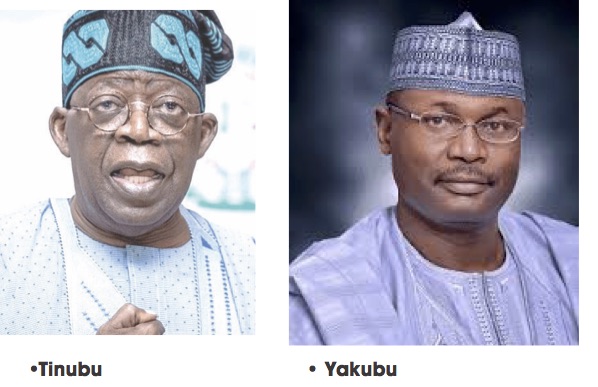
Chairman of the commission, Professor Mahmood Yakubu, who expressed the upsetting frustration, equally frowned at incidents of the political actors using cultural festivals and religious gatherings, among many other situations, to campaign and drop hints about their ambitions.
The commission’s chairman had wondered why political parties, candidates, and their supporters seem to be perpetually in election mood ahead of the timeframe provided by law, and even when the electoral umpire has yet to release the timetable and schedule of activities for elections.
Prof. Yakubu further expressed concern over proliferation of outdoor advertising, media campaigns, and rallies promoting various political parties and candidates everywhere around the country, emphasising that they usually disguise as appreciation or philanthropic gestures to declare their intentions and readiness to aspire for elective positions for a dispensation still very far away in clear violation of the provisions of the Electoral Act.
Daily Sun investigations reveal visible evidence of early commencement of campaigns as a build-up to the 2027 general elections in almost every part of the country, two years ahead of the polls.
From the billboards strategically positioned in several areas, especially along the Airport Road and City Centres of the Federal Capital Territory (FCT), Abuja, to the state capitals and even suburbs across the country, none of the political parties is exonerated from blame in the allegation of their involvement in the trend.
For instance, at a national summit by the All Progressives Congress (APC), held at the Aso Rock Presidential Villa, where an automatic endorsement ticket was offered to President Bola Tinubu for his 2027 re-election, the stakeholders in attendance not only promise to collapse all their political structures to guarantee his re-election bid, but to also replicate the campaign trend in all the geopolitical zones, and in almost all the APC-controlled states, in an attempt to send a warning signal to the opponents that the 2027 presidential race has commenced even without the umpire taking charge of the game.
And true to the promises of the APC stakeholders to channel all their political arsenals toward delivering President Tinubu in 2027, President Tinubu’s visits to some states to commission projects have been disguisedly packaged in such a way as to confirm the possibility of his securing outright massive victory votes or at least the constitutionally stipulated 25 per cent votes.
However, Daily Sun gathered that the early commencement of campaigns is not peculiar to only the ruling party. Recall that since the change of guard in its national leadership, the opposition coalition party, the African Democratic Congress (ADC), has stopped at nothing in exploiting and exploring every avenue to make its visibility and entry to change the political dynamics loud and practically felt in the build-up to the 2027 presidential election.
Evidentially, both the ruling and opposition political parties, through their words and actions, have, directly and or indirectly, been involved in the early campaign to announce to Nigerians that the political season has begun in earnest, with their deployment of strategies and counterstrategies aimed at outsmarting each other.
It is not surprising, therefore, that in the consideration of the National Chairman of the APC, Professor Nentawe Goshwe Yilwatda, the ruling party is not in any way guilty of the violation of any Section of the Electoral Act despite its alleged involvement in the early commencement of political campaigns.
Yilwatda, who was even a former Resident Electoral Commissioner (REC), in his defence of the ruling party, argued that there is a difference between political mobilisation and political campaign, stressing that the electoral umpire would have written formally to the APC national leadership to notify it of violation of the campaign rule.
“We are not violating campaign rules at all,” Yilwatda insisted while appearing on a national television recently, explaining that, “there are almost six items that must be contained in a campaign material for it to constitute a campaign document.”
He further said “All you have been classifying as campaign material are just pictures of Mr President. Campaign materials must have a date of the election, the logo of the party, among others, but the posters and billboards you are referring to don’t contain all these materials,” Yilwatda argued further.
And asked whether those mobilising support for President Tinubu for the 2027 election are not campaigning, he thundered: “Which political party will not mobilise membership? It is part of political activities but it is not a campaign activity. Mobilisation is a constant act of political activity and we will keep mobilising every day, even a day after the election.”
The ruling party boss finally nailed the coffin of the complaints over violation of campaign rule, when he argued: “If it were campaign material, INEC would have contacted the party at the national level. But as I speak, we have not received any letter from INEC asking us to remove anything because it constitutes campaign material. That is what normally happens.
“If a material looks like a campaign material, INEC is supposed to write a letter directing the party to remove it because the content has to do with campaign issues. But as of now, we have not received any letter from the INEC or any dissenting voice from the electoral umpire because the Electoral Act specified what constitutes campaign material. All you have been seeing is not campaign material,” he insisted.
Yilwatda equally addressed the true identity of the status of those mobilising Nigerians as his party members, admitting, “Of course, they are my party members. We have a very wide reach across the country because APC is the only nationwide political party, for now, with an overwhelming acceptance across the country, including all religions, tribes, geopolitical zones, as we saw during the last legislative bye-elections across the country.”
But, evidently miffed by the claims and the disturbing level of the violations of campaign rules, the electoral umpire boss, at a stakeholders’ roundtable on premature political campaign, held recently in Abuja, had particularly decried the early commencement of campaign ahead of off-season governorship elections, forthcoming FCT Area Council elections, and the 2027 general elections.
Yakubu had lamented that; “these actions and activities undermine the commission’s ability to track campaign finance limits as politicians, prospective candidates, and third-party agents expend large amounts of money that cannot be effectively monitored before the official commencement of campaigns.
“Quite correctly, Nigerians expect INEC, as registrar and regulator of political parties, to act in the face of the brazen breach of the law on early campaign. However, the major challenge for the commission is the law itself. Section 94(2) of the Electoral Act 2022 imposes sanctions, albeit mild (a maximum amount of N500,000 on conviction), on any political party or a person acting on its behalf who engages in campaigns 24 hours before polling day.
“But, there is no sanction whatsoever concerning breaches for campaigns earlier than 150 days to an election. Here lies the challenge for the commission in dealing with early campaigns by political parties, prospective candidates, and their supporters.
“In a sense, the problem of the early campaign in Nigeria is not new. The seeming inability of the commission and other regulatory agencies to deal with the menace within the ambit of the existing electoral legal framework calls for deep reflection,” he said.
Interestingly, the INEC’s boss was not alone in condemning and frowning against the menace of early commencement of campaign as his National Commissioner and Chairman of the Board of the Electoral Institute (BEI), Prof. Abdullahi Abdul Zuru, described it as one of the most worrying challenges of Nigeria’s democracy.
Prof. Zuru, who spoke at the stakeholders’ roundtable, accused the aspirants of often using cultural festivals, religious events, billboards, branded vehicles, and even social media influencers as fronts for premature campaigns.
He said: “When aspirants or parties compete to dominate visibility long before the official campaign period, it distorts fairness and raises the cost of political competition. The trend distracts elected officials from governance, erodes public confidence in the electoral system, and fuels cynicism about the rule of law. We must refine the regulatory framework so that what constitutes premature or early campaigning is more clearly defined in today’s digital age.”
In his presentation titled “Towards addressing the challenges of premature election campaigns in Nigeria, former INEC Chairman, Prof. Attahiru Jega, said that premature campaigning has regrettably remained inadequately regulated and become increasingly widespread.
“Although the Nigerian electoral legal framework contains some provisions regulating election campaigns, as it provides for the period of commencement and end of campaigns, regrettably, premature campaigning has remained inadequately regulated and has become increasingly widespread.
“It has been characterised mainly by the display of posters featuring politicians, across political parties, but especially of incumbents, at both federal and state levels, literally ‘jumping the gun’, some two years before the official election/campaign period.
“Many, if not most of these, are what can be termed as ‘third-party’ campaigns, ostensibly carried out by candidates’ support groups, with dubious financing, most likely in crass violation of campaign financing legislation.
“Premature campaigns consist of, not only the erection of billboards with candidates’ portraits and messages soliciting votes and/or endorsements, but they also include the use of public media and resources to advertise records of ‘achievements’ of incumbents, or the use of official positions and commissioning of projects for electioneering purposes,” Jega argued further.
Interestingly, the biggest takeaway from the roundtable discussion on the solution to the menace is that all eyes are now on the National Assembly, the relevant authority, to enact applicable legislation to tackle the menace of early campaigns.
In his contributions, however, the Chairman of the House of Representatives Committee on Electoral Matters, Hon. Adebayo Olusegun Balogun, said: “When the government is commissioning a project, and it presents itself, they are sitting and laughing. When a very good Assembly member is commissioning a constituency project, he starts the campaign. And when the opposition party organises a rally to oppose any programme of the ruling government, it is also a campaign.
“So, we need to really check what we are actually referring to as a campaign. The CSOs talk about policies of the government, either for or against, every day. The fuel subsidy debate is still on. It is either you support or oppose it. Do we consider this as campaign? Even the American President, up till today, is still talking about his own government.
“This could not have come at a better time. We should use this programme to search our mind and ask whether we still want to have any law-restricting campaign. Is that what is obtainable in any other part of the world? If we are not careful, we will continue to take some of these programmes that will go through the military regime, when you are given two days, one week campaign, and after that period, if you are caught, you are going to jail.
“We are in a democracy. The social media space cannot even be controlled. We have to be careful when we make some of these laws. They accuse you of campaigning when you don’t even know the people that printed the posters on your behalf. You only see the posters from Airport Road to wherever in Abuja, and who do you hold liable? Is it the party or the person?
“We must be careful so that we do not create a situation where the law will be used to witch-hunt some people. I suggest that, at the end of the day, there should be more community discussion on whether the law should still be there or not,” he noted.