Follow Us on Google
By Oluseye Ojo
Prominent scholars, legal luminaries and political analysts have warned that Nigeria’s democratic stability ahead of the 2027 general elections is at risk unless the country undergoes an urgent restructuring of its governance architecture.
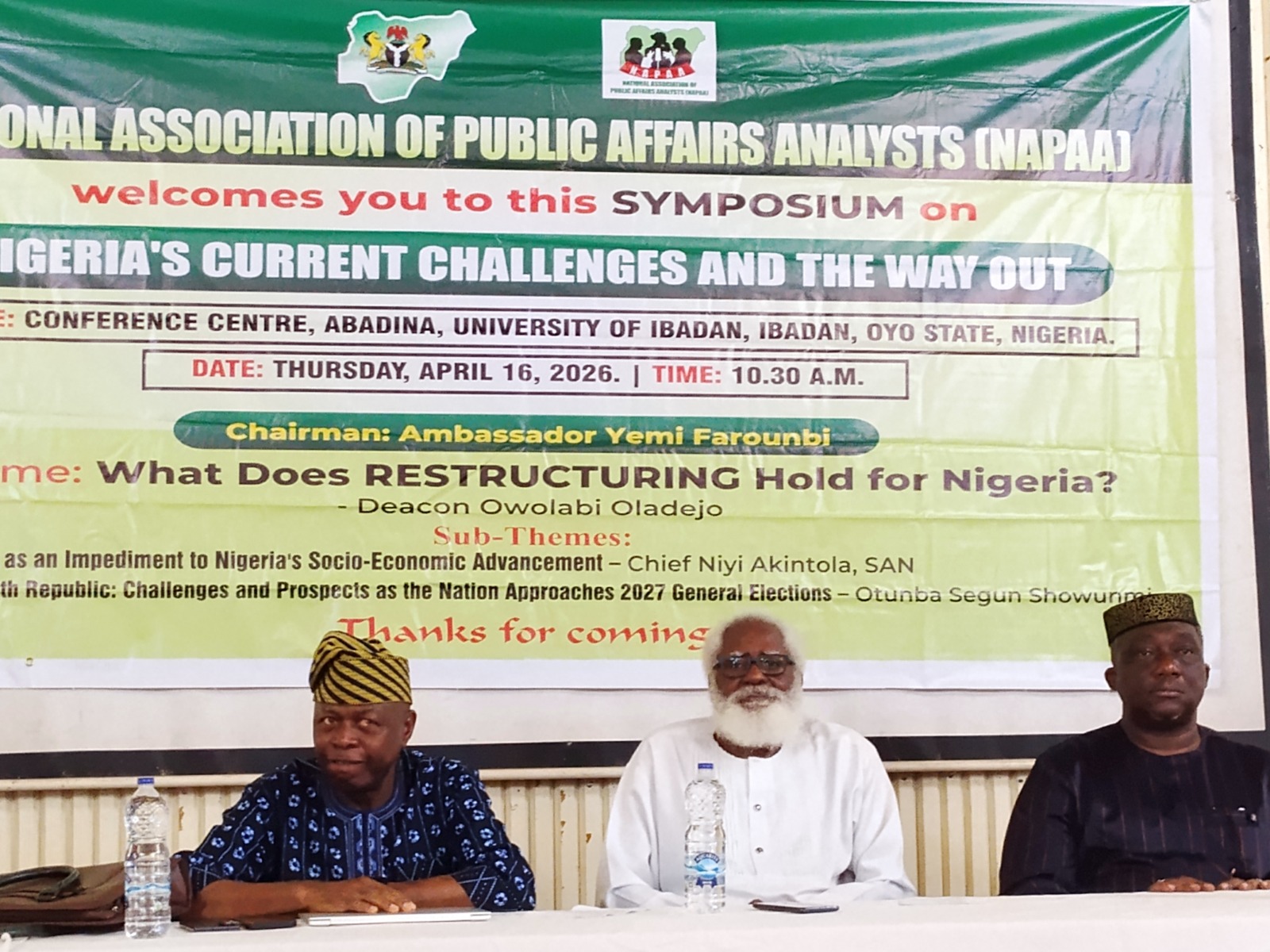
The call was the central theme of a symposium organised by the National Association of Public Affairs Analysts (NAPAA) at the University of Ibadan.
Stakeholders at the event, themed ‘Nigeria’s Current Challenges and the Way Out,’ described the nation’s current structural imbalance as the primary driver of rising insecurity and a deepening deficit in public trust.
Chairman of the occasion and former Nigerian Ambassador to the Philippines and Kingdom of Cambodia, Dr. Yemi Farounbi, characterised Nigeria as a nation of paradox, where abundant human and natural resources fail to yield development due to weak institutions.
He insisted that Nigeria’s crisis is not a lack of ideas but a systemic absence of the discipline and accountability required to implement them.
“Nigeria’s problem is not the absence of solutions, but the absence of structure and responsibility to implement those solutions.”
He added that no nation could progress with a fragile security architecture.
Convener of The Alternative Movement, Segun Showunmi, warned that the 2027 elections represent a critical turning point.
Presenting a paper on the prospects of the Fourth Republic, Showunmi argued that the country’s democracy is currently trapped between electoral continuity and true consolidation.
He identified elite dominance, weak internal party democracy, and declining voter confidence as major threats to the legitimacy of the next general elections. He called for immediate reforms in the electoral administration to prevent a total erosion of public trust.
Adding a legal perspective, Chief Niyi Akintola emphasised the devastating socio-economic impact of insecurity. He argued that the current climate of fear acts as a deterrent to investment and a disruptor of agriculture and education.
He called for urgent policy interventions to strengthen the justice delivery system and security frameworks. He further advocated massive investment in youth empowerment as a long-term strategy to address the root causes of crime and unrest.
The NAPAA Chairman, Prince Seun Adelore, and other speakers including Deacon Owolabi Oladejo, championed decentralisation as a pathway to economic growth.
Oladejo projected that the Western Region alone could achieve exponential economic growth within a decade if empowered to harness its comparative advantages.
He also disclosed that stakeholders are already finalising proposals for the establishment of regional security outfits and state policing to be presented to the government.
The event featured further insights from NAPAA Secretary, Mr. Jare Ajayi, who emphasised the role of informed civic engagement, and Moshood Erubami, who expressed concern over the lack of collective political will to implement restructuring despite decades of advocacy.
Chairman of the Nigeria Union of Journalists (NUJ), Oyo State Council, Akeem Abas, supported the consensus that restructuring remains the most viable step toward addressing Nigeria’s mounting systemic challenges.