Follow Us on Google
From Sola Ojo, Abuja
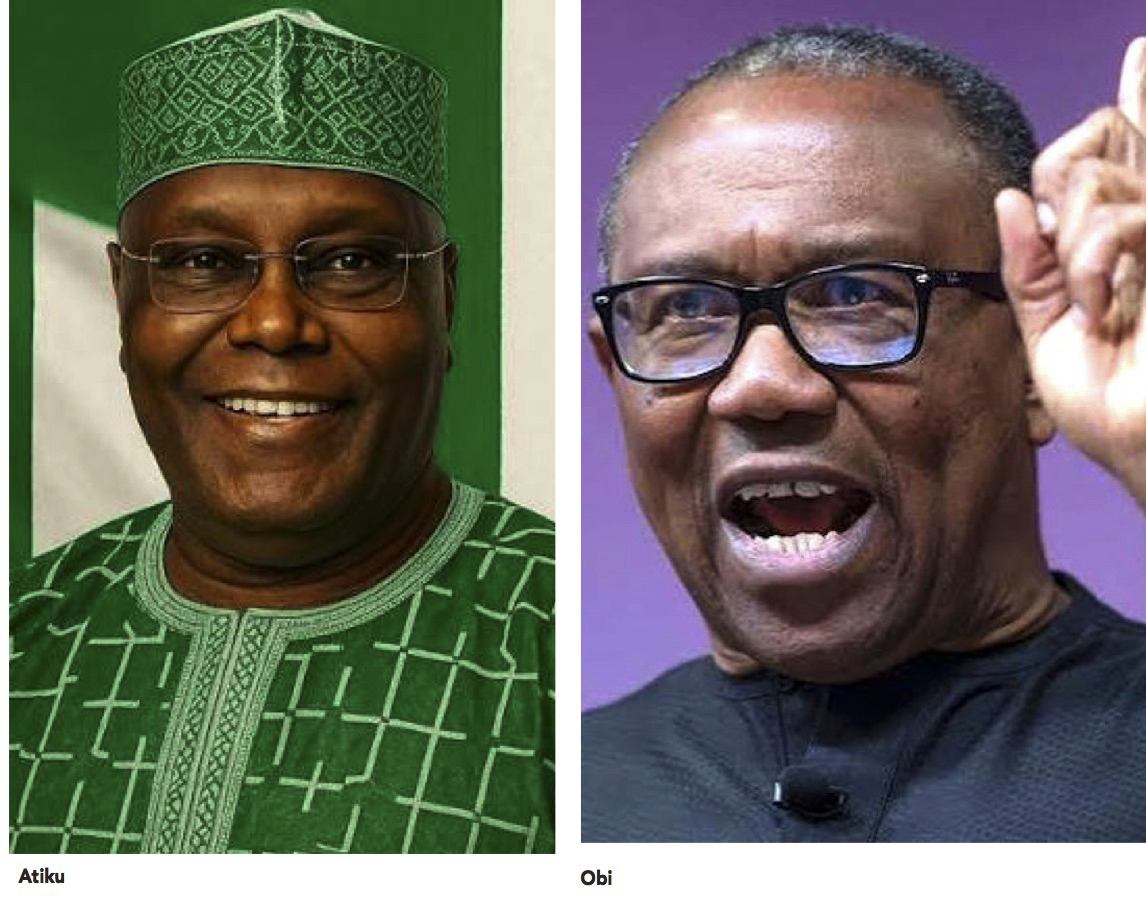
Nigeria’s 2027 presidential contest is gradually raising an uncomfortable question for Peter Obi; what happens when the political space he occupied so successfully in 2023 begins to be occupied by somebody else?
Obi is certainly not out of the race. He remains the presidential candidate of the Nigeria Democratic Congress (NDC), with Rabiu Kwankwaso as his running mate, and the duo are already mobilising their structures across the country.
As recently as September 1, Obi and Kwankwaso met with the NDC’s candidates from different states to strategise on taking their message to rural communities and the hinterlands.
But politics is not only about whether a candidate is still standing, but it is also about whether voters still see that candidate as the most compelling alternative.
And this is where former vice president Atiku Abubakar’s emerging strategy, attacking President Bola Tinubu from two politically sensitive directions: the economic hardship associated with petrol subsidy removal and the controversy over historical US law-enforcement records concerning allegations of drug trafficking involving Tinubu, becomes important.
Both issues allow Atiku to present himself as the opposition figure most directly challenging the president. So if there is anything Atiku appears to have learned, it is how to campaign to Nigerians’ emotions and deepest desires, much as the political narrative was shaped in the years leading up to Muhammadu Buhari’s victory in 2015.
He seemed to have understood that beyond policies, statistics and political calculations, Nigerians respond strongly to messages that speak directly to their frustrations, hopes and aspirations. His recent messaging increasingly taps into the mood of a population yearning for economic relief, good governance and a sense of renewed national direction.
In that respect, Atiku appeared to be rediscovering the power of emotional politics, the kind that can turn widespread dissatisfaction into a potent electoral force like what Obi himself enjoyed in some parts of the country in the 2023 presidential election he contested on the platform of the troubled Labour Party.
For millions of Nigerians who are unable to drive their cars as desired, petrol subsidy is not an economic theory but an economic reality they yearn to overcome. In Nigeria, petrol is everything. Transport fare is now out of reach for many Nigerians.
Although the APC-led federal government has said repeatedly that Tinubu’s administration has stabilize macro economy, which they believe will, over time, have a ripple effect on the microeconomy where the majority of Nigerians fall.
So when Atiku said he would restore subsidy if elected in 2027, he is speaking directly to the pocket of the ordinary Nigerians who are unable to feed well due to the high cost of petrol, from less than N200 when Tinubu took over in 2023 to over N1,300 and still counting.
Atiku has insisted that the policy he proposed would be targeted and designed to make fuel more affordable, rather than simply returning to the old system.
Politically, that was a powerful message in a country where the removal of subsidy has become one of the defining symbols of the economic pain of the Tinubu years in government so far.
But then Peter Obi entered the debate, and surprisingly, he took a position that puts him closer to Tinubu’s original economic argument than Atiku’s.
To him, subsidy removal was necessary, especially as all the top presidential candidates said in the run-up to the 2023 general election, including Atiku.
He objected that the government failed to properly manage and invest the savings and failed to provide sufficient alternatives to cushion Nigerians from the consequences. That difference is politically significant but seems not to matter to Nigerians who are not ready for economic analysis, at least for the time being.
Atiku’s promise: “I will restore fuel subsidy and make fuel cheaper,” was all he needed to put Tinubu and APC on the hot defence seats, and this is where Atiku may be unintentionally squeezing Obi out of the equation.
The former vice president is taking ownership of the immediate pain narrative, while Obi is trying to explain the structural economic argument behind the pain.
And Nigerians who are struggling to survive may not have the patience for complicated economic explanations and statistical comparisons Obi has been enjoying in the past few years.
Atiku’s second move is even more politically consequential; his campaign has been involved in efforts surrounding the release of US records relating to historical investigations involving Tinubu.
The FBI has asked a US court to permit confidential explanations for withholding some records, citing exemptions under the Freedom of Information Act. The records relate to investigations from the 1990s.
Other News
It is important to make one distinction clear: the existence of an investigation or withheld records is not, by itself, proof that Tinubu committed drug trafficking or any other offence. That distinction matters because this is an allegation-driven political controversy, not a judicial finding of guilt.
The controversy is now becoming part of the 2027 political conversation, with other opposition groups also demanding the release of the records. The Allied Peoples Movement, for instance, recently called on US authorities to release the FBI report.
Tinubu’s legal team has argued that the election should ultimately be decided by campaign promises rather than documents and has defended reliance on legal protections governing the withheld material.
The more the opposition conversation revolves around Tinubu’s past, the more the voters are drawn into emotions, and of course the more the contest risks becoming a straightforward question like who can defeat Tinubu? And that again is precisely where Atiku has an advantage over Obi.
Atiku has spent decades inside Nigeria’s political establishment, and he has contested the presidency under all the major political parties several times.
He has a national political network and, through the ADC, is positioning himself around the argument that he is the experienced opposition figure capable of taking on the APC and incumbent Tinubu.
The bottom line is that Atiku is gradually occupying the political space Obi once owned by walking into the heart of many Nigerians as far as their livelihood is concerned.
By Adesuwa Tsan, Abuja
Quote: “The coming months will therefore be a contest between two interpretations of the same reality, Tinubu presenting the reforms as the foundation of a stronger economy, the opposition presenting them as evidence of a government that has shifted the burden of adjustment onto ordinary Nigerians.”
With months left to the 2027 general elections, Nigeria is entering one of the most consequential political periods since the return to democratic rule in 1999. The familiar manoeuvring of an approaching election has hardened into a contest anchored on the record of President Bola Tinubu’s administration and the ability of the opposition to present a credible alternative. The ruling All Progressives Congress is seeking to retain power and return Tinubu for a second term, while opposition forces are attempting to convert public dissatisfaction into a coherent electoral coalition capable of defeating an incumbent with the full machinery of the federal government behind him.
Two competing narratives have emerged. For Tinubu and the APC, the argument is that the painful economic reforms introduced since 2023 were necessary to rescue the economy from structural weaknesses and place it on a sustainable path. For the opposition, the reverse is true, that Nigerians have endured years of rising living costs, insecurity and declining purchasing power, and that whatever improvement the government points to in its statistics has yet to translate into the lives of ordinary citizens. From these two positions, Nigerians will decide whether to vote for the promise of an unknown tomorrow or the reality of today, a question that could determine whether Tinubu secures another four years or whether the opposition produces Nigeria’s first presidential turnover since the APC itself defeated the Peoples Democratic Party in 2015.
Tinubu’s political case rests heavily on the removal of the petrol subsidy and the liberalisation of the foreign exchange market, decisions that broke sharply from the economic management of previous administrations and imposed real costs on households and businesses. The government maintains those costs were unavoidable given a fiscally unsustainable system that starved infrastructure and social services of resources. Three years in, the administration can point to a growing economy, improved oil production and recovering investor sentiment, with the Director General of the International Energy Agency, Fatih Birol, suggesting Nigeria could double energy investment within five years if the current template continues, as the country targets three million barrels of daily oil production by 2030.
Yet politics is rarely settled by macroeconomic statistics alone. Nigerians still describe food, transport, rent and other necessities as unaffordable, and the administration’s challenge is not proving the economy has improved on paper but convincing citizens that improvement is something they can actually feel. That gap is the government’s greatest vulnerability. Millions of Nigerians do not experience the economy through GDP figures or investor confidence but through the price of rice, transport fares, school fees, rent, electricity bills and whether three meals reach the table. The opposition is exploiting that contradiction aggressively, asking simply who the recovery is actually for. The coming months will therefore be a contest between two interpretations of the same reality, Tinubu presenting the reforms as the foundation of a stronger economy, the opposition presenting them as evidence of a government that has shifted the burden of adjustment onto ordinary Nigerians.
If the economy is Tinubu’s greatest vulnerability, insecurity runs a close second. Terrorism, banditry, kidnapping and communal violence have spread beyond the traditional conflict zones of the North East and North West into highways, schools, farms and communities nationwide. Recent reporting has highlighted thousands abducted and more than a thousand killed, a crisis that touches Nigerians of every class, from the farmer who cannot safely reach his land to the parent who cannot safely send a child to school. For the opposition, this offers a straightforward argument, that a government unable to guarantee citizens’ safety cannot claim its economic achievements are sufficient.
The APC’s likely response is that insecurity is a longstanding national problem demanding sustained investment and that security spending has expanded, though voters will ultimately judge by results in their own communities. This is part of why the push for state police has gathered fresh momentum, with the legislature advancing proposals even as debate continues over whether devolving policing power to governors would improve local response or simply create new avenues for abuse, a debate that is really about the balance of power between Abuja and the states and will remain part of the 2027 conversation.
Tinubu’s clearest advantage remains incumbency. The APC has consolidated control across much of the country, drawing governors, legislators and influential politicians into its fold, giving it an organisational reach built for the ward-by-ward, polling-unit-by-polling-unit work that actually decides Nigerian elections. That structural advantage does not guarantee victory, since Nigerian politics has repeatedly shown that strong machinery can be undone by voter dissatisfaction, but it means criticism alone will not be enough to remove the APC from power.
The opposition enters the contest with something the ruling party cannot manufacture, widespread public dissatisfaction, but it carries its own burden of fragmentation. The emergence of the Nigeria Democratic Congress, the revived African Democratic Congress, the Allied Peoples Movement and other arrangements have reshaped the landscape, with Peter Obi emerging as a major contender alongside former Vice President Atiku Abubakar, while the PDP struggles to find its place in an increasingly fluid environment. The real question is no longer whether Nigerians are dissatisfied but whether the opposition can persuade dissatisfied voters to unite behind one alternative, a task complicated by a constitutional system that rewards geographical spread, requiring a candidate to win the highest number of votes nationally and at least twenty five per cent of votes in two thirds of the states and the Federal Capital Territory.
The lesson of 2023 looms large here, when opposition votes were split between Obi, Atiku and Rabiu Kwankwaso, allowing Tinubu to prevail with a plurality. Without solving that arithmetic, the opposition’s efforts risk futility regardless of how compelling its message is.
Obi’s candidacy is perhaps the most interesting test of that equation. His 2023 run proved a candidate outside the APC PDP duopoly could mobilise millions, particularly young voters and parts of the South, but his task now is expanding that energy into a genuinely national coalition, especially in the North, where the APC retains powerful structures. The North itself may prove the ultimate linchpin.
Tinubu must hold together the coalition that delivered his 2023 victory, Obi needs support well beyond his southern base, and Atiku, despite longstanding northern networks, must contend with a changing landscape, including his once reliable Kano stronghold now split by the state governor’s alignment with the APC. The South East, meanwhile, remains closely tied to Obi’s political strength, leaving the APC to try to erode that advantage while the opposition tries to convert regional dominance into something broader.
Two further dangers hang over the process itself. Vote buying, which a former INEC commissioner, Festus Okoye, describes as evolving into a more visible form of inducement tied to actual vote counts at polling units, threatens to distort outcomes even where voting technology functions properly, particularly among citizens whose immediate economic hardship makes cash offers hard to resist. And the credibility of the Electoral Act 2026 itself, along with continuing debates over transmission and accreditation technology, will determine whether 2027 can avoid the disputes that trailed the 2023 result.
Ultimately, this election is shaping up as a referendum on three things, Tinubu’s reforms, the APC’s record and the credibility of the opposition alternative. Tinubu cannot campaign on promises alone and must defend a record Nigerians can feel. The opposition cannot campaign on anger alone and must answer hard questions about how it would govern differently. Voters must decide whether the administration deserves more time to complete its reforms or whether the cost of waiting has already grown too high.