Follow Us on Google
From Romanus Ugwu, Abuja
Like the end-time Biblical signs, there appear to be indications in Nigeria’s political firmament that something unpleasant is about to happen ahead of a major election in 2027. This is so because, already, the signs have started manifesting in several ways less than a year to the polls. These signs have come in the form of stakeholders scheming against each other, in the form of treachery, brutal violence, endless intra and inter-party crises, threats of implosion of political parties, and unending gale of defections by aggrieved party members among many others.
For the records, political observers believe that the recent “deliberate” inferno at the Rivers State office of the opposition coalition party, the African Democratic Congress (ADC) and the increasing hostile political intolerance worsening the relationship among the actors at almost every part of the states in the country, were just the few eloquent manifestations of the magnitude of the looming signs of electoral violence ahead of next year’s polls.
They further argued that the recent incidents of brutal attacks and mayhem in Edo State, unleashed at the ADC leaders, including the 2023 Labour Party (LP) presidential candidate, Peter Obi, also clearly encapsulate the warning political signs of what awaits Nigerians during the 2027 polls.
Evidently, the narrow escape in the alleged plans to deregister the coalition opposition party, ADC through the legal backdoor last week, and the recent amendment of the Electoral Act, wherein their parties are compulsory expected to go through digital computerisation of their membership register less than a month to the party primaries, are according to members of the opposition, allegedly targeted at incapacitating their parties.
On the timetable released by the Independent National Electoral Commission (INEC), the ADC claimed that it is a rigged system intended to facilitate President Tinubu’s re-election without genuine competition.
The party’s National Publicity Secretary, Bolaji Abdullahi, in expressing strong reservations, maintained that the new electoral schedule is “an administrative document, and a political tool meant to predetermine the 2027 outcome.
“The law requires us to have a digital membership register in all 36 states within about 32 days. We must submit this to INEC and notify them of our congresses. This is nearly impossible for us,” he lamented, claiming that the APC already knew of the planned digitalisation, and had worked from answer to question in concluding theirs ahead of time.
But in confirmation that the last may not have been heard about that particular aspect of the Electoral Act, if the ADC spokesman was mild in his rejection, the party’s presidential hopeful, Peter Obi, was ferocious in his threat to challenge the newly passed 2026 Electoral Act in court.
While alleging that the law contains provisions aimed at manipulating the outcome of the next general elections, he warned: “I am going to challenge the decision in court; INEC has no reason to assume processes in how political parties elect their candidates. Its responsibility is to conduct elections. You don’t tell a team how to prepare its players before a match. As a referee, INEC’s role is to officiate, not to determine which players a team should field. All the laws hurriedly created are simply aimed at enabling the ruling party to snatch the 2027 presidential election and run away with it,” Obi quipped sarcastically.
But if the ADC members are united against fighting common enemies in APC and INEC, many political watchers have expressed deep concerns over the possibility of their manoeuvring the teething hurdles of conducting a credible presidential primary among the galaxy of heavyweight aspirants and coming out clean.
For many Nigerians, nothing posed more ominous danger signs against next year’s polls than the choking interests among the party’s top figures, like the two frontline aspirants, who were candidates in the 2023 presidential election, Atiku Abubakar and Peter Obi, in addition to the former minister of Transportation, Rotimi Chibuke Amaechi, jostling for the ticket.
However, in what looked like pouring cold water to downplay the intensity of the contention over the digital membership register of the opposition parties, APC’s National Secretary, Senator Ajibola Basiru described the complaints from the opposition parties as an attestation of a lack of seriousness in contesting the 2027 general elections.
Speaking recently, Senator Basiru described opposition parties’ criticism as a sign of unseriousness in the running of political party affairs, stressing that any party serious about contesting an election does not need the guidance of an electoral umpire to do the right thing toward seeking political power.
“The rule about registration is very clear,” he argued, stressing, “The existing law, even before the Electoral Act was amended, is that every data must be linked with the NIN. So, when the APC started its digital registration, we insisted that it must be linked with the NIN. And at the time that we closed the registration, we had registered about 12 million Nigerians, and they are all linked with the NIN.
“We find it very strange that any political party would be complaining that they don’t have a register of members, or that the time for registration of members is too short, because under the old law, there’s actually a requirement for the register of members to be submitted 30 days ahead. What the Electoral Act has now done is to reduce the time from 30 days to 21 days.
Other News
“So, it’s actually very strange. It appears that the opposition party are not ready to contest the election, and if they are not so ready, rather than creating unnecessary names for established institutions, they could, I mean, opt to boycott the election if they are not ready,” he said.
But it is not a bed of roses on the side of the ruling party, APC, either, with regards to the looming dangers ahead of 2027. The situation is almost the same, considering the legal battles, complaints, crises, and parallel executives, threats of impending implosion over the violent outcomes of the recently conducted wards, local government, and state congresses across the country.
In the 36 states of the federation, there is no part of the political environment where there is no existence of a fragile piece of the graveyard pervading the party. It is either that there is intra or inter-party crises among stakeholders, i or planning to outsmart and reduce themselves to the level of inconsequential competitors ahead of the crucial general elections in 2027.
The precarious signs are the same in every state. In Bayelsa, for instance, the APC under the leadership of Governor Douye Diri and his loyalists has the new kid on the block, the newly registered Nigeria Democratic Congress (NDC), led by Senator Henry Seriake Dickson, to contend with.
Apart from the intensity of the battle, the state is equally struggling to weather the storm and survive the internal conflict among pioneer members of the ruling party, already embittered and aggrieved over the scheming of the governor with his allies to sideline and relegate them to the background after defecting from the Peoples Democratic Party (PDP).
Also in Enugu State, the Governor Peter Mbah-led newly defected APC team had to surmount an internal crisis to brace up for a battle royal with the ADC apologists struggling to chook them. The ADC’s recent allegations that APC apologists are desperate and determined to frustrate it by unleashing mayhem on their members participating in the ongoing digital membership registration confirm the political tension in the state.
In Delta State, it was a deadly internal wrangling between the loyalists to Governor Sheriff Francis Orohwedor Oborevwori and the duo of Senator Ned Nwoke and Ovie Omo-Agege that not only rejected the outcome of the state congress but also threatened legal action.
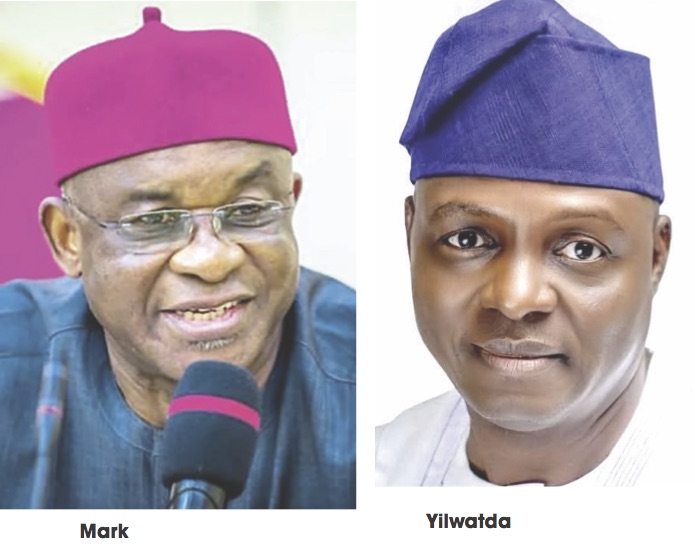
Benue State has apparently become the epicentre of APC’s internal strife, with the ruthless fight going on between the governor, Rev. Fr. Hyacinth Alia and the Secretary to the Government of the Federation (SGF), Senator George Akume. They have not only defied a solution but also led to the emergence of two parallel executives after the state congress. The insoluble battle between the two gladiators has become so fierce that President Tinubu’s hands seem to be tied, judging by his recent intervention in only appealing to them to mend fences.
As a confirmation of the rift, President Tinubu, through Vice President Kashim Shettima, had recently noted: “I want to use this special forum to make an appeal to the SGF and Governor Alia to mend fences and move the state forward. What binds us together, as I have always said, supersedes whatever divides us. The trajectory of global growth is facing Africa, and Nigeria will make or break that transition. Nigeria is greater than all of us. As Martin Luther King rightly said, ‘we either learn to live together as brothers or perish together as fools.’ And we are not a nation of fools. We are a nation of very intelligent, smart people who know their onions,” he appealed.
The list is inexhaustive. The situation is almost the same in Kogi State, where many contending forces, including the removal and replacement of the erstwhile APC state chairman, Alhaji Abdullahi Bello, with Engr. Aliyu Momoh and the imaginary emerging contending presidency-backed Hon. James Faleke-led political force, political observers say, also portends some kinds of danger ahead of 2027.
As for Kano State, the battle is even more intense, with the gladiators contending with the return of Abdullahi Umar Ganduje from the outcome of the state congress, the planned impeachment of the Deputy Governor, Aminu Gwarzo, hiding under allegations of gross misconduct, abuse of office, and breach of public trust, even when it was apparently politically motivated, portends a looming political danger.
The impeachment move came amid heightened political tensions following Governor Abba Yusuf’s defection to the APC and detachment from the Rabiu Musa Kwankwaso-led New Nigeria People’s Party (NNPP).
Unexpectedly, the situation is not different in Lagos, where the newly elected APC state chairman, Cornelius Ojelabi, warned members of his newly inaugurated party officers to shun factional groups and caucuses, insisting that loyalty to the party must supersede all other political allegiances ahead of the 2027 general elections.
In what looked like an intra-party crisis, the chairman had noted: “Irrespective of the groups that you belong to, you just have to set it aside and realise that you are no longer a member of any group, rather, you are a symbol of our party. Don’t let anybody threaten that you belong here or there to survive. They must see you as a free person, a man or woman representing the party. Don’t attend any caucus meetings other than APC meetings.”
But the ominous signs are not only limited to the intra and inter-party squabbles, the scheming is also to consolidate or outsmart each other in all elective political positions, ranging from councillors, local government chairmen, state Assembly, National Assembly members, first term governors to the president, particularly seeking automatic tickets.
However, head or tail, what all the prophets of doom may have to contend with is that, though the blood of many unfortunate innocent Nigerians may flow like the Nwaegene River, the elections will definitely be conducted, and winners emerge before peaceful measures will be deployed to calm the frayed nerves.