Follow Us on Google
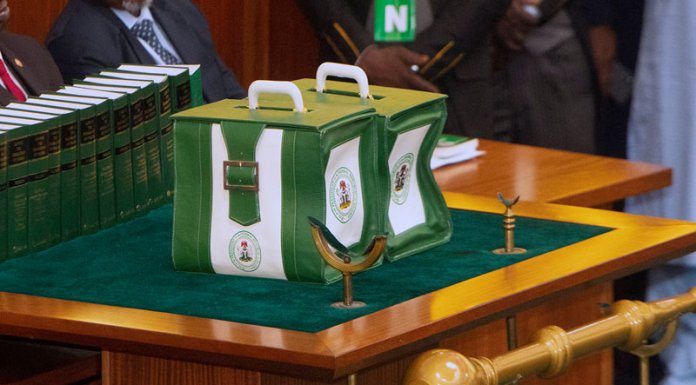
president Bola Tinubu, on December 19, presented N58.18 trillion Appropriation Bill before a joint session of the National Assembly for consideration. A few days later, the Senate raised the original estimate to N58.47 trillion, representing an addition of N292 billion. It said the upward review arose from a “minor miscalculation in the President’s speech and other supporting documents”. Themed “Budget of Consolidation, Renewed Resilience and Shared Prosperity,” President Tinubu said the budget reflects the government’s determination to “lock in macroeconomic stability, deepen competitiveness and ensure that growth translates into decent jobs, rising incomes and a better quality of life across every Nigerian.”
The budget estimate is based on a crude oil benchmark price of $64.85 per barrel, alongside projection of 1.84 million barrels per day (bod), and an exchange rate of N1,400 to the U.S. dollar, as outlined in the Medium Term Expenditure Framework (MTEP). The total expenditure of N58.47trillion includes N15.52trillion for debt servicing. Expected revenue is estimated at N34.33trn, while Recurrent (non-debt) expenditure is N15.25trillion. Capital expenditure is N26.08trillion. This puts the total budget deficit for 2026 at N23.85trillion, representing 4.28 per cent of the Gross Domestic Product (GDP). According to the president, the numbers were not mere accounting lines, but a statement of national priorities, adding that the government “is committed to fiscal responsibility, debt transparency, and value-for-money spending.”
Besides, he listed four key objectives that will guide the budget implementation. These include consolidated macroeconomic stability, improving the business and investment environment, promoting job-rich growth and reducing poverty, as well as strengthening human capital development, while protecting the vulnerable in the society. Defence and Security takes the lion’s share of N5.4trillion; Infrastructure, N3.56trillion; Education, N3.52trillion; Health, N2.48trillion. “The priorities are interlinked, because without security, investment will not work, and without education and a healthy citizenry, productivity will not rise, and without infrastructure, jobs and enterprises will not scale,” Tinubu stated.
These are statements of intent until they are translated to visible, tangible outcomes that will impact development and the wellbeing of the people. It is heartwarming that the president has issued directives to the Minister of Finance and Coordinating Minister of the Economy, Wale Edun, and the Director-General of the Budget Office of the Federation to ensure that the 2026 budget is implemented strictly in line with the appropriated details and timelines. We consider this directive very imperative this time around, especially with the 2024 and 2025 budgets falling far below targets, prompting the National Assembly last week to roll over the 2025 Appropriation Act till March 31, 2026.
Clearly, this offends the spirit of budgeting, which by law is supposed to have a lifespan of one calendar year. This is the first time in Nigeria’s budgeting history that the country will experience such carry-over financial appropriation. The reasons are obvious but unacceptable. It makes a mockery of the budgeting processes and expenditure over-spending. Statistics show that Nigeria’s finances came under intense pressure in the first half of 2025, with the federal government spending a staggering N5.7trillion more than it earned.
Other News
Revenues declined drastically and expenditures ballooned. This is according to data for the Q1 and Q2, 2025 Budget Implementation Reports released by the Budget Office of the Federation. It shows that though the deficits, which the Finance Minister put at N30trillion, they were clearly higher than levels recorded in the corresponding period of 2024. This underscores government’s increasing dependence on borrowing from domestic and foreign markets. This speaks volumes about transparency and accountability in the implementation of budget.
The government should realise that Budget represents the most important legislation to effect desired changes in different spheres of the country’s development, as well as the welfare of the people. A budget that fails to meet its target is not the name. It erodes investor’s confidence and trust in governance. It is no surprise why the 2026 budget as provisioned by President has come under intense criticism from opposition parties and economists. Some have described it as a “debt trap” because of what they called unrealistic projections.
Sadly, the budget relies on borrowing and provides N15.52trillion for debt servicing. This is bound to increase Nigeria’s debt profile to about N180trillion by first quarter of 2026. This is unsustainable. It could further plunge the country into debt trap, with unpleasant consequences. There is also a significant mismatch between government’s claimed revenue performance and the actual revenue generated. That happened in the 2025 budget, when the President bragged that the government had met its projected revenue target in August. Later disclosure by the Finance Minister proved otherwise.
Another concern is that the budget focuses more on consumption, rather than economic diversification beyond oil. It ought to focus more on revamping ailing industries and boosting food production. We call for faithful implementation of the budget with measurable timelines. The mistakes of the 2025 budget will not be repeated.
The budget should impact positively on Nigerians. They expect better living conditions in 2026. The 2026 budget must reduce poverty and cost of food items and petrol. Let the government continue to address the nation’s intractable security challenges until terrorists are defeated.