Follow Us on Google

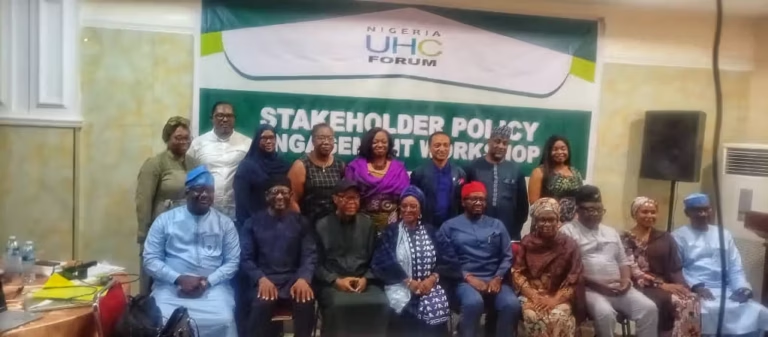
As the 2023 general elections draw nearer with heightened fear, anxiety and tension, the Civil Society Organizations (CSOs) and the the media have been tasked to engage Political leaders even now on health financing in the country.
Since CSOs and the Media are undoubtedly critical stakeholders that help in no small measure to shape the political economy of any Nation, the task of keeping leaders on their toes becomes imperative particularly with the sad declining state of Nigeria’s health care system and Nigeria’s inability to near- achieving Universal Health Coverage (UHC) and health security.
At a discourse with the Executive Director, Centre for Universal Health, Robert Yates, the Civil Society Organizations and the Media were asked to act like never before in line with their mandates to ensure that electorate and political candidates all get it right as Nigerians go to the polls to decide their fate for the next four years or more.
But as a critical driver of the economy anywhere in the world, the health sector has not received optimum attention across different leadership successions in Nigeria, less achieving UHC. They lamented. The reason for this shortfall was due to dearth of strong political will at different levels of government to do the right thing at the right time and place.
Speaking, the Managing Director, Nigeria Health Watch, Mrs Vivianne Ihekweazu, said the meeting was an avenue for CSOs and the media to engage political candidates on active citizenship towards achieving UHC and Health Security in Nigeria as Nigerians decide in February 2023.
“In spite of the health sector being a critical driver of the economy across the globe, it has not received optimum attention across different leaderships. As political parties begin their campaigns, it is important that CSOs and the media engage their candidates as well as citizens,”
For the candidates, she added that this engagement will put into perspective challenges in the health sector and the required policy interventions to change the narrative, noting that this would create an opportunity for citizens to hold the incoming government accountable.
On his part, Mr. Yates said there was a need for the indigent to have access to health as the government must finance the health system and the services must be subsidised for the poor.
Yates also called on the rich to key into the health system for everyone to benefit. He said for politicians to be in power, they should look for feasible ideals such as financing the health system as it affected the population.
“As media, how can you change the political narrative, you can do it, and it does happen, if the politicians and individuals emerge, they will get it. This will involve sensational reporting of people languishing in the hospitals as they need to be catered for, put your heads together and identify the leaders who are willing,’’ he said.
Yates also urged the media to use the languages best understood by the politicians to get them involved in financing the health system. He tasked the CSOs to always play the role of holding the government accountable.
Similarly, the Programme Director, DGI Consult, Grafar Alawode, who shared and reviewed the work done by the UHC2023 forum on Citizen-led health agenda revealed that Nigeria had made some progress in terms of fighting child and infant mortality.
According to him maternal health care requires more health system strengthening of having health care workers and facilities in place. He therefore, called for the incorporation of the role of other sectors in all health design and implementation.
“We must leverage human capital development as a springboard for multi-sectoral and coordinated actions that include health, education, nutrition, WASH, and livelihood sectors,” Dr. Alawode urged.
On a lighter note, Dr. Omokhudu Idogho, Managing Director, Society for Family Health, said there was the need for UHC to be taken to the states level which was going to be critical.
“This is so because, I see situations where a lot of fundamentals at the federal level are soon coming together, some of the laws are in place and how this work will be determined at the state level,’’ he said.
Also, Ifeyinwa Yusuf, Director of Policy and Advocacy, Nigeria Health Watch, said there was need to do more in exploring other internal local resources to increase and pool public financing for health. She said a human capital development approach should be employed in communication to the government to increase funds allocations for health.
“We have to do things differently, by contextualising our interventions, and communication to identify influential men and women who can bring a change in the health space,” she maintained.
Source: NAN