Follow Us on Google
•Time for action, say stakeholders
By Gabriel Dike, Fred Ezeh, Abuja and Aniekan Aniekan, Calabar
Nigeria will join other countries on September 8 to celebrate World Literacy Day. But from statistics, there is little to roll out the drum to celebrate. Stakeholders say the nation’s abysmal performance in tackling illiteracy rate is unsettling . They stress that the situation is further exacerbated by the high figure of out-school-children, which stood at about 20million.
The theme for this year’s World Literacy Day is, “Literacy for people, the planet and prosperity.” This year also marks the 60th anniversary of the observance established by The United Nations Educational, Scientific and Cultural Organization (UNESCO). The theme highlights literacy’s role in promoting inclusion, supporting sustainable futures and expanding opportunities for livelihoods and economic development.
UNESCO in 1967 declared every September 8 as World Literacy Day to draw attention to governments to take drastic action to address the illiteracy level in countries. It is celebrated globally to promote education and awareness. Activities include hosting a school book swap, organizing a community book drive, taking a field trip to a local library for a scavenger hunt, inviting a guest author to speak, or volunteering to tutor someone in reading.
Mrs. Ifeoma Esiri, Co-Founder and Chair, Zaccheus Onumba Dibiaezue Memorial Libraries (ZODML), said: “14.8 million children, according to Federal Government data, are out-of-school; 45.6 million are unable to read and understand, an age-appropriate text by age 10. This translates to 76 per cent, ranging from 47 per cent in the South to 93 per cent in the North. Only 1.20 per cent of our GDP goes to education against UNESCO’s 4-6 per cent recommendation. That is the size of the problem.It is a foundational-learning crisis of exceptional scale.
“Federal Government established HOPE for Quality Basic Education for All (HOPE-EDU) programme to address this crisis and was unveiled in March 2026. HOPE-EDU is a $552 million initiative co-financed by the World Bank and the Global Partnership for Education.
“HOPE-EDU’s objectives are to improve foundational literacy and numeracy, train and mentor teachers, provide teaching and learning materials, expand classroom capacity, and bring out-of-school children (OOSC) into education.
“It is expected that by 2030, learning outcomes will improve for 29 million children as teachers and learning materials are introduced in l50,000 schools and annual school grants are given to reduce pressure on fees and address dropout rates. And that 1.5 million out-of-school children will complete non-formal basic education through the establishment of 10,000 non-formal learning centres; 13,000 classrooms will be constructed in areas where schools are inaccessible or overcrowded; 500,000 primary school teachers will be trained, mentored and their effectiveness measured.
“A March 2026 survey in Kano Ministry of Education in collaboration with Partnership for Learning for All in Nigeria estimated about 870,000 of the state’s projected 6.6 million children to be out of school. Ninety-nine per cent of parents said education is ‘important’ or ‘very important’ for their children.
“This is a key finding, and the survey says the policy message is unambiguous: the out-of-school crisis in Kano State is not an attitude or demand problem… Parents want school for their children; the system is failing to make it accessible, affordable, and of sufficient quality.”
She observed that the top barriers were financial constraints at 22.3 per cent and limited access to schools at 17.2 per cent: “This information matters for how we frame what needs to be done. There is overwhelming demand for education and schools; what we need to fix is the supply end. HOPE-EDU’s annual school grants and classroom expansion are set to tackle these barriers.
“The same survey found out-of-school rates ranging from zero per cent in one Kano LG to 40 per cent in another; researchers noted that concentrating investment in the highest-burden LGs could meaningfully improve the state’s overall out-of-school rate. This sort of disparity is found across the country, with urban areas faring better than rural communities, making HOPE-EDU’s prioritising policy a model worthy of emulation, concentrating resources where the data shows the crisis is most acute.
“So, are we doing enough to reduce illiteracy and out-of-school children? Government has committed substantial resources through HOPE-EDU and the programme is rightly focused on getting children into school and improving what happens inside the classroom. But as a World Bank official has noted, ‘quality instruction is critical for teaching children to read, but the time spent in school isn’t enough: to read with fluency, children need plenty of practice and opportunities.’ Clearly more needs to be done, and the private sector must get involved.”

On what role for the private sector, she noted: “HOPE-EDU represents an unprecedented effort to improve what happens inside the classroom. The next question is what happens when the lesson ends. Does the child have a book? Is there somewhere safe and welcoming to read? Can the child practise the skill that the teacher has just taught?
“For millions of Nigerian children, the answer is still no. This is an opportunity for the private sector to complement the HOPE-EDU programme by investing in the foundational learning resources, such as libraries, that children need beyond the classroom.
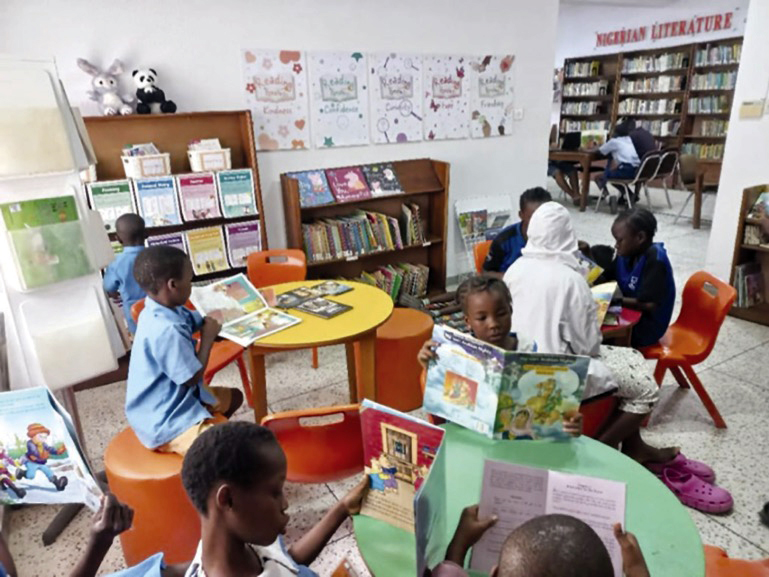
“Libraries will give children, particularly those in underserved communities, more opportunities to read; provide access to books beyond prescribed classroom materials; build reading habits and confidence; support struggling readers; provide a safe reading space; and offer reading programmes and additional opportunities to practise literacy.
“The notion of investing in libraries has a strong policy foundation. The National Policy on Education recognises the importance of functional libraries and reading culture. It expressly requires states, FCT and local governments, as well as school proprietors, to establish functional libraries in accordance with established standards.
“That notwithstanding, estimates put the number of functional public libraries nationwide at about 300, for our population of around 220 million, which translates to a ratio of about 1:700,000. UNESCO recommends around 1:20,000. By investing in libraries, therefore, the private sector will be closing the implementation gap around a national policy aspiration.
“Other things the private sector can support are reading corners in schools, mobile libraries to get books to rural primary schools and reading programmes. As government invests in teaching children to read, the private sector should invest in expanding equitable access to books, reading spaces and reading programmes for primary school children, with priority given to underserved and rural communities.”
President, Association for Formidable Educational Development (AFED), Mr. Emmanuel Orji, said: “The nation is doing more to tackle the illiteracy rate but we are not yet doing enough.”
He observed that the challenge of illiteracy and out-of-school children remains one of our biggest threats to national development and that for the first time in years, “we have the political will, policy direction, and platforms in place to change the trajectory.
“Government is scaling up the National Commission for Almajiri and out-of-school children’s education to mop up children and bring them into formal, non-formal and vocational learning while states are being supported with data to identify and enroll every child. Curriculum review is focused on getting children to read with understanding by primary three. You cannot fix illiteracy at SS3 if the foundation is broken. Teacher training is being retooled for this.”
On community and private sector partnership, he said: “Government cannot do it alone. We are engaging traditional rulers, religious leaders, NGOs, and the private sector to take ownership of literacy in their communities.” He called on parents, schools, media, and communities to see literacy as everyone’s business: “A literate Nigeria is a productive Nigeria. We will get there.”
Rasheed Aderionye, a Professor of literacy and open distance learning, said: “Nigeria is still paying lip service to the promotion of literacy despite persistent efforts by stakeholders to address the country’s persistent literacy challenges, an education. Inadequate funding, shortage of teachers, poor access to learning materials and insufficient support for non-governmental organisations working in the field have continued to undermine efforts to improve the nation’s literacy rate.
“Government needs to provide adequate funding to the National Commission for Mass Literacy, Adult and Non-Formal Education (NMEC) to enable it mobilise learners and effectively support NGOs and other organisations working at the grassroots to promote literacy. While some steps have been taken to address the problem, many of the initiatives are yet to be fully operationalised.”
He cited the establishment of special schools, bilingual schools and other initiatives aimed at expanding access to education as positive steps, but noted that many of the projects were still at the construction stage: “The very steps we have taken, until they are operationalised, are not enough. However, the success of such initiatives will depend on their completion and effective implementation.”
Aderionye, a former Deputy Executive Secretary, Universal Basic Education Commission (UBEC) and Executive Secretary, National Commission for Nomadic Education (NCNE), also acknowledged efforts by government to identify and enroll children who are out of school in the non-formal education system, where they could acquire basic literacy, reading, writing and digital skills.
However, he said, “such interventions have not received the level of support required to make a significant impact, with reference to concerns raised by international organisations over Nigeria’s literacy crisis. Their concerns remain valid because evidently, a large proportion of children enrolled in schools still lack basic reading, writing and numeracy skills. Sadly, the problem is not limited to access to schools, but extends to the quality of teaching and learning taking place within them.
“I raised similar concerns about a decade ago when I noticed that many pupils completing basic education still struggled with basic reading and writing. This means that our teaching has not been effective.” He identified shortage of teachers in many states as another major obstacle to improving literacy outcomes: “Some states have gone for years without recruiting sufficient teachers. When there are no teachers to teach, teaching and learning actually go astray in schools.”
He also identified the absence of reading corners and adequate literacy materials in many schools as a factor contributing to poor reading habits among pupils. And suggested that schools should provide reading corners where pupils could regularly read and develop a culture of reading, while also encouraging them to take literacy materials home for further practice.
He called for greater involvement of non-governmental organisations, community leaders, individuals and the media in promoting literacy, stressing that improving literacy should not be regarded as the sole responsibility of government: “Government should encourage them. In the past, NGOs were very active in this particular programme, but today there are only a few of them actually going out to do it because there has not been enough funding.
“Digital literacy has become an essential component of modern literacy. Government should prioritise the training of teachers and facilitators in digital literacy so they can, in turn, equip learners with the skills required to function effectively in a digital society. If you are not digitally literate now, you cannot even register for the Joint Admissions Matriculation Board (JAMB). You cannot expect the outcome when it comes to examinations. You have to go to CBT.
“Digital literacy is a equally important for adults, particularly in accessing financial services. Digitally literate citizens can carry out banking transactions without physically visiting banks.”
He advocated massive and continuous training of teachers and facilitators, rather than restricting such programmes to individual states or isolated interventions. He also called for stronger advocacy by the media, radio and television stations to promote literacy and digital literacy as part of their public-interest programming.
An Abuja-based educationist, Kamarudeen Olode, expressed mixed feelings regarding the state of literacy among Nigerians, adult and children: “I visited some parts of Nigeria, and was shocked that many adults could not interact and express themselves in English being an official language of communication in Nigeria.
“It is a thing of concern for us all. There has been several efforts and policies by previous governments to fix this challenge, but it seems the progress is slow. UBEC should join effort with NCNE and National Commission for Mass Education to design a three or five-year working plan backed with adequate funding to fight the challenge.
“The world is increasingly being digitised, hence it might be difficult for someone with poor literacy and numeracy skills to survive personally, not to talk of making significant contribution to the society, economically and otherwise.” He urged the Minister of Education, Dr. Tunji Alausa, to infuse the issue of literacy and numeracy in the education sector transformation agenda of the government.
Castro Ezama, former Special Adviser to the Cross River State governor on Education: “Nigeria’s adult literacy rate was approximately 70.4 per cent in 2024, according to the latest World Bank data sourced from the UNESCO Institute for Statistics. This means that roughly seven out of every 10 Nigerians aged 15 and above are classified as literate under the internationally used definition.
“ While this represents an important level of educational attainment, the national average should be interpreted cautiously. It can conceal substantial differences across regions, genders and age groups, while also saying relatively little about the quality of literacy—for example, whether people can comprehend, evaluate and effectively use written information in everyday life.”
Dr. Efio Nyok, a development and communications expert said HOPE-EDU programme which aims to bring over 1.5 million out-of-school children back to school, while over one million have already been enrolled through the Adolescent Girls Initiative for Learning and Empowerment is instructive: “The new Almajiri education policy banning street begging and introducing literacy and numeracy into Qur’anic schools are another bold reforms worth highlighting.
“However, there are structural barriers like multidimensional poverty, insecurity, child labour, early marriage and the disarticulation policy-separating junior from senior secondary schools, which remain formidable obstacles. Strengthening transition mechanisms, expanding social protection, as well as ensuring accountability in the implementation of extant legislation and these reforms will determine whether Nigeria turns the tide on its literacy challenge.”
Frank Ulom, a scholar said: “Literacy is contextual. When I say based on the context that you’re using that term, that terminology, because Nigerians specifically have abused that word. They only believe that only those with formal education, in quotes, someone who goes to school, studies from primary to high school, that is the only person eligible to be called illiterate, while others are illiterate.
“But we’ve seen professors who are illiterate in computer operation, ICT, who are illiterate in mobile phone operation, whose vehicle gets bad and then they have to meet a roadside mechanic. So it means that the roadside mechanic who people are calling illiterate is literate in the mechanic business, in the repair of cars.
“For us to improve literacy in Nigeria, it has to be two ways. We improve on the formal education and the informal education. Yes, because that is what our constitution or even our educational curriculum at the federal level approves both the formal and informal.
“That’s why people go to acquire informal education. They say trade test, you’ve been given a certificate and you can work in the informal sector. So we should improve on that. It shouldn’t only be because not everybody that can afford to send his or her child to acquire formal education. But even an informal education you can see gain literacy.
“For instance, literacy in phone repairs, literacy in ICT, literacy in repairing of cars or vehicles, literacy in house painting, literacy in house building like a masonry or bricklaying, literacy in certain. Let me give you an instance. I have a friend who just left the country about two years ago to the UK.
“Currently she’s doing her postgraduate programme. She has a degree here. But she said it wasn’t the degree that employed her in the UK. It was what? It was skills. Yes, and then the skills she acquired was through informal education. And she said there are a lot of education opportunities in the informal sector.
“So it’s the same thing. With that, the informal sector also has a great sector that can create literacy that employs a lot of people. So they should also be looking through. There are a lot of jobs opportunities in the informal sector. And you and I know even people you cannot come with your formal education when you can’t do this job. Nobody will employ you.
“So that we can improve our literacy. It’s not only by the formal sector. I’m looking at improving on the informal sector. Our literacy status in Nigeria will improve. I think that’s what in most countries. For instance, the person who created created the popular Facebook. The entire world is using Facebook with over two or three billion subscribers. The founder was a dropout. So in Nigeria, they would call him an illiterate. But he created Facebook for everybody, before he even went back to school.
“There are many tech start-ups in the country. Most of them are working with the informal sector to grow it. If we look at that, it will also increase. Let us see literacy in several ways. It’s not only going to school to learn how to speak English, or learn how to calculate mathematics and the rest.”