Follow Us on Google
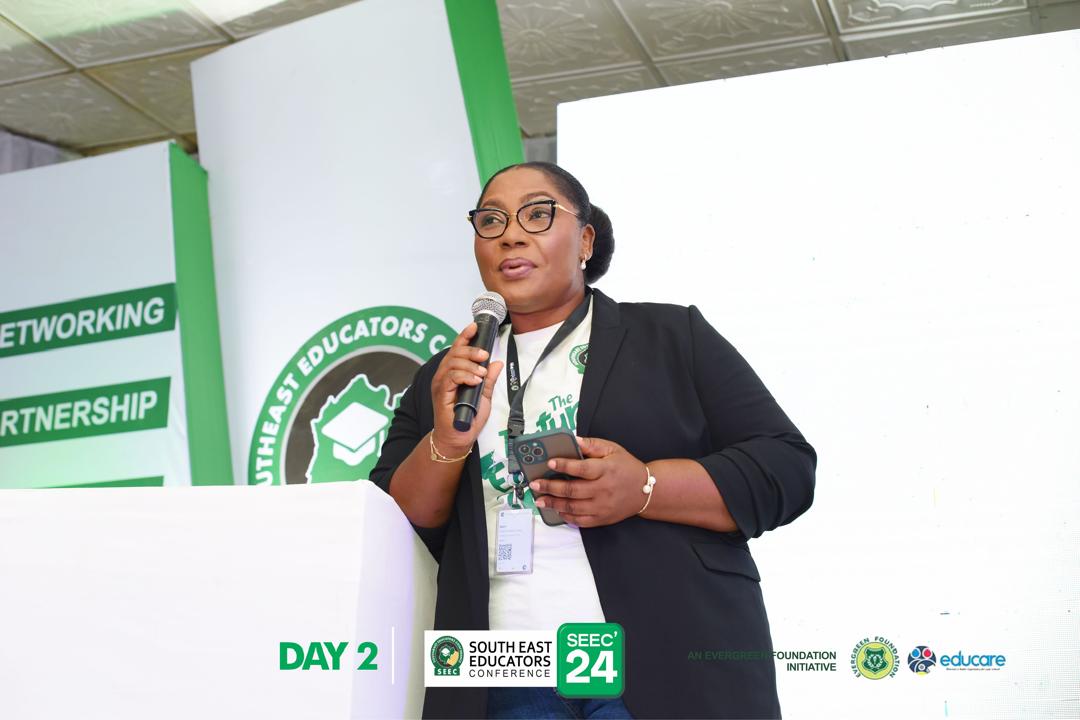

Chinedu-Okoro and Prof. Mbah at the conference
There is a popular saying that ‘education without creativity is equal to illiteracy and backwardness’. Thus, at a defining time of social and cultural transformations in Nigeria, the possibility of developing creative education based on local cultural knowledge and problem-solving capabilities cannot be ignored.
The convener of Southeast Educators Conference (SEEC), Mrs. Doris Chinedu-Okoro said there is urgent need for inclusive educational approach to harness the creative minds in the Southeast Nigeria.
She said that education in the region must have the ability of harnessing the creative minds of the students towards solving societal problems.
The convener of SEEC warned that anything short of this might end up producing “educated illiterates” who can neither become successful entrepreneurs nor prepared for the future of work.
Mrs. Chinedu-Okoro made these remarks at SEEC 2024 held in Enugu State; recently, highlighting that in a world that is rapidly evolving, facing challenges from technological changes to societal shifts, the role of the educator has never been more pivotal.
Addressing the assembly of educators, advocates, and innovators with a common commitment to fostering educational excellence, Chinedu-Okoro, a legal luminary, said that SEEC was set against the backdrop of a vibrant community, which represents a unique opportunity to exchange ideas, share strategies, and reinforce “our collective commitment to shaping the future through education”.
She said that the conference theme, “Future Focused Learning: Igniting the Competitive Edge,” highlights the dual focus of equipping educators with the tools and insights necessary to excel, and crafting learning environments where the students can thrive.
“In a world that is rapidly evolving, facing challenges from technological changes to societal shifts, the role of the educator has never been more pivotal.
“As we navigate these changes, it is your resilience, creativity, and dedication that will mold the next generation of leaders and innovators,’’ she stressed.
In his keynote address titled “Let Us Build and Export Education: A Vision for Southeast Nigeria”, Mr. Osita Chidoka, the Chancellor, the Athena Centre for Policy and Leadership, called on Nigerian educational institutions, particularly Southeast educators, to reverse the growing ugly trend of importing education that is fast gaining acceptance amongst Nigerians of all classes.
Chidoka urged educators to reverse the trend where Nigerians predominantly seek education abroad.
According to him, over 71,753 Nigerians studying overseas, of which about 11,000 are in African schools and only one international student opting for Nigeria.
He emphasised that Southeast Nigeria, with its high literacy rates and robust basic education performance, is ideally positioned to become a leading educational hub in Nigeria and Africa.
Chidoka’s address resonated with the audience comprising school administrators, government officials, education technology professionals, and private school owners.
He outlined several practical policy initiatives aimed at enhancing the global competitiveness of Southeast schools and positioning them as leaders in exporting education.
“Southeast Nigeria could reverse the current trend of educational emigration and instead become a prime destination for global learners if the leaders adopt the measures he outlined amongst other Conference proposals,” he argued.
The keynote speaker urged state governments to bolster education quality through robust inspections and adequate supervision.
On tax reform for educational institutions, Chidoka recommended a simplifying compliance by consolidating taxes into a single system for private schools, thus enhancing ease of business and inviting more investment.
Chidoka added that education system must be benchmarked to globally acceptable standards.
His words: “Adopting international standards and assessments like the Program for International Students”, Nigeria’s former Minister of Aviation said at SEEC’24.
On his part, Professor Ndubueze Mbah, the Commissioner for Education, Enugu State, commended said that in line with the conference “Future Focused Learning: Igniting the Competitive Edge,” experiential learning is a meaningful intervention for the state’s education system.
Mbah, an associate Professor of History at the University of Buffalo, said that Governor Dr. Peter Ndubuisi Mbah’s administration is adopting learning models in experiential learning network to reform the states elementary and secondary schools.
He believes that experiential learning is a durable African solution to underdevelopment and youth empowerment, and is aligned with the UN SDGs.