Follow Us on Google
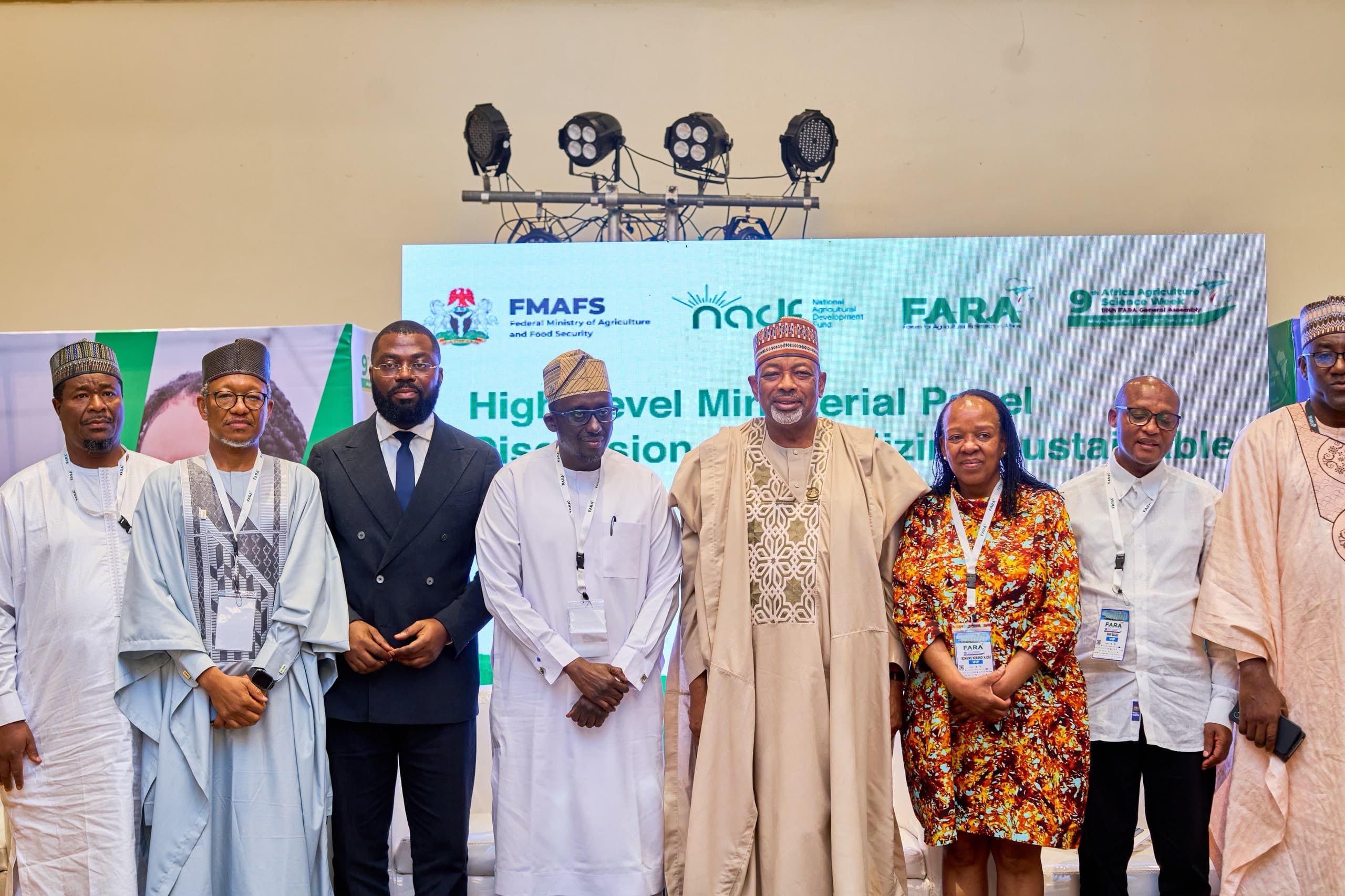
Minister of Agriculture and Food Security, Abubakar Kyari, has attributed declining farm productivity to poor access to quality seeds, inadequate financing, shrinking arable land, climate pressures, and prolonged neglect of agricultural research institutions.
Kyari disclosed that many farmers now resort to planting harvested grains as seeds because they cannot afford certified planting materials, resulting in lower yields and declining productivity.
The minister stated this at a ministerial dialogue on sustainable financing for Agricultural Research, Development and Innovation (AR4D), held as part of the 9th Africa Agriculture Science Week (AASW9) yesterday in Abuja.
The dialogue, jointly organised by the National Agricultural Development Fund (NADF) and the Forum for Agricultural Research in Africa (FARA), focused on the theme, “Financing Africa’s Agricultural Future: Mobilizing Strategic Investments for Science, Innovation and Transformation.”
He advocated a fundamental shift in how Africa finances agricultural research, insisting that sustainable agricultural transformation requires more than increased funding.
The minister said the establishment of NADF represents a strategic intervention designed to reverse decades of underinvestment in Nigeria’s agricultural research system and improve the livelihoods of millions of rural farmers.
Reflecting on his time in the National Assembly, when the NADF Bill was considered, the minister said he supported its creation after witnessing the impact of dedicated intervention agencies in other sectors.
Despite agriculture contributing roughly one-quarter of Nigeria’s Gross Domestic Product, Kyari lamented that rural communities, where most food is produced, have seen little improvement over several decades.
“Eighty-five percent of the food we consume comes from smallholder farmers, yet their living conditions have remained virtually unchanged. That shows there is a structural imbalance in the agricultural economy,” he said.
Other News
Kyari commended NADF for conducting a comprehensive baseline assessment of Nigeria’s 16 agricultural research institutes and 17 colleges of agriculture, describing the exercise as a critical step towards revitalising the country’s research infrastructure.
On his part, NADF Executive Secretary Mohammed Ibrahim, who addressed policymakers, researchers, and development partners, argued that while funding remains important, the continent’s biggest challenge lies in creating an innovation ecosystem that connects research with industry and market demand.
“Financing is not the major challenge. It’s actually an ecosystem challenge,” he said, stressing that agricultural research should go beyond academic publications to produce innovations capable of attracting investment, commercialization and large-scale adoption.
He explained that an effective agricultural innovation system must rest on three interconnected pillars: government institutions that provide policy and funding, research institutions that generate knowledge, and industries that transform research into marketable solutions.
According to him, research financing naturally follows innovations that demonstrate economic value, questioning whether many research projects across Africa are sufficiently demand-driven and aligned with market realities.
“As much as research requires funding, the market also requires research. Financing flows wherever there are returns,” he noted.
Ibrahim also outlined NADF’s funding structure, explaining that the agency receives statutory budgetary allocations, strategic funding from designated levies and natural resource development contributions, while also being empowered to raise capital through investments and philanthropy.
He said the Fund deploys its resources through three major asset classes: debt financing, grants, and equity investments, with lending channelled through participating financial institutions.