Follow Us on Google
•NCC partners relevant agencies to fight cybercrime
By Ngozi Nwoke
The director-general of the Nigerian Copyright Commission (NCC), Dr. John Asien, has disclosed the commission’s intention to partner relevant agencies to encourage the use of copyright to promote creativity in the digital and creative industry. He spoke at a one-day workshop on online management and digital privacy, organised in Lagos by the NCC.
He said: “The aim of the workshop is to share experiences and draw up strategies on the management of online content and the challenges of digital piracy. The federal government has reiterated its commitment to providing an enabling environment for the digital economy to thrive, promote wealth creation, and contribute to national development. The new Copyright Act, 2022, which was signed into law this year, seeks, among other things, to guarantee adequate protection of rights and provide for effective enforcement of those rights, particularly in a digital environment.

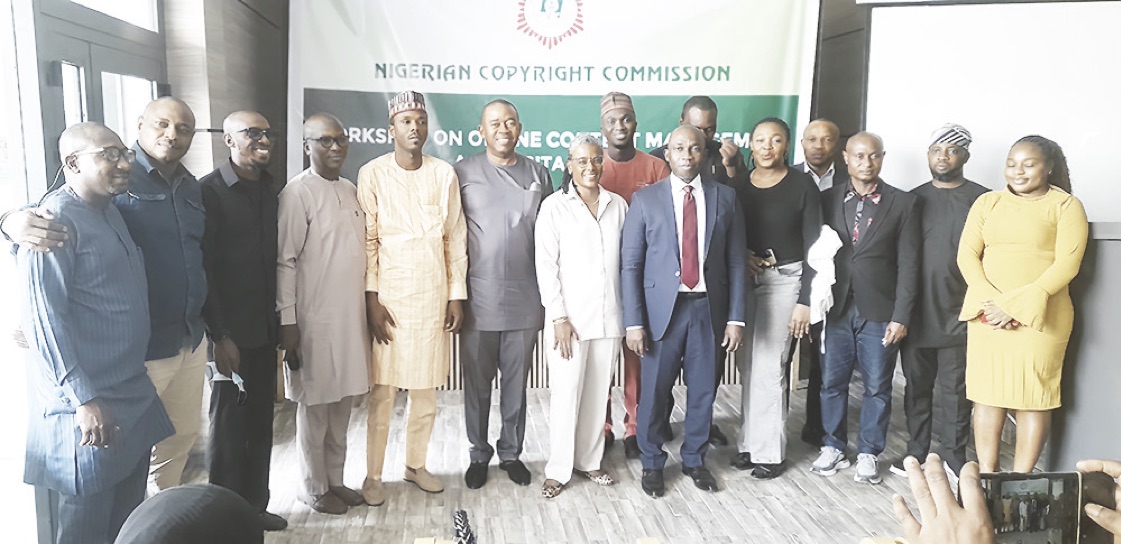
• Participants at the NCC workshop
“The act, which is a product of extensive consultations and robust stakeholder engagement, has as its four cardinal objectives to: protect the rights of authors to ensure just rewards and recognition for their intellectual efforts, provide appropriate limitations and exceptions to guarantee access to creative works, facilitate Nigeria’s compliance with obligations arising from relevant international copyright treaties and conventions; and enhance the capacity of the Nigerian Copyright Commission for effective regulation, administration, and enforcement of the provisions of [the] Act.
“It is against the backdrop of the foregoing that the commission has continued to engage with right owners, users, intermediaries and facilitators to formulate appropriate regulatory and administrative frameworks for the effective implementation of the provisions of the Act. This workshop would focus on the delicate balance between the rights of content creators and the responsibilities of service providers in tackling the menace of piracy online.
“The advent of digital technology has challenged traditional copyright paradigms. More than ever before, creative content, which is the oxygen without which digital technology would be unattractive, is being threatened by different forms of abuses. There is no doubt that Nigeria has enormous potential as a major player in the creative space with huge content creators. Our music and movies have phenomenal appeals across the globe, and our creativity as a people has become legendary.
“Nollywood is said to be the largest private sector employer in Africa, while the creative industry is only next to agriculture as the highest employer of labour, contributing significantly to the country’s GDP.
However, a recent report updated in July 2023 has also confirmed an alarming rise in online piracy across the globe. According to the report, the annual global revenue loss in the movie industry attributable to digital piracy is between $40 billion and $97.1 billion while the illegal downloading of copyrighted materials takes up about 24% of the global bandwidth. It also shows the high propensity in various countries for visit to pirate sites with United States toping with 17.3 billion visits, Russia had 4.5 billion, India 9.6 billion, and United Kingdom 5.8 billion visits.
“While the online piracy of movies may be lower in Nigeria, music piracy is more rampant, with 54.3 million visits in the first quarter of 2022 alone. As on-demand services become more popular, there has been a surge in illegal downloads and mobile piracy all over the world, with more than 87% of those seeking to download music now using mobile devices. Stream-ripping, i.e., the illegal download of files from streaming platforms, which IFPI describes as the “hottest trend in music piracy” is now more common with widely available stream-ripping tools online.
“Instead of paying subscription fees to legitimate sites to access music, millions of consumers resort to pirate sites that offer them adequate service cheaply or free while the pirates are compensated through other means such as advert placements, phishing or other clandestine background activities. With growing internet penetration and lower cost of data, there is every likelihood that Nigeria will experience more copyright abuses unless we nip it in the bud.
“Online piracy poses a serious threat, not only to the creative industry – film, music, books, software, visual art, and broadcasts – but also a threat to national security and critical infrastructure. The risk of malware could easily compromise vital information and threaten the safety of online transactions. Although several reasons may be advanced for the phenomenal rise in illegal downloads and other copyright abuses, the impact is better imagined as right owners lose expected incomes, jobs are threatened, and the nation’s creative economy is threatened. Many musicians and film makers today are unable to recoup the return on their intellectual and financial investments due to the illicit activities of pirates.
“Part VII of the new Copyright Act contains elaborate provisions to safeguard copyright content online. The Nigerian Copyright Commission has also been invested with more powers of investigation, seizure, arrest, and prosecution. The Commission will take proactive steps to ensure that Nigeria is not turned into a piracy hotbed or a hub in the online piracy network. To this end, a Special Online Investigation Unit has been set up to monitor sites, investigate complaints, and enforce online violations. So far, the unit has recorded modest success.
“We are confident that, working with other relevant agencies, it will henceforth more speedily take down infringing materials, block websites, and arrest infringers. It will also be taking steps to control the import, sale, and use of devices that are primarily designed or configured to circumvent technological protection measures. The attention of intermediaries is also drawn to their possible liabilities under the Act for aiding or procuring others to commit an offence under the Act in which case they would be liable to the same punishment as prescribed for the commission of the main offence.
“I urge participants to take full advantage of the experience and expertise of the resource persons and come up with recommendations that would enhance the management of content and protect the rights of authors in the online environment.
We are glad to have the representatives of the Office of the National Security Adviser (ONSA), the National Information Technology Development Agency (NITDA), the Economic and Financial Crimes Commission (EFCC) and other partner agencies. As first responders, we will leverage on available expertise, benefit from training and technical support, and ensure seamless implementation of the provisions of the Copyright Act.
“We must begin to encourage and promote legitimate and serious platforms. For instance, if it was possible to stream a Netflix movie, and you are able to distribute it on your own site, and anybody can go there and watch it for free, then Netflix will not be encouraged to invest in those movies. So eventually, it will affect the Nigerian movie industry. Someone would have invested in those legitimate platforms. That’s why we often say that the three purpose of pirates, is to steal, destroy and kill creativity. They steal from the rightful owners, and eventually destroy the creative economy.”
The first speaker and NCC’s lawyer, Mrs. Sandra Oyewole, spoke on the protection of digital content under the copyright law. She disclosed that the commission is galvanizing the Nigerian Ports Authority (NPA), Association of Nigerian Authors (ANA), the NCoS, Performing Musicians Employers Association of Nigeria (PMAN) and the Society of Nigerian Artists (SNA) to facilitate the reformation, rehabilitation and reintegration of inmates through creative activities.
She said the move is to facilitate the reformation, rehabilitation and reintegration of inmates through creative activities for inmates of correctional facilities.
She said: “A lot of abuses are coming up online. So, it is only appropriate that as the regulatory body and enforcement agencies in Nigeria, we should find the right strategies to reduce piracy online. That is what we are here to address.
“It is a fact that the commission will be stronger and we will go the extra mile to ensure that the creative industry is allowed to fully harness the digital ecosystem or the digital platforms available. If you don’t do that, it doesn’t matter how much content we create as a country.
“It doesn’t matter how good we are as a people. If the environment is not conducive, you will end up putting money more in the hands of pirates and those who are doing the investment intellectual and financial investment. We don’t get a return on the investment.
“If you are not getting it right, what should then happen is that you will find people who will be using Nigeria or Nigerians as the pawns. So, you will first find pirate sites that are not busy in Nigeria but because you know Nigerians will consume those contents, they make them available to Nigerians, and every time you download those materials, two things could happen.
“One is that you expose yourself to all kinds of risk or they also use those avenues to introduce malware, to breach security to so what they cannot get from you scamming, they will do it by giving you free video or cheap video.
“We should not encourage that. But like we’ve been told here, we must start by doing more in-depth enlightenment, and this is part of the enlightenment. So that the service providers, the telcos, the backbones will know what the issues are, and then they will help us when we now want to enforce because under the law, we have the powers not just to block but also to bring down or to achieve that. “You need to work with the backbones, as it were. Apart from having the Copyright Act, which kicked in on the 17th of March this year, we have also gone ahead to establish an online enforcement unit in the commission.
“We have begun to talk with different stakeholders. We have this collaboration with other agencies. For instance, the NCC is working with the office of the National Security Adviser. We are working with the other NCC communications commission.
“We are working with the EFCC because very often when you are choosing a pirated domain, it gets to a point where he goes into the alley, you won’t be able to track him, but some of that agency may be able to track him in an instance, if you are able to get to the point where his financial dealings, you have some information, you can take him through the process of crime Act, seek the help or support of the office of the NSA. So, without collaboration, you are unable to track such a pirate wherever he or she goes.”
Frikkie Jonker, second speaker and anti-piracy director for a cyber and broadcasting company in Africa, warned about the dangers of online piracy in the creative industry.
He said: “The purpose of this event today which was hosted by the NCC is to actually draw attention to the public out there of the dangers of the main pirate domains, and also internet streaming pirate operations out there as well. The main issue here was to get the support of backbone internet providers. Just a quick definition. What is it backbone internet provider? Those are the people that bring actual data into the country and then resell it to ISPs.
” So, the purpose of this workshop was to actually talk to backbone Internet providers in Nigeria, and to explain to them the dangers of allowing these pirated domains to be accessed via their networks and to urge them to fight the pirates with us to block those infringing domains.
“Today, I’m standing and actually advocating for hard working content creators. We are here assisting the NCC to see collectively how we can go about fighting piracy. When it comes to digital piracy from a streaming piracy point of view, and also from a domain piracy point of view, we want to see how to actually address the menace, because the negative impacts of domain and events during piracy, is huge.
“It is a revenue and tax loss that the creative industry suffers because of piracy, but the biggest issue is how you expose yourself as a family when you entertain these unscrupulous domains.
“What happens is that if you start accessing these pirate domains, you actually give access, knowingly or unknowingly, to these pirates, and by doing that, you actually give them access to your computer, you give them access to your home, because once they actually get access to your laptop, to your computer to your phone, and if just think to yourself, what is on your phone today that is sensitive? A lot of things are on your laptop. My whole life is on my laptop, my social security number, my policies and my bank account details.
“By accessing these unauthorised and unsecured platforms, you are actually allowing people to get access to your personal data. That is why I call upon mothers and fathers to protect their children and families against this type of piracy. The NCC has got the power to enforce the act. So, by what the DG of the NCC has said as well, there’s a new law, we have the power to act. We don’t want to just go in with a sledgehammer. We want to talk to the people and say, ‘these are the dangers.’
“So, when we come to you, and we say block infringing domains; they don’t have to start the education process afresh. It has happened today already, and people now know what role they have to play, but in the remarks of the DG, what’s very important is that the ones that will work with them will work with them, but the ones that will not work with them, will work with them in a different manner.
“The NCC should protect the customers at the end of the day. Do you work with the ISPs block infringing domains? They should work with the police, work with the cybercrime, work with the EFCC, continue the movement to still continue the fight against piracy. But now, probably one of the most effective copyright laws in Africa is in Nigeria. Please, let’s use the law to fight these pirates.”