Follow Us on Google

From Fred Itua, Abuja
With less than nine weeks remaining to the conduct of the presidential and National Assembly elections, the Independent National Electoral Commission (INEC) is contending with a convergence of pressures. Within a single month, the commission has acknowledged that Artificial Intelligence (AI) generated photographs entered its preliminary voter register, confirmed that 54 of its own personnel across 10 states are facing disciplinary action, and has seen its chairman, Professor Joash Amupitan, surrounded by demonstrators outside Chatham House in London.
Behind these episodes lies a longer sequence of events; opposition parties that have demanded the chairman’s removal since April, a contested court judgment touching the principal opposition party, and the record of the 2023 election, when the commission’s result viewing technology encountered difficulties at a critical stage.
This analysis sets out, in sequence, what has been alleged, what INEC and its chairman have stated in reply, and what the public record currently shows. It is organised around a single question, whether a commission whose chairman has stated that it is still recovering from a loss of public trust can, in the time remaining, assemble the confidence on which the acceptance of any result ultimately depends.
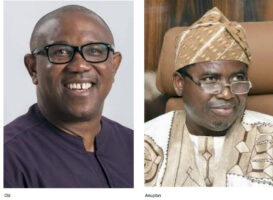
The chairman and the question of neutrality
Amupitan, a professor of law and Senior Advocate of Nigeria, was nominated by President Bola Tinubu on 9 October 2025, approved by the Council of State, confirmed by the Senate a week later and sworn in on 23 October 2025, succeeding Professor Mahmood Yakubu. The constitutional process was followed.
In a letter dated 8 April 2026, the African Democratic Congress (ADC) called for the chairman’s immediate resignation or removal, alleging misconduct and abuse of office and stating that INEC had abandoned neutrality. The party’s caucus in the House of Representatives subsequently demanded his removal and prosecution, describing the commission’s handling of the ADC leadership as undemocratic. On 25 April, a national summit of opposition parties in Ibadan, whose communiqué was signed by the chairmen of the Peoples Democratic Party, the Labour Party, the New Nigeria Peoples Party and the ADC, passed a vote of no confidence in him. The summit also requested the National Assembly to review the Electoral Act 2026 and described INEC’s timetable guidelines as obstacles that constrained opposition parties.
A separate controversy arose on social media concerning an account bearing the handle @joashamupitan, which was alleged to have expressed support for the All Progressives Congress (APC) during the 2023 campaign, including a reply of three words, “Victory is sure”, to a post by the party’s national youth leader. INEC stated on 10 April that fraudulent accounts had been created in the chairman’s name. The commission’s Director of Information and Communication Technology later said that no verified forensic evidence linked the chairman to the account.
At Chatham House on 12 November, 2026, Professor Amupitan stated that he had never operated an X account, that an independent forensic review had been obtained, and that the matter had been referred to the Department of State Services (DSS)and the Inspector-General of Police (IGP). He rejected claims that he had served on President Tinubu’s legal team or misrepresented his academic credentials, stating that security agency inquiries had found those allegations unfounded. He explained that earlier professional engagements in political disputes had been undertaken as a Senior Advocate before his appointment, and said he would accept no appointment from any quarter after leaving office.
The forensic report has not been published. The findings of the security agency inquiry have been described only by the chairman. The public record therefore consists of the allegations on one side and the commission’s and chairman’s responses on the other.
The ADC dispute and judicial proceedings
A central point of friction has been the leadership crisis within the ADC. Following a Court of Appeal order that the status quo ante bellum be maintained, INEC removed the names of the David Mark led National Working Committee from its portal. Opposition figures characterised this step as rendering the party inoperative. The commission’s chairman stated in an interview with Arise News that it had received conflicting communications from rival factions, that the courts rather than the commission should determine the rights of the parties, and that it was not party to any design to create a one party state.
The Supreme Court later set aside aspects of the earlier rulings, after which INEC restored recognition to the Mark led leadership, while the substantive suit remained before the Federal High Court.
On 5 November, 2026, Justice Peter Lifu of the Federal High Court in Abuja, nullified the Mark-led leadership and the decisions taken under it, including the primary that produced former Vice President Atiku Abubakar as the party’s presidential candidate. The ADC has appealed and applied for a stay of execution. Its counsel contends that the judgment did not expressly invalidate Mr Abubakar’s candidacy.
Speaking in London, Professor Amupitan described the question of the former vice president’s eligibility as “a very big issue”, stated that INEC is bound by Section 285 of the Constitution to obey court orders, particularly those of the Supreme Court, and disclosed that the commission is defending more than 300 court cases with the election approximately two months away. He added that INEC had pressed for an accelerated hearing when the leadership dispute arose in April.
The commission’s stated position is one of compliance with court orders. The calendar, however, means that the identity of a leading opposition candidate may remain subject to judicial determination close to election day, at a stage when ballot production and logistics normally proceed on the basis of settled candidate lists. The dispute has also become a principal reference point in opposition commentary on the commission’s other decisions.
The voter register and AI-generated photographs
In October, the preliminary voter register was placed online. Screenshots of suspicious photographs circulated on social media. INEC acknowledged the concerns the following day and later attributed some of the irregularities to its own registration officers.
On 9 November, Professor Amupitan announced that the commission had removed 1,609,553 records from the register following a nationwide clean up that uncovered multiple registrations, manipulated photographs, irregular registration patterns and records belonging to deceased persons. He confirmed that cases involving manipulated images had been identified and that the access points used to introduce them had been traced. He observed that a single compromised password was sufficient to open the door.
Other News
Fifty four registration personnel across 10 states were identified as complicit and are now facing disciplinary action, including possible prosecution. Two days later, National Commissioner Mohammed Haruna told a webinar organised by the Punch Media Foundation that a large number of AI-generated photographs had been posted to the register and removed. He stated that the commission had limited control over members of the public who enhance their pictures before uploading them, and greater control over violations committed by its own staff.
The commission has discontinued the use of external webcam based image uploads in favour of an approved application that captures photographs directly. The chairman has stated that an AI governance framework has been approved. On 11 November, Mr Haruna described the commission’s AI policy as developed but still being finalised.
INEC has not stated how many photographs were AI-generated or how many staff credentials were compromised. It has not indicated whether the 54 officials are the same individuals responsible for the synthetic images, although it confirmed that all of them are its employees. The chairman has said that security agencies are conducting their own investigations and that the commission is “not covering anything”. No published breakdown of the 1.6 million deletions by category or by state has been released.
The register forms the basis for accreditation, voting and result reconciliation. On the commission’s account, the breach originated within the registration chain. The clean up has been presented by INEC as evidence of corrective action. Others have previously argued that register revalidation exercises carry risks of disenfranchisement and have called for independent verification of the process.
The Chatham House episode
On 12 November, Professor Amupitan attended a dialogue at Chatham House organised in partnership with the Kimpact Development Initiative on the theme of Nigeria’s 2027 elections and regional stability. As he left the venue, Nigerians in the diaspora surrounded his vehicle, pressed against it, held up papers and placards, and demanded that he speak to them. Videos circulating online show the crowd shouting accusations and demanding his resignation. The protesters cited alleged irregularities in the preliminary voter register, including the AI-generated entries, and accused INEC of failing to provide satisfactory explanations. The chairman remained in the vehicle and made no audible response.
The protesters were private citizens resident abroad. Their stated grievance concerned the voter register. Inside the hall, the chairman acknowledged that the controversies surrounding the 2023 presidential election produced a “significant trust deficit”, damage so large, in his words, that the commission has not yet fully recovered from it. He then asked Nigerians to trust his leadership to deliver a free, fair and credible election.
The 2023 election and subsequent measures
In 2023, INEC had stated that results from polling units would be uploaded to the IReV portal in real time. According to the European Union Election Observation Mission, presidential result forms began to appear only after 10pm on election day and had reached 20 per cent by noon the following day. The mission concluded that INEC lacked efficient planning and transparency at critical stages and that trust in the commission was further reduced on election day.
Yiaga Africa described the delayed uploads as a disregard of the commission’s own regulations. Professor Mahmoud Yakubu, former INEC chairman, later admitted that glitches had occurred in transmitting presidential results through IReV and expressed regret for the delays. Opposition parties and some observers alleged malpractice, which the commission rejected.
Professor Amupitan told the London audience that a post 2023 audit traced the most acute result management failures to collation centres rather than to polling units. The commission has devised a technical safeguard under which a polling unit result that is inaccurate, or that shows over voting, will not be uploaded to IReV. INEC has stated that administrative reforms allowed it to announce the results of the Anambra and Osun governorship elections the day after voting.
A nationwide mock accreditation and result transmission exercise has been scheduled for 28 November. The commission has opted to upgrade existing technology rather than introduce a new system, citing the limited time before the poll.
The safeguard is designed to prevent inaccurate figures from reaching the public portal. It does not specify how a blocked result will be publicised, reconciled or corrected. Off cycle elections are conducted on a smaller scale than a presidential poll. The 28 November exercise will be the first national scale test of the upgraded systems and will take place approximately seven weeks before voting begins.
Funding, litigation and the Electoral Act
INEC put the cost of the 2027 general elections at approximately N873.78 billion when it presented its estimates to the National Assembly in February. The Electoral Act 2026 requires that election funds be released at least six months before the poll, a deadline that fell around July 2026. In June, the commission stated that it had yet to receive the allocations earmarked for the elections.
At Chatham House, the chairman said INEC had received a substantial portion of the budget and had been assured that the balance, part of which is intended for the recruitment and welfare of ad hoc election staff, would be released before the end of November. The outstanding sums have not been stated publicly.
The chairman has disclosed that the commission is defending more than three hundred court cases. Some of these cases concern candidate eligibility and party structures. Their resolution is subject to judicial timetables.
The Electoral Act 2026, signed on 18 February, gave statutory recognition to IReV and compressed the election timetable, moving the presidential poll from February to 16 January. Section 60(3) provides for electronic transmission of results but allows the signed manual Form EC8A to prevail where transmission fails because of communication failure. The provision was enacted by the legislature. The commission is the body required to apply it.
The position at present
The acceptance of an election result rests on confidence in the register, the candidate list, the personnel who administer the polling units, the technology that records and transmits the count, and the neutrality of the body that announces the outcome. The events of the past month have affected several of these elements. The commission has itself acknowledged a residual trust deficit from 2023.
INEC has removed more than 1.6 million records from the preliminary register, identified 54 personnel for disciplinary action, altered its image capture process, scheduled a national mock exercise, and reported faster results in recent off cycle elections. The public record does not yet contain a detailed breakdown of the deleted register entries, the findings of the forensic inquiry into the social media account, a final determination of the ADC candidacy dispute, confirmation of the full release of election funds, or evidence of the transmission system’s performance under national scale conditions.
The chairman has stated that the commission is working to deliver a free, fair and credible election and has asked for public trust. The remaining weeks will show the extent to which the outstanding questions are addressed through further disclosure, consistency of statements, and the conduct of the scheduled national test.