Follow Us on Google
By Stanley Uzoaru, Owerri
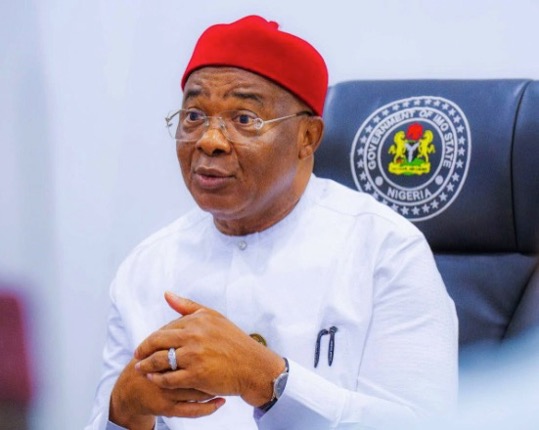
Governor Hope Uzodimma of Imo State is in the middle of one of the trickiest political balancing acts in Nigeria right now. He wants to jump from Douglas House to the Senate in 2027, but the calendar, the Constitution, and his old rival Rochas Okorocha are all pulling the rope in different directions.
His greatest undoing could be his timing problem; governorship vs Senate resumption. Uzodimma began his second term as governor in January 2024, and that tenure runs until January 2028. The problem is the 11th National Assembly is scheduled to be inaugurated in June 2027. That leaves roughly seven months where he would legally be both governor and senator-elect.
Section 183 of the 1999 Constitution is clear on this point, “The Governor shall not, during the period when he holds office, hold any other executive office or paid employment in any capacity whatsoever”. Legal analysts have said the implication is straightforward, if he wins the senatorial election he must resign before being sworn in as senator.
Officials in his government have already floated the workaround: Uzodimma would vacate office for the deputy governor to complete his second term. That solves the constitutional clash, but it opens a fresh political one.
This is not Uzodimma’s first dance with the Red Chamber. He was senator for Imo West from June 2011 to June 2019 before the Supreme Court judgement brought him to the governorship in January 2020. Now he is going back for the same Imo West seat, and it has turned into a war of titans within the APC.
In the May 2026 APC primary, Williams Kayode, chairman of the Imo APC National Assembly Primary Election Committee, declared Uzodimma winner with 230,464 votes.
Scaling this hurdle could also be determined by Okorocha’s latest spanner thrown at Uzodimma to scuttle his chances at the Senate . Former Governor Rochas Okorocha, who held the Imo West seat from 2019 to 2023, is not conceding. On August 13, 2026 he filed suit FHC/ABJ/CS/1854/2026 at the Federal High Court in Abuja naming INEC, Uzodimma and the APC as respondents.
Okorocha’s case rests on two legs. First, he claims he actually won the primary with 150,780 votes to Uzodimma’s 102,158, and he is asking the court to set aside INEC’s publication and declare him the candidate.
Secondly, Okorocha is challenging Uzodimma’s eligibility to contest while still governor, citing Section 183. He argues the governor cannot validly be a candidate for a seat he would be constitutionally unable to occupy on inauguration day.
Other News
For the Imo APC, the case has opened another front in the long-running Okorocha-Uzodimma rivalry, and the outcome will determine not just who flies the party flag in 2027, but how Uzodimma’s post-government future unfolds.
Handover to the deputy or a loyal replacement? Here is where the tight rope gets thinnest. If Uzodimma wins and resigns in mid-2027, power passes to his deputy to serve out the remaining months until January 2028.
But Imo politics rarely allows a deputy to simply inherit. Uzodimma is also keenly interested in choosing his successor for 2028, and that brings in the controversial “charter of equity” debate within Imo APC. The charter, pushed by various stakeholders, argues for rotational power among the three senatorial zones. Uzodimma’s own zone, Owerri, had the governorship before him, and many Orlu and Okigwe voices insist it is now their turn.
Sacking the current deputy and installing a loyalist as acting governor for those last months would give him direct control over patronage, appointments and the party structure heading into the 2028 governorship race. It would also be read as an attempt to anoint a successor outside the equity conversation, and could trigger another round of intra-party rebellion.
Leaving the deputy in place is safer constitutionally, but riskier politically. A deputy with seven months in office and the powers of incumbency could become an independent power center, or be courted by other governorship aspirants.
Legally, the path is narrow. He cannot hold both offices, so resignation is inevitable if he wins. Politically, the path is narrower. He has to beat Okorocha in court, manage the APC primaries without fracturing the party, and then decide whether to trust his deputy or gamble on a handpicked loyalist for the transition period.
That decision will signal a lot about 2028. If he prioritizes the charter of equity, he may have to cede influence. If he prioritizes control, he risks alienating zones that feel entitled to power.
In short, Uzodimma is walking the tight rope: one misstep on the legal timing, one miscalculation on the deputy, and the ambition to move “to the next level” in the Senate could end up costing him influence over who succeeds him in Imo.
To many political analyst, Uzodimma’s fate is hanging like a Yoyo , who can tell his biggest risk alone right now, the court case with Okorocha or the succession fight inside the APC or even his charter of equity succession plan ?