Follow Us on Google
In a country where crime is rampant, kidnapping has become a daily news item, and bandits walk the land like kings, the fate of those who once stood between society and chaos is nothing short of a national disgrace.
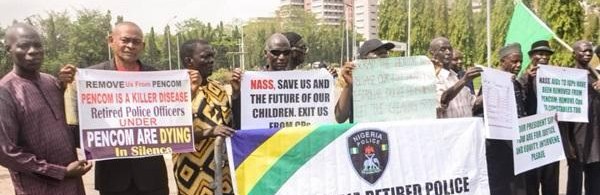
Retired police officers, men and women who dedicated their youth and risked their lives for the Republic, are today protesting in the streets, begging not for handouts, but for dignity.
They stood in the sun for years, wearing faded uniforms and bulletproof vests that barely stopped a stone, let alone a bullet. They guarded banks, hunted robbers, survived ambushes, and protected the high and mighty. But today, they stand in protest—retired, broke, and betrayed by the nation they once vowed to serve. Some live on ₦70,000 a month. Others receive just ₦20,000. Former commissioners of police—the apex of a police career—are managing with stipends that can’t feed a family for a week. What then do you expect the rank and file to receive? Misery. And in the shadows of this misery, something deadlier lurks: corruption, bitterness, and insecurity.
The recent protests by Nigerian police retirees are not just a demonstration of pain; they are a warning shot to a government deaf to suffering and blind to consequences. A nation that starves its veterans cannot demand sacrifice from its young. And a police system that punishes its own after service cannot expect loyalty before retirement.
From the image of the Weekend newspaper I read last week, a retired commissioner of police, after decades of service, reportedly receives ₦70,000 monthly pension—a figure many casual workers in Lagos already exceed in daily gig work. More appalling, many former inspectors, sergeants, and rank-and-file police personnel receive as little as ₦20,000 monthly.
According to the retired Assistant Inspector General of Police (AIG), Ambrose Aisabor in the Weekend newspaper, the contributory pension scheme has forced police retirees into poverty, and many have died from preventable illnesses due to lack of funds. Some retired officers are unable to afford rent, buy medication, or pay for transportation. Their reward for risking their lives for Nigeria is a life of penury and humiliation.
Let us place this in context: ₦20,000 is equivalent to roughly $13 per month. The minimum cost of a 50kg bag of rice in Nigeria as of July 2025 is over ₦80,000. Basic healthcare, accommodation, and food are now luxuries that many retired police officers cannot afford. And all of this while some ex-governors and senators walk away with millions in monthly “pensions,” multiple cars, and luxury homes funded by state treasuries.
Why Are Police Retirees Suffering This Fate?
There are two main primary reasons:
First, The Contributory Pension Scheme (CPS) under PENCOM, introduced during the Obasanjo administration, mandates that workers and government contribute a percentage of salaries toward retirement. But police officers argue that unlike their military counterparts, they are poorly paid and inconsistently supported during service, and the deductions do not reflect their service risks. Worse, many say their remittances were not properly accounted for by Pension Fund Administrators (PFAs).
Second, Police were excluded from the special military retirement system. While army retirees benefit from a more structured and generous pension payout system, police officers—despite working in similar dangerous environments—are lumped into the general civilian scheme, which is poorly managed and rife with complaints.
Injustice Within the Uniform: Why a Commissioner Gets ₦70,000 and an Inspector ₦20,000
This inequity reveals deep cracks in Nigeria’s public service compensation framework. While it is expected that those in higher positions receive slightly better pensions, the gap between ₦20,000 and ₦70,000 is criminally wide—and both amounts are still absurdly low in any modern economy.
This distorted compensation scale results from: Poor initial salaries during service, which affects final pension computations, Non-remittance or mismanagement of pension deductions by corrupt officials, and a deeply flawed contributory scheme that lacks transparency and accountability.
When you pay your security agents like beggars, don’t be surprised when they start behaving like thieves. Many police officers, knowing their retirement will bring only suffering, begin to extract bribes, abuse authority, and weaponize their uniforms for personal gain while still in service.
This systemic impoverishment fuels: Petty corruption: roadblock extortion, illegal bail fees. Grand betrayal: leaking of operational secrets to criminals. Internal resentment: moral disengagement from law enforcement ethics. In essence, Nigeria is breeding insecurity by institutionalizing injustice in its police system. And this isn’t just a police issue—it’s a national security crisis.
African Parallels: How Other Countries Honour Their Uniformed Veterans
Nigeria’s disgraceful handling of police retirees becomes even more unforgivable when compared with how other African nations treat theirs. In many countries where governance still carries a semblance of accountability, the men and women who risk their lives for national security are not discarded like broken tools.
Ghana: A Model of Modest Dignity
In Ghana, the police pension structure is governed by the Social Security and National Insurance Trust (SSNIT) and the Pensions Act 2008. A retired Superintendent earns between ₦250,000 to ₦300,000 equivalent per month in Nigeria, depending on years of service. Pension payments are regular, with automatic inflation adjustments. Retired officers are also entitled to free medical checkups, subsidized medications, and transport allowances.
It is telling that Ghana, a country with fewer resources than Nigeria, does more to protect its protectors. The lesson here? It is not about wealth—it is about will.
South Africa: Honoring Service with Substance
South Africa treats its uniformed retirees with dignity. Through the Government Employees Pension Fund (GEPF), retirees from the South African Police Service (SAPS) and the SANDF (South African National Defence Force) receive generous pensions—often no less than R6,500 monthly (about ₦500,000 equivalent). That’s in addition to gratuities, retirement bonuses, and free medical aid via the PERSAL scheme.
The difference is that the South African government sees pensioners as state assets—not liabilities.
Kenya: A Struggle, But With Progress
In Kenya, the National Police Service Commission (NPSC) has initiated reforms that ensure retirees are paid promptly and well. Retired officers receive pensions ranging from KSh 30,000 to KSh 150,000 (₦200,000 to ₦900,000), depending on rank. The government also provides access to public health services, community housing schemes, and veteran programs.
Uganda
Even in Uganda, a country with fewer resources than Nigeria, the government recently increased pensions for police officers. A retired Assistant Commissioner earns about UGX 1 million (₦300,000), while lower ranks earn UGX 600,000 or more. Moreover, the government introduced a “Veterans Welfare Fund” to support families of retired security personnel.
Why Nigeria Fails: The Architecture of Neglect
The failure of Nigeria’s police pension system is rooted in three key problems:
Firstly, Dual Pension Schemes – The Nigeria Police operates both the Contributory Pension Scheme (CPS) under PENCOM and the Defined Benefit Scheme (DBS) for older officers. Many fall between the cracks or are caught in transition, leading to payment delays, confusion, and loss.
Secondly, Corruption – Embezzlement in the pension sector is legendary. The Police Pensions Office was once looted to the tune of over ₦24 billion. No significant reforms followed. The system remains porous and vulnerable.
Thirdly, Lack of Political Will – Unlike the military or customs, the police have no powerful lobby at the top. No former IGP has ever been appointed Minister of Defence. The police remain underpaid, underfunded, and underrepresented.
Palliatives Instead of Pensions
In Nigeria today, palliatives have replaced pensions. What was meant to be a systemic reward for service has become a one-off bag of rice, distributed with fanfare and photographs, as if hunger can be postponed with a carton of Indomie and a sachet of vegetable oil.
What we are witnessing is a calculated neglect—a deliberate institutional abandonment of men who once guarded the gates. Instead of being honored with robust pension systems and monthly gratuities, retired police officers are now added to the same list as widows, flood victims, and IDPs, handed political crumbs during campaign seasons.
How did we get here?
The Nigerian pension system has gone through multiple reforms — all ambitious on paper but fragile in execution. In 2004, the Contributory Pension Scheme (CPS) was introduced under the Pension Reform Act, managed by the National Pension Commission (PENCOM). While the military and intelligence agencies opted out and maintained their independent structures, the police were forced into CPS without adequate preparation or transition arrangements.
The result? A chaotic pension landscape where officers are unsure whether they fall under the old Defined Benefit Scheme (DBS) or the CPS. Many retirees are yet to receive their gratuity, while those under CPS lament the paltry sums that cannot match inflation.
Worse still, the Police Trust Fund, meant to cater to welfare and pensions, is more active in purchasing new Hilux vans and ceremonial uniforms than in improving retirement conditions. When inflation meets a fixed pension, it is the retiree who pays the price.
Furthermore, everywhere you look, loyalty to Nigeria is punished. Civil servants are abandoned. Teachers are owed. Doctors are poached by other countries. But none suffer as silently as police retirees. They live like ghosts among us — once feared in uniform, now forgotten in rags.
This is why corruption festers. A constable who knows that he will retire into poverty has little incentive to reject bribes. A DPO who watches his former Oga turned Okada rider understands that loyalty is for fools. When a nation criminalizes loyalty and rewards political gangsterism, it loses its moral fabric.
Over the years, Nigeria has announced dozens of reform efforts: The Police Pension Reform Task Force (2008), The Contributory Pension Adjustment Directive (2014), The Presidential Pension Reform Audit (2017), The Transition Management Plan under PTAD (2021), and The IGP’s Welfare and Cooperative Scheme (2023). And yet, nothing changes.
Pensions are still delayed. Gratuities are still withheld. No comprehensive health insurance exists. No housing schemes for retirees are active. No functioning database of widows and next-of-kin exists. It is all bureaucracy and broken promises.
A Glimmer of Hope? Maybe. Maybe Not.
In 2024, the National Assembly proposed a “Police Pension Protection Bill” aimed at improving post-retirement welfare. But like many bills before it, it stalled at the committee level.
Several state governments, like Lagos and Rivers, have also initiated state-level pension top-ups for security retirees. But these are limited and politicized. Unless a national conversation — rooted in empathy and justice — forces the hands of our policymakers, police pensions will remain a national shame.
There is no redemption without recognition. And there can be no reform until we accept that Nigeria has failed its police — not just in barracks, salaries, and equipment, but in the most sacred obligation of all: the duty to protect those who protected us.
The question now is simple: What does justice look like for the forgotten men and women of the police force?
The Memory of Disgrace: A Nation that Eats Its Protectors
Nigeria has institutionalized a peculiar form of injustice — the kind that wears a smile and offers ceremonies while stealing a man’s legacy.
During Police Week or October 1st parades, retired officers are invited to clap as dignitaries wave, the national anthem is played, and awards are handed to serving officers. But ask them what happens afterward — nothing. No follow-up. No allowance. No health support.
Even funerals are humiliating. I once attended the burial of a retired Deputy Superintendent. There was no police band, no escort, no folded flag handed to the family. Just neighbors, a rented canopy, and a dusty photograph of the man in uniform — his glory reduced to 6 inches of printed memory.
From Colonial Watchdogs to Disposable Workers
The Nigerian Police Force traces its origins to the Hausa Constabulary of 1861, established by the British as a colonial watchdog. Over the decades, the force became an emblem of authority, feared and sometimes hated, but always obeyed. The uniform was once sacred. It commanded respect.
But since the 1980s, underfunding, politicization, and lack of welfare have turned the force into a shadow of itself. The decay began at the top and trickled down. Today, promotions are allegedly bought, transfer postings are auctioned, and salary delays are normalized. When the system fails in-service, it cannot succeed post-service.
The Unspoken Fear Among Serving Officers
What does a young corporal think when he sees his former commander selling cement ?
What hope does a constable have when his uncle, a retired inspector, now sleeps in an uncompleted building?
Desperation breeds corruption. Bribery becomes insurance. Extortion becomes a pension plan. And misconduct becomes self-defense against a predictable future of hunger.
We cannot expect decency in service when we promise disgrace in retirement.
Real Reform: What Needs to Be Done
1. Pension Restructuring Based on Rank and Inflation
It is absurd that a Commissioner of Police earns ₦70,000 monthly in retirement, while political aides and consultants are paid millions. The National Salaries, Incomes and Wages Commission must initiate a special review for police retirees, adjusting pensions in line with current inflation, rank, and years of service.
Let the man who spent 35 years chasing armed robbers not become one more victim of government robbery.
2. Automatic Enrollment in NHIS
Every retired officer should be automatically enrolled in the National Health Insurance Scheme. Chronic illnesses such as hypertension, arthritis, and diabetes — common among aging officers — should be fully covered. Officers should not have to choose between medication and food.
3. Widow and Next-of-Kin Benefits
A centralized widow registry should be created by the Ministry of Police Affairs in partnership with PENCOM and PTAD. Death benefits must be disbursed within three months of an officer’s passing. Widows and next-of-kin must be treated as partners in service, not posthumous burdens.
4. Veterans Housing Scheme
We must take inspiration from Kenya’s Police Housing Bill, which includes provisions for retired officers. Why can’t Nigeria allocate just 1% of the Police Trust Fund to construct simple housing estates in each geopolitical zone, where retired officers can live rent-free?
5. Police Pension Tribunal
Nigeria needs a Police Pension Tribunal — a fast-track agency where pension complaints by retired officers can be heard and resolved within 30 days. No one should wait 8 years to be paid a pension earned over 35 years.
Lament and Duty
Let us pause and ask ourselves: What kind of nation buries its heroes in silence?
The same policeman who stopped a robbery at gunpoint, who stood guard at polling stations, who escorted judges and foiled kidnappings — he now queues for pension like a street beggar. His wife sells akara, his son drops out of school, his dignity becomes a luxury.
We love to quote security as the foundation of development. But what is the security of the man who secures the rest of us?
What is his tomorrow?
If Nigeria cannot offer comfort to those who served, then we have no right to demand loyalty from those still wearing the badge. A broken pension system is not just an economic issue — it is a moral indictment. It tells the world who we really are.
Not the land of honor and glory, but a country where the uniform fades — and so does memory.
Finally, Nigeria must decide what kind of country it wants to be: A country where men and women risk their lives for nothing but insults and poverty? Or a republic that rewards duty with dignity, sacrifice with security, and loyalty with lifelong respect?
The protests we are seeing today across Abuja, Kano, Rivers, and Ogun by retired police officers are not just demonstrations—they are desperate cries for justice. These men fought robbers, kidnappers, and terrorists. They endured hunger, blood, and broken promises. They deserve more than ₦20,000 and forgotten files. They deserve a nation with a conscience.
If we cannot fix the pensions of those who served us, we have no right to expect service from anyone else.
Abbas Haruna Idris is a Nigerian writer. He writes from Kwarbai Zaria city. He can be reached at [email protected]