Follow Us on Google
From Abdulrazaq Mungadi, Gombe
In view of the growing issues and challenges affecting children all over the world, the United Nations Children’s Fund (UNICEF) has called on governments and stakeholders in Nigeria to take a fresh approach to tackling and addressing such challenges.

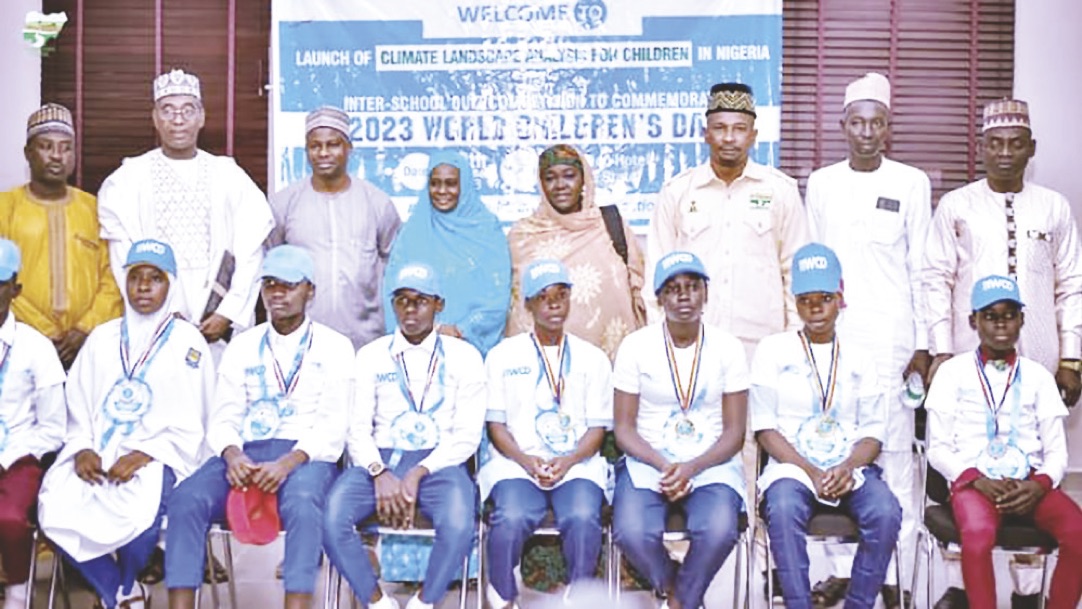
•Participants
According to the organization, while working to improve the lives of children, government and other stakeholders must understand that the issue confronting households where children’s lives are complex and require a multidimensional approach to be addressed.
This was revealed by the officer in charge, Clement Adams, Bauchi Field Office, UNICEF, in an interview with journalists during the 2023 end-of-year review meeting organized by UNICEF for states covered by the Bauchi Field Office.
He said: “All issues that are confronting households are multidimensional The same house that needs health services, the same house needs nutrition, the same house needs water and sanitation, the same house needs agriculture, they need everything. So, how are we implementing things holistically, multisectorally?”.
He explained that UNICEF has been working to identify methods and approaches that work in tackling challenges as to encourage the government to scale up and expand such method for better and more impactful results.
“What UNICEF is trying to do is to show the government what works, because we do not have the funding required to do the needed higher coverage, but we have the funding to identify and show what will work and what is the best approach. If we are able to do that, we will then build on advocacy so that the government will expand.
“One of the critical things is to know what will work. If we get that right by knowing what works, I don’t think we will be having much challenges.
“However, getting the government to scale up the methods and approach that works is another thing we need to work hard on, there are several things that come along with getting the government to scale up. Part of it is funding. The second part of it is the political will. The third part is about capacities,” the OIC said.
He further disclosed that there is need for a strengthened Monitoring and Evaluation (M&E) framework for better results and optimum impact of intervention programmes and efforts.
He said: “In planning activities and initiatives, you have to put your efforts into the things that work. However, the things that show and prove that your interventions are working are monitoring and evaluation.
“So, you need to also put a good M&E system in place as part of the planning process because one of the things lacking in the government systems is adding M&E into planning and consistently following to see if it is actually working.”
Adams stated that the challenges being experienced around the world, especially in Nigeria and states of the UNICEF’s Bauchi Field Office require all actors to embrace a holistic and multidimensional approach to ensure a better outcome and impact on the lives of children.
He said: “We need to be holistic in implementing things; our approach needs to be implemented multisectoral because if we do not do that we will not achieve the desired results. Water and sanitation have a very good correlation and impact on health and nutrition, and education has a very high impact on service adaptation. So all thede must go hand in hand.
“Having health working in isolation from water and sanitation as well as education will give us the needed results. Every actor needs to be invited to the table and work for a common goal because they have a stake in achieving meaningful results.”
Speaking on the end of the year review meeting which was held in Gombe, Adams explained that the meeting had representatives and other stakeholders from Bauchi, Gombe, Adamawa, Taraba, and Plateau states which are covered by the Bauchi Field Office.
According to him, the meeting was to review the progress made in the different areas of UNICEF’s work in the Bauchi Field Office. The participants discussed the successes and challenges faced in the different programmes and initiatives implemented by UNICEF. Adams explained that the review meeting was a reminder of the importance of collaboration and partnership in achieving UNICEF’s goals of ensuring a better future for children.
He disclosed that with the continued support from UNICEF and cooperation from all stakeholders, the states within the Bauchi Field Office were able to achieve a lot and make positive impact on the lives of the most vulnerable children and families in the year under review. However, he noted that a lot needs to be done to address challenges being faced by children in the region, especially the issues of poverty, water and hygiene as well as access to education and health.
He acknowledged that the challenges cannot be fully addressed by a single approach. Instead, a multidimensional approach is necessary. He said that the government and other stakeholders must understand that children’s needs are interconnected and require a comprehensive response that addresses various sectors, including health, education, environment water, sanitation and hygiene as well as protection. “Going forward, we need to develop an approach that recognizes such to be able to tackle such issues affecting children,” he said.
Adams added that the data from the review had uncovered the need for better and strengthened monitoring and evaluation to measure the impact and successes of various intervention programmes and initiatives. He emphasized that monitoring and evaluation serve as important tools to track progress, identify gaps and adjust strategies to ensure better outcomes for children.
The OIC further revealed that the team recorded significant progress in terms of the formulation of policies and other initiatives as well as implementation to address the critical and diverse challenges facing children, stressing: “It is a call to action for governments.”
He added that the review meeting has provided a platform for the team to better plan and work more towards creating a better future for every child.