Follow Us on Google

By Fred Itua
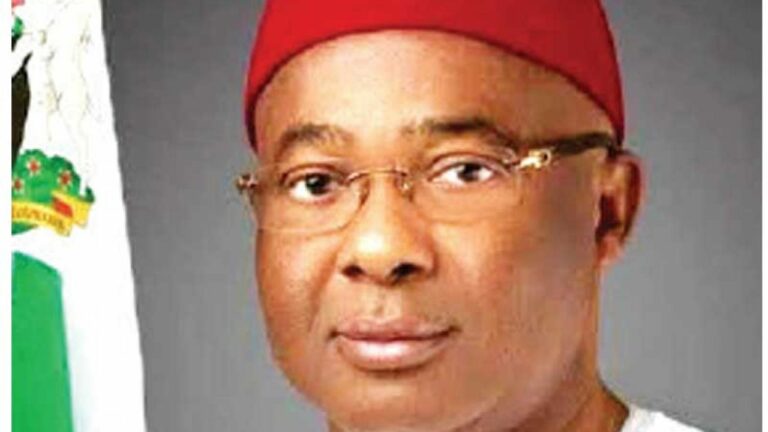
Governor Ifeanyi Ugwuanyi, fondly called ‘Gburugburu’, means different things to different people. For some, he’s a trailblazer. For another category, he’s a peacemaker, and for others, he’s a worthy leader. Whichever side of the divide you elect to pitch tent with, you’re right.
Ugwuanyi took over as governor of the Coal City State at a time when it didn’t make any logical sense to assume any political office. The economy was at its lowest ebb. Insecurity was biting and the fabrics that held the society technically collapsed. Yet, he came like a lion ready to roar.
In Enugu State, insecurity and political division held sway. It was a royal rumble. Like Jesus who calmed the storm, Ugwuanyi came in and peace permeated every facet of the state. Seven years after, the state is still basking in the euphoria of Ugwuanyi’s peace.
Today, he is a friend even to the opposition. Unlike other governors, Ugwuanyi enjoys the support of opposition political parties in the Enugu State. For a country like Nigeria, this is rare, and scholars still wonder how he performs the magic.
In keeping faith with his driving principles of entrenching peace and good governance in the state, Ugwuanyi has created an acceptable balance between the urban and rural population.
He has provided quality leadership and has opened up the rural areas with massive infrastructural development and other basic amenities in a manner that has endeared him to residents.
Ugwuanyi’s special interest in taking democracy dividends to the doorsteps of the rural dwellers of Enugu State, the long neglected, to give them a sense of belonging, is novel in the state’s history and a mark of conscience.
These aforementioned facts were obviously the major reason the people of Enugu State overwhelmingly re-elected him in 2019 with an unprecedented 95.54 per cent of the votes cast. The landslide victory was actually the highest in the nation’s electoral history.
Enugu, under Ugwuanyi’s watch, is in the list of the few states that pay N30,000 new minimum wage to their workers, with the consequential adjustment, without any form of rancour.
Ugwuanyi’s administration has covered about 700 kilometres of urban and rural roads largely concentrated in the rural areas. The first flyover bridge to be constructed by Enugu State government is nearing completion at Nike Lake Road T-junction, Enugu, courtesy of Governor Ugwuanyi.
The ultramodern 5,000-seat capacity Township Stadium, Nsukka, aimed at promoting and encouraging grassroots sports development and youth empowerment, is at the final stage, following the successful installation of AstroTurf, tartan tracks, seats, and flood-light stands, as well as pavement works. It is gratifying to note that the construction of a similar befitting stadium in Oji River Local Government Area was captured in the 2022 budget.
Also concerned about the wellbeing of the rural dwellers, Gburugburu has renovated district hospitals and constructed healthcare facilities such as Type 3 healthcare centres, cottage hospitals with isolation wings and an amenity hospitals (ongoing) in the rural areas to provide adequate and affordable healthcare services to the people.
Besides the ongoing massive construction work at the permanent site of Enugu State University of Science and Technology (ESUT) Teaching Hospital and College of Medicine, Igbo-Eno, a multibillion-naira project, Ugwuanyi’s administration rehabilitated the former Colliery Hospital, Enugu, with the construction of new structures, and transformed it to Enugu State Infectious Disease Hospital, for isolation and treatment of patients with infectious diseases.
In education, Ugwuanyi’s administration has recruited 5,030 primary school teachers under the Enugu State Universal Basic Education Board (ENSUBEB) and over 2,000 secondary school teachers under the Post-Primary Schools Management Board (PPSMB). His administration has constructed, renovated and equipped 1,255 classroom blocks and other school projects under ENSUBEB, and procured and distributed over 50,000 classroom furniture and other learning tools for primary school children and their teachers.
Ugwuanyi’s administration has so far supplied and installed computers in 209 secondary schools and science equipment in 294 secondary schools; constructed and renovated classroom blocks, offices and hostels, among others.
In the state-owned tertiary institutions, the story is the same. For instance, the Institute of Management and Technology (IMT), Enugu, which is now a degree-awarding institute, courtesy of Ugwuanyi’s administration, has witnessed massive infrastructural transformation through construction of multiple landmark projects.
These projects include a block of 15 ultra-modern classrooms on two suspended floors with seating capacity of 1,224 students; block of ultra-modern offices for Registry Division (Exams and Records) with accommodation for a minimum of 75 staff; block of fully furnished ultra-modern Academic Staff Office complex comprising 60 offices with intercom facility; and a world-class medical centre with all necessary appurtenances for provision of quality medical services to staff and students of IMT.
During the inauguration recently, Ugwuanyi disclosed that the intervention became imperative to provide the needed infrastructural transformation in IMT, Enugu, as well as save the institute from total collapse and withdrawal of its accreditation. It was only possible under Ugwuanyi’s watch for IMT, Enugu, to hold its first convocation, after 11 years.
On security, Ugwuanyi as a security-conscious and peace-loving leader, has made huge investments to keep Enugu State safe and secure as well as maintain its enviable status as one of the most peaceful states in Nigeria. All the security agencies have continued to appreciate the governor for his outstanding support and cooperation.
The Enugu State judiciary isn’t left out.
It witnessed unprecedented infrastructural interventions in its history with numerous landmark projects such as the building and equipping of 24 Magistrate Courts (16 of which are brand new); massive renovation of the State Judiciary Headquarters complex, Enugu; construction of the first Enugu State Customary Court of Appeal Headquarter complex in Enugu; and the construction of 34 brand new model Customary Courts (two per local government) across the 17 local government areas of the state simultaneously, to give them a new lease of life and relevance in line with international best practices for efficient and effective dispensation of justice in the rural areas and beyond.
Verifiable investments have also been made in other sectors such as investment promotion, agriculture, workers’ welfare, ICT innovation, Small and Medium-sized Enterprises (SMEs), youth and women empowerment, housing development, among others.
It is interesting to note that Enugu, yet to be recognised as an oil producing state, under Governor Ugwuanyi’s watch, was rated among the six economically most viable states in the country that can survive without federal allocations. It was also rated as the second most advanced state in Nigeria, on the Ease of Doing Business by the World Bank Group; one of only three states out of the 36 states of the federation that have fulfilled obligations to their workers (BudgIT); and among the seven states that are solvent with an impressive over 30 percent Internally Generated Revenue (IGR) to fund additional economic activities.
With over one year to go, the State will witness more transformational projects. Ugwuanyi isn’t done yet. As a reward for hard work, Ugwuanyi may heed the clarion call and take his needed services to the centre