Follow Us on Google
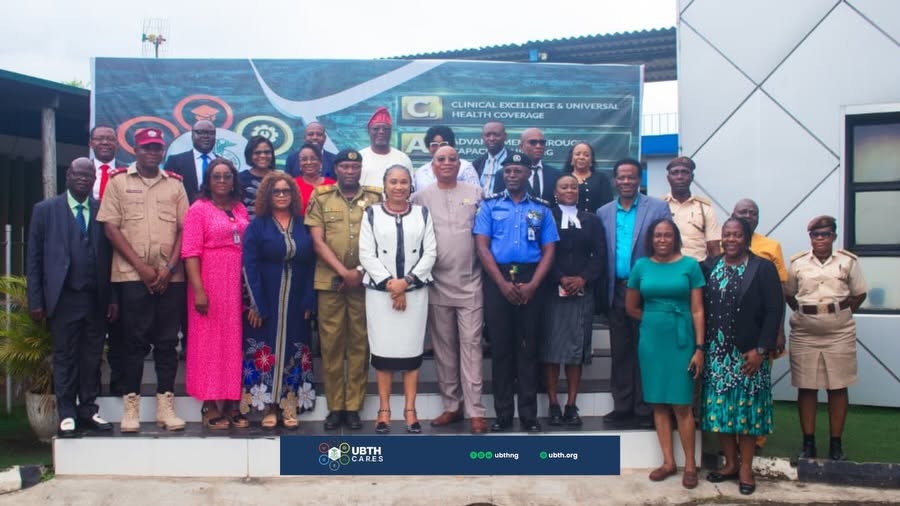
The University of Benin Teaching Hospital (UBTH) has commissioned a Drug Testing Centre as part of efforts to strengthen the early detection, prevention and management of substance abuse and its associated health and safety challenges.
The facility was unveiled during the opening of the hospital’s 2nd Special Intervention and Stakeholders Workshop, which brought together representatives of the healthcare sector and key stakeholders, including the National Drug Law Enforcement Agency (NDLEA), Nigeria Police Force, Judiciary and Ministry of Public Safety and Security.
Speaking at the occasion, the Chief Medical Director, UBTH, Prof. Idia Ize-Iyamu, described the commissioning as more than the opening of a new facility, noting that it represents a significant step towards prevention, early intervention, safer communities and improved health outcomes.
She noted that substance abuse has become an increasing concern, with consequences ranging from impaired judgement, road traffic accidents and violence to broken families, poor academic and occupational performance, declining productivity and loss of life.
Prof. Ize-Iyamu maintained that the new centre is equipped to test for a range of substances, including amphetamines, benzodiazepines, marijuana/cannabis, ethanol, fentanyl, methadone, tramadol and barbiturates.
Ize-Iyamu emphasised that the dangers associated with substance use vary according to the substance involved.
She said amphetamines, for instance, may cause agitation, increased heart rate, high blood pressure, anxiety and impaired judgement, while severe cases may result in psychosis or seizures.
Benzodiazepines can cause excessive sedation, impaired coordination and memory problems, with the risks becoming particularly serious when combined with alcohol or opioids.
Cannabis may impair memory, concentration, coordination and judgement and, in some individuals, may contribute to severe anxiety, paranoia and other psychological problems.
She said methadone, despite its legitimate medical applications, can cause dangerous sedation and respiratory depression when misused or combined with other substances.
She stressed that the risk does not always arise from the use of a single substance, as combinations of drugs can significantly increase the likelihood of severe complications.
According to her, this makes drug testing an important tool, not merely for identifying substances but also for identifying risks before they become tragedies.
She said the establishment of the centre within a tertiary healthcare institution gives UBTH an added advantage, as testing can immediately connect patients to appropriate medical intervention.
“When a problem is identified, we have the doctors, nurses, laboratory professionals, emergency teams and specialists who can assess the patient, manage complications and provide or facilitate appropriate treatment,” the CMD said.
Other News
She said the centre is therefore designed to create a pathway from detection to intervention, rather than making testing an end in itself.
She noted that the presence of the NDLEA, Nigeria Police Force, Judiciary, Ministry of Public Safety and Security and other stakeholders at the workshop reflects the multi-sectoral nature of the substance abuse challenge.
According to her, substance abuse is simultaneously a public health, safety, social and human issue, requiring collaboration among healthcare institutions, law enforcement agencies, government, families, communities and other stakeholders.
She commended the hospital team, staff, partners and other individuals and organisations whose contributions made the Drug Testing Centre possible.
She said the centre is expected to support earlier detection, faster intervention, better clinical decision-making and improved emergency response, while also contributing to broader efforts to reduce the devastating consequences of substance abuse in society.
She expressed the hope that the facility would become a trusted, professional and impactful centre for drug testing and intervention.
“Behind every test is a human being. Behind every positive result is a person who may need help. Behind every emergency is a family. And behind every intervention is an opportunity to prevent tragedy,” the hospital stated.
Representing the Edo State Governor, Monday Okpebholo, the Commissioner for Public Safety and Security, Hon. Festus Ebea, expressed confidence that the new facility at UBTH would provide reliable testing, counselling and treatment, rather than the inadequate testing services sometimes found elsewhere.
Ebea also stressed that illicit drug use is a serious contributor to crime and dangerous behaviour, including reckless driving, armed robbery and violence.
He praised UBTH for establishing a facility where drivers, new employees and members of the public can be properly tested and, where necessary, counselled and treated.
He encouraged people struggling with drug use to seek rehabilitation, saying that collaboration among the hospital, police and NDLEA would help address the problem more effectively.
Earlier, Prof. Eddy Ehikhamenor, Director of the Centre for Forensic and DNA Studies, University of Benin, commended the Federal Government for its call for drug testing among students, noting that the initiative would go a long way towards tackling the drug menace in society.
He also commended the management of UBTH for establishing the centre and called on Nigerians to avail themselves of the screening services, assuring them that there would be no stigmatisation.