Follow Us on Google
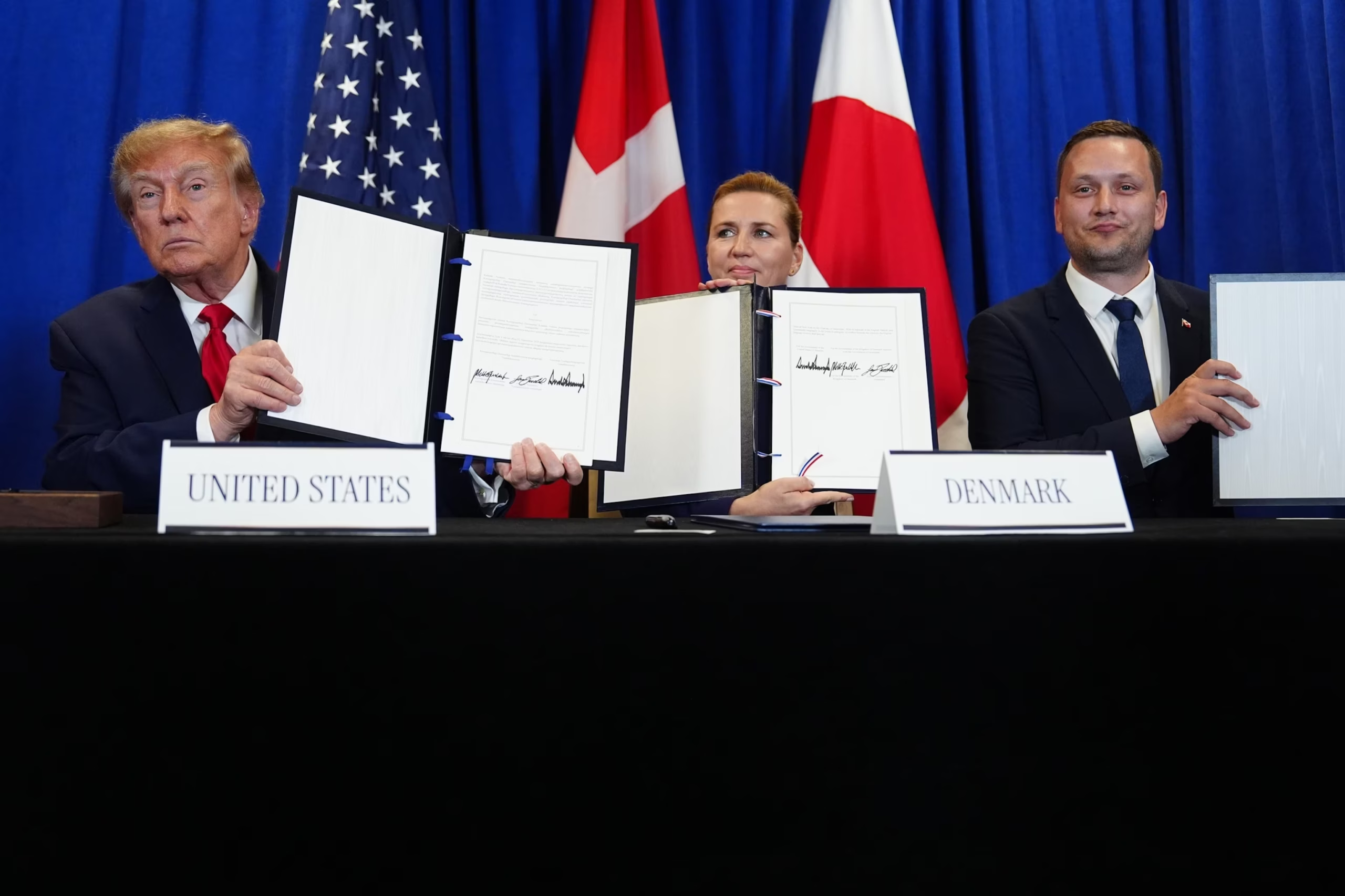
US President Donald Trump has signed a new security agreement with Denmark and Greenland, paving the way for an expanded American military presence on the Arctic island after months of tensions over his calls for greater US control of the territory.
Trump signed the agreement with Danish Prime Minister Mette Frederiksen and Greenland’s Prime Minister Jens-Frederik Nielsen on Tuesday on the sidelines of the United Nations General Assembly in New York.
Speaking at the signing ceremony, Trump described the agreement as beneficial to the United States and Europe.
“It’s going to be a long-term, fantastic relationship,” Trump said.
“This is tremendous for Europe and for the United States and for everybody,” he added.
The agreement allows the US to establish new military facilities at Narsarsuaq in southern Greenland and Mestersvig in the east, while also expanding and modernising its existing Pituffik Space Base in the northwest.
The pact also permits expanded US military operations on the island, including broader access for American aircraft and other defence activities.
Despite the expanded US military presence, the agreement reaffirms the sovereignty and territorial integrity of the Kingdom of Denmark and recognises Greenland’s right to self-determination.
Trump had repeatedly pushed for the United States to acquire Greenland, citing its strategic importance to American security. His position created tensions with Denmark, a fellow NATO member, and generated opposition in Greenland.
The new agreement instead leaves Greenland within the Kingdom of Denmark while giving Washington greater military access and a larger security role on the island.
Greenland’s location in the Arctic makes it strategically important to the United States and NATO, particularly because of its proximity to North America and the shortest routes between North America and Russia. The territory is also rich in mineral resources and could become increasingly important as melting Arctic ice opens new shipping routes.
Other News
Frederiksen welcomed the agreement, saying Denmark was in a better position following the deal.
“As everyone knows, we live in uncertain times,” she said.
She added that she hoped the agreement would provide greater reassurance to Greenlanders after months of uncertainty.
Greenland’s Prime Minister Nielsen also said the agreement reflected the island’s role in North American and transatlantic security.
“This agreement reflects that we understand our responsibility and act accordingly,” Nielsen said.
However, he acknowledged that rebuilding trust at home would take time.
The agreement further restricts non-NATO and non-EU countries from gaining a military or strategic foothold in Greenland. It prevents such countries from establishing military installations or obtaining significant influence in sensitive sectors without the required approval.
The provisions are widely viewed in the context of US concerns about the potential influence of Russia and China in the Arctic.
The agreement is also designed to remain applicable if Greenland eventually becomes independent from Denmark, provided it remains within NATO.
European officials welcomed the deal. European Council President Antonio Costa described it as a positive step for transatlantic cooperation and Arctic security, while German Chancellor Friedrich Merz also expressed support.
The agreement builds on a 1951 US-Danish defence arrangement that was updated in 2004 and gives Washington significant military rights in Greenland.