Follow Us on Google

By Paschal Oluchukwu Omaka
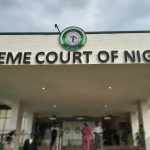
The political fate of Nigeria as a constitutional democratic nation now hangs precariously on the shoulders of some eminent jurists at the apex Court in the land.
The Supreme Court of Nigeria with an initially constituted seven-man panel has commenced hearing and reserved judgment on the appeals brought before it by both the Presidential candidates of the People’s Democratic Party, PDP and former Vice President, Atiku Abubakar and his Labour Party counterpart and former Governor of Anambra State, Mr. Peter Obi.
Being the terminal Court in our nation’s jurisprudence with unequivocal and equally irrevocable powers to determine political and any other matter brought before it, there’s no over-emphasising the fact that so much is undoubtedly at stake. The words and pronouncements of the jurists, now reduced is not only final but also has always been the law itself.
It would be recalled that as a result of the death of Justice Centus Chima Nweze earlier in the year and the retirement of Justice Amina Augie and the retirement of His Lordship, Justice Ahmed Dattijo also billed to retire on Friday this week having completed his compulsory 35 years of service in the nation’s judiciary, the Supreme Court’s Justices have been reduced to just 10, 11 short of the 21 stipulated by Section 230(2) of the 1999 Constitution. In advanced democracies where Nigeria borrowed the concept of democratic governance such as the United States of America, the Supreme Court as the highest court in the land is the court of last resort for those looking for justice and as a result of its power of judicial review, it plays an essential role in ensuring that each branch of government recognises the limits of its own power. In essence, they often bury all sentiments and technicalities to protect and preserve the constitution of the land no matter how powerful who may be involved in a crime or incidence may appear- that is particularly if the lower Courts of the land had failed in it’s own duties as the last hope of the common man.
In Nigeria, the Supreme Court does not only have original jurisdiction in any dispute between the federation and a state or between states but also has an appellate jurisdiction to hear and determine appeals from the Court of Appeals. In the instant case, it is vested with the powers to determine not only who actually won the 2023 presidential elections but also whether all the vexed issues of compliance to our electoral laws were observed by both the candidates in the election, the political Parties and of course, the electoral umpire.
Reuben Abati, in a piece titled: “Rebellion at the apex Court” published in the Cable Newspaper, Nigeria (2022) in emphasizing their powers as the final abiter in any adjudication brought before it, quoted Justice Chukwudi Oputa, JSC per Adegoke Motors vs Adesanya (1989) who once said that, “The Supreme Court (in Nigeria or elsewhere) is the apex court of the land. It is, in defining its character, not an infallible court, but it is final because its decisions are final”.
He continued that the overwhelming implication is that the only recourse beyond any decision taken by the Supreme Court is God, not even the West African Court of Appeal can overturn this apex court. Only the Supreme Court can rehearse its own decisions and reverse itself. Therefore, its words as earlier emphasized is the law!
With the powers vested in them under Section 6 of the 1999 Nigerian Constitution, and the doctrine of the separation of powers as articulated for eternal relevance and coherence by Baron de Montesquieu in 1748, the Judiciary, (particularly the last Court of the land) constitutes a major pillar of the balance of powers in society and the protection of the rule of law. It therefore could be deciphered that it is not for nothing that the Supreme Court has been celebrated as the last hope of the common man, that final temple of justice where the law lords define the law, give the law and interpret the law to modulate and to ensure social justice.
If we could recall, just three decades ago and in this same country, and notably, under military rule, this was the same Court on which Bench sat legends of the law like Kayode Eso, Chukwudifu Oputa, Andrews Otutu Obaseki, Ayo Irikefe, Chukwuenike Idigbe, Augustine Nnamani, Mohammed Bello, Adolphus Karibi-Whyte, Ephraim Akpata, Bola Babalakin, Anthony Aniagolu and others. On both the Supreme and Appellate Courts, these justices gave Nigeria an image of the role of the law as an instrument for nation-building. For more than a decade they spoke the law to power. They were fearless, independent, firm and robustly intelligent. They were leaders of an incorruptible court, dramatized for posterity in D. Olu Adegoke’s play, The Incorruptible Judge (Evans Publishers, 1962).
Today, the hopes of the common man in the Nigerian Judicial system has not only waned but it is also almost completely lost! The Court, just like the ineptly corrupt lower Courts in the land appears to have toed the path of technicalities in resolving issues brought before it as was evident in the Imo Governorship appeal which sacked an incumbent Governor, Rt. Hon. Emeka Ihedioha and returned APC’s Hope Uzodinma who was placed a distant fourth in the 2019 Imo Governorship election. Many had thought the apex Court’s decision which decided to restore hitherto discarded votes was a joke but today, Uzodinma is completing a four year tenure and also seeking a re-election in Imo.
Apart from the Imo scenerio, the apex Court has largely been inconsistent in interpreting some of the provisions of the Electoral Act vis-a-vis the Constitution of the land. The cases of the return to the ballot of both former and serving Senate Presidents; Ahmed Lawan and Godswill Akpabio and even David Umahi all of the ruling All Progressives Congress during the last general election speaks volumes of the fears that the eminent Jurists may no longer be valuable instruments of social modulation but now appears to be consistently in pursuit of ruling class and personal cum selfish interests. All that the masses and the electorate looked up to from the noble Jurists at the apex Court was a simple and critical dissection of the clear and extant provisions of Section 84(8) of the Electoral Act (as amended) on the issue of a candidate contesting for another position after vying for the ticket of the same Party in another primary election.
Or does it not baffle both the illiterate and semi-literate Nigerians that even some sane minds are yet debating and attempting to create chaos and confusion on the deposition made under oath by the Registrar of Chicago State University, Caleb Westberg to the effect that the Diploma certificate presented to INEC by APC’s Presidential candidate in the 2023 election, Bola Ahmed Tinubu was not issued by the institution? It is pathetically ridiculous that a retinue of aides goes to the extent of appearing on Live National Televisions to dare the apex Court to admit the said depositions as fresh evidence before it.
For some sane Nigerians and the rest of the world, it is a huge shame the apex Court is alleged to be under pressure not to accept as evidence before it, pre-qualification documents that INEC as an institution bound by the Nigerian law deliberately ignored or failed to check and act. In saner climes, this ordinarily ought not to have been debatable in the first instance.
And for the very fact that the US Court in Illinois had after some long attempts at tactical manoeuvres by Tinubu legal team ruled in favour of Atiku to the effect that they do not see any “irreparable damage” that would be done to the Nigerian President if his academic records from CSU were released to the latter, our judicial system and all institutions, particularly INEC as the regulator who should have put these checks in place even before publication of names of successfully-screened candidates for the election ought to have all buried their heads in shame!
The ordinarily needless debates renting the air at the moment only goes to prove how powerful certain individuals- not institutions have become in today’s Nigeria. This is the more reason the apex Court must distinguish itself. Already, the feelers that some of the Jurists have recused themselves from the matter for various reasons ought to have been celebrated but the Nigerian masses and particularly the electorate yet have their fears about what may be the eventual outcome of all the evidences laid before and downrightly abandoned by the Presidential Elections Petitions Tribunals headed by Justice Tsammani and his co-jurists.
Even at the lower elections Petitions tribunals, the verdicts have been rather conflicting! In one instance, a candidate is sacked for proven case of forgery. In another fell swoop, another elected candidate’s election is upheld for committing the same offense. A candidate of a ruling Party has his election upheld despite allegations of non-compliance with the electoral law and another candidate has his own election invalidated either or being in opposition or falling out of faour with the cabals of the government in power. How then, can one expect a nation where justice is for the highest bidders to make progress?
Since September, the lamentations on the mainstream and Social media over the PEPT verdict has been that technicalities carried the day at the Court of Appeal level where the judges descrnded to the gallery in lampooning the Petitioners for bringing an issue that affects the over 200 Million Nigerians before it. Sadly, they seemed not to have even pretended one bit about their decision and the reactions that greeted it.
To the Seven eminent Jurists who are sitting over these election cases particularly the Presidential election at the apex Court, they must understand that the fate of our democracy and elections with reasonably acceptable outcomes as the pinnacle of our leadership selection process hangs on the shoulders. They should be reminded that our institutions such as INEC would continue to suffer and remain a laughing stock if some of their actions especially as it concerns our laws and the electoral Acts (as recently amended) are not brought to question by the temple of justice that serves as the final regulator of the role of a referee in a football match.
In essence, the Supreme Court ought to and therefore should become the Video Assistant Referee, VAR in its role as the final Ombudsman. They should remember that they would be referenced just like constitutional lawyers; Rotimi Alade Williams and all the fine Jurists mentioned above who bestrode the Nigerian Legal system like colossuses and not by the number of mansions discreetly acquired or the fatness of the currencies in their bank accounts be there in local or foreign denominations. They must set fresh judicial precedents that would be anchored on the laws and the facts before it and not look away, relying on mere technicalities.
As they commonly say, a good name, remains better and more valuable than gold. In other words, their Lordships must live above boards and for the sake and sustenance of our hard fought democracy protect and preserve it by following and applying strictly the law and not technicalities.
As the nation’s fate hangs on their shoulders, will their Lordships be supreme in remedy and live above what Aquinas called a ‘Corruption of law’? The stage is all theirs from now till November to dance either to Fame, shame, infamy or even ignominy!
Amazingly, the whole world is watching Nigeria as Africa’s giant at this time in it’s democratic history.
• Omaka, a political Commentator cum Activist wrote from Abuja, Nigeria.