Follow Us on Google
From Juliana Taiwo-Obalonye & Okwe Obi, Abuja
President Bola Tinubu has sought stronger economic and security partnership between Nigeria and the United Kingdom, urging both nations to deepen trade ties and collaborate more to address shared global challenges.
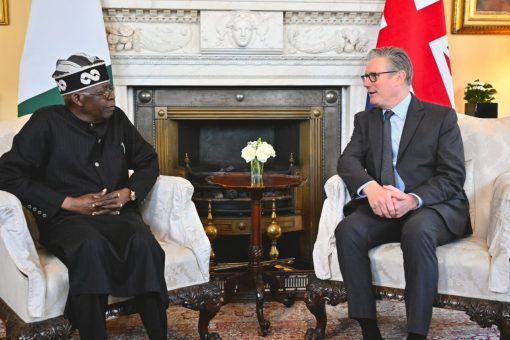
Speaking during a meeting with British Prime Minister, Keir Starmer, at 10 Downing Street in London, yesterday, Tinubu emphasised the need to nurture existing trade frameworks and stimulate broader economic relationships that would benefit both countries. “We need to nurture the trade agreement and stimulate more economic relationships that will build our two nations.”
Tinubu pointed out that Nigeria is undergoing far-reaching economic reforms aimed at stabilising the economy and improving the welfare of citizens, even as it grapples with global economic volatility.
“Nigeria is currently going through a very strong reform of the economy, and beyond the volatility that we are seeing, what we are facing is not a small challenge,” he stated.
He stressed that the economic difficulties confronting Nigeria are part of a wider global trend, affecting even advanced economies such as the United Kingdom.
“Currently, the entire world is challenged, and Nigeria is not immune, just as Britain is not immune. We have all been watching developments as they unfold.”
He underscored the importance of prioritising citizens’ welfare in bilateral engagements, calling for coordinated efforts to mitigate economic instability and improve livelihoods. “My concern is the economy and the welfare of the people, and how we should work together to improve their livelihood while mitigating economic volatility.”
Tinubu also pointed out growing security threats across Africa, particularly terrorism emanating from the Sahel region, and linked the challenges to climate change and broader socio-economic pressures. “As the largest country in West Africa and on the continent, we are challenged by terrorism coming from the Sahel, as well as the conflicts arising from climate change and other pressures.”
He expressed optimism that ongoing bilateral discussions would produce practical outcomes, particularly in strengthening cooperation on security and development.
“We will be able to discuss these further in our bilateral engagements and see what Britain can do to accelerate friendship, partnership and collaboration,” he added.
Prime Minister Starmer described Tinubu’s visit as historic, noting that it marked the first inward state visit hosted by the United Kingdom in 37 years.
Starmer highlighted the longstanding ties between both nations, anchored on shared history and strong people-to-people connections.
“The long and shared history between our countries is obvious and much valued by us, as is the people-to-people contact and engagement that enriches our relationship,” he said.
The British leader also acknowledged existing cooperation between Nigeria and the UK in areas such as the economy, defence, and security, adding that the visit provides an opportunity to elevate the partnership.
“We have a lot of work that we already do on the economy, on defence, on security, but today is an opportunity to take that to another level with the agreements we have been able to reach.”
Earlier at a State Banquet held at Windsor Castle on Wednesday night, hosted by King Charles III, Tinubu, President Tinubu reaffirmed Nigeria’s enduring commitment to a robust partnership with the United Kingdom, pledged closer cooperation in democracy, trade, security and cultural exchange between the two Commonwealth nations.
He described the relationship between both countries as a friendship built on shared values, deep history and mutual respect, adding that Nigeria always approaches the future with confidence and a renewed sense of purpose.
“Nigeria and the United Kingdom have shared more than just history; our two nations share a vision of progress and resilience,” the President declared. “Today, we continue that journey, committed to building a future rooted in partnership, mutual respect and common values.”
The event made history as Tinubu became the first Nigerian leader to address guests at Windsor Castle, a symbolic milestone reflecting what he called the “evolution of institutions that have shaped governance, culture and public life far beyond these shores.”
The President lauded Britain’s role in shaping modern democratic governance, referencing the Magna Carta of 1215 and the influence of great thinkers such as Thomas Hobbes, John Locke and Edmund Burke.
He noted that Nigeria’s institutions continue to draw inspiration from British democratic and legal traditions.
Other News
“Our courts draw upon legal traditions rooted in English common law,” he said. “Our parliamentary institutions reflect constitutional practices that evolved here over centuries. Our civil service structures have also drawn upon administrative models developed in Britain and adapted to Nigeria’s own national context.”
According to him, this shared inheritance places both nations in a “unique position to chart a new era of democratic strength, economic opportunity and international cooperation.”
President Tinubu emphasised that as one of the largest countries in the Commonwealth of Nations, Nigeria would continue to play a constructive role under King Charles’s leadership, particularly in promoting stability, good governance and sustainable growth across Africa.
“Our West African region faces complex terrorism challenges with roots in the Sahel,” he noted. “Nigeria carries an enormous responsibility to help safeguard regional stability. In confronting these threats, partnership with the United Kingdom remains essential and I look forward to meeting with the Prime Minister, Keir Starmer tomorrow.”
The President described security cooperation as a cornerstone of Nigeria-UK engagement, stressing that both governments must deepen collaboration in intelligence sharing, counterterrorism and defence capacity-building to address threats that cross borders.
Beyond institutions and governments, Tinubu praised the Nigerian diaspora in the United Kingdom as the living bridge between the two nations.
“The Nigerian community in the United Kingdom has become one of the most dynamic diasporan communities worldwide,” he said, highlighting their contributions to the National Health Service and sporting excellence. “Nigerian-trained doctors are among the largest groups of international medical professionals serving the NHS.”
He cited the success of Nigerian-born athletes, rugby star, Maro Itoje, footballers, Bukayo Saka and Eberechi Eze and world champion boxer, Anthony Joshua, as testaments to the remarkable human connection that links Nigeria and the United Kingdom.
In a deeply personal reflection, President Tinubu recalled finding refuge in Britain during Nigeria’s military dictatorship, noting that the solidarity extended to him then remains a cornerstone of his respect for the UK.
“During the dark years of military dictatorship, I found safety here. My residence was placed under Metropolitan Police surveillance for protection following threats from agents of the junta. That solidarity remains etched in our collective memory,” he recounted.
He concluded by proposing a toast to the special bond between Nigeria and the United Kingdom and to a brighter shared future.
“God bless His Majesty, the King. God bless Nigeria. God bless the United Kingdom,” Tinubu declared, as the royal hosts and guests raised their glasses.
King Charles, in his welcoming remarks, captured the warmth of the occasion in Yoruba, greeting the Nigerian President with “Ekabo. Se Daaa Daa Ni,” before extending best wishes for Ramadan. “Ramadan Mubarak!” the monarch said, expressing admiration for Tinubu’s decision to travel during the holy month.
The King recalled his visits to Nigeria and the country’s remarkable transformation. “Nigeria hasn’t merely changed. It has arrived. Yours is now a nation of over 230 million people, half of whom are under 18, with the energy, ingenuity, ambition and resolve to address the great challenges of our age,” he said.
He described Nigerians in the UK as a vital part of Britain’s fabric, noting their contributions to every sector of British life, ranging from the National Health Service to science, arts and business.
“We, in the United Kingdom, are blessed that so many people of Nigerian heritage, having chosen Britain as their home, are now at the heart of British life through excelling at the highest levels of business, technology, academia, law, science, sport, literature, arts and public service,” King Charles said.
The monarch shared a light-hearted anecdote about hosting a “Jollof and Tea Party” with young Nigerians supported by his King’s Trust at St James’s Palace. “I was firmly assured that the Jollof was only the best for Nigerians, of course or perhaps Ghanaian or Senegalese. “Diplomatically, I cannot remember!” he quipped, drawing laughter from the audience.
He emphasised that the relationship between Nigeria and the UK was no longer defined by history alone but by shared progress. “The friendship between our two countries, Mr President, is a partnership of equals that has brought to both of us enormous benefits,” he said. “It has been described to me as a deeply spiritual connection, beyond churches and mosques, through which we have strengthened our shared security, ensured our economies are more prosperous and empowered each other to believe in a more hopeful future.”
Acknowledging the painful chapters of colonial history, he added: “I do not seek to offer words that dissolve the past, for no words can. But, I do believe, as I know you believe, Mr President, that history is not merely a record of what was done to us; it is a lesson in how we go forward together to continue building a future rooted in hope and growth for all.”
He praised Nigeria’s leadership role in Africa, describing it as “an economic powerhouse, a cultural force and an influential diplomatic voice.” Drawing on African proverbs, he said: “I heed the Yoruba wisdom that rain does not fall on one roof alone. As the Hausa saying goes, when the music changes, so does the dance.”
“As the world changes,” he continued, “we must learn new dance steps together.” He recognised Nigeria’s initiative in promoting intra-Commonwealth trade and digital alignment, noting its partnership with the UK as “an example of shared economic leadership.”
Ending his speech on a jovial note, King Charles proposed a toast to Nigeria, saying, “Naija no dey carry last!” a phrase that drew warm applause from the distinguished guests.