Follow Us on Google
•Says FG’s excessive borrowing without accountability affirms imprudent governance
By Chinelo Obogo
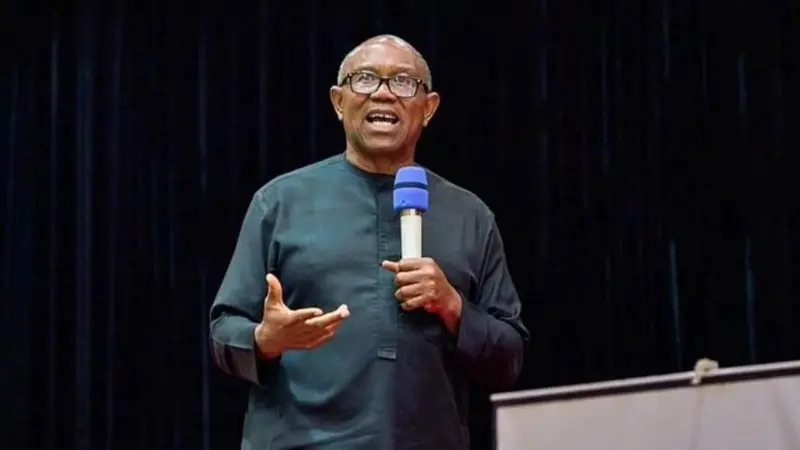
Presidential candidate of the Nigeria Democratic Congress (NDC), Peter Obi, has blasted the administration of President Bola Tinubu, accusing the Federal Government of reckless borrowing, financial mismanagement, and lack of accountability in the deployment of public funds.
Obi, in a post made on his X handle on Tuesday, said the Tinubu administration had driven Nigeria’s total debt to approximately N200 trillion through what he described as “remarkably imprudent borrowing,” warning that the trajectory was unsustainable and deeply damaging to the nation’s economic future.
Citing data from the Federation’s Budget Office, the former Anambra State governor disclosed that the Federal Government borrowed N11.89 trillion in the first three quarters of 2025 from January to September exceeding its own planned borrowing target of N10.34 trillion by approximately N1.54 trillion.
He noted that under a responsible and accountable government, such an overshoot would necessitate rigorous scrutiny and explanation from relevant governmental bodies but that this is not the reality under the current administration.
He said more alarming is the gross underfunding of capital expenditure during the same period and of the N17.58 trillion earmarked for capital projects, only N3.10 trillion which is 17.66%, was actually allocated. This leaves a deficit of approximately N14.488 trillion, or 82.34% of planned capital expenditure, completely unfunded.
The former governor questioned where the balance of borrowed funds was deployed, given that capital projects received only a fraction of what was planned.
Obi described the absence of any official explanation for the unaccounted funds as “the most disturbing aspect of the financial management fiasco” under the Tinubu government. He demanded transparency, pointedly asking whether the unspent funds were channelled into recurrent expenditure, used for entertainment at Aso Rock, or diverted to what he called a “Renewed Hope Agenda 2027 Election Campaign Fund.”
He said: “Data from the Federation’s Budget Office reveals that the Bola Tinubu government borrowed N11.89 trillion in the first three quarters of 2025 (January to September), exceeding the planned borrowing target of N10.34 trillion by approximately N1.54 trillion. Under a responsible and accountable government, such an overshoot would necessitate rigorous scrutiny and explanation from relevant governmental bodies. Regrettably, this is not the reality under the current administration.
“Compounding this issue, only N3.10 trillion of the borrowed funds was allocated to capital expenditure during the same January-September 2025 period. This constitutes a mere 17.66% of the N17.58 trillion earmarked for capital projects, leaving a deficit of roughly N14.4N14.488 trillion, or 82.34% of planned capital expenditure unfunded.
“The most disturbing aspect of the financial management fiasco under Bola Tinubu is that there is no explanation or Tinubu is that there is no explanation or information regarding how the balance was utilised or deployed. The question that Nigerian information regarding how the balance was utilised or deployed. The question that Nigerians are rightly asking and deserve anNigerians answer to is what happened to the balance? Was it deployed for recurrent expenditure/ consumption, for the entertainment of guests to Aso Rock or transferred to the Renewed Hope Agenda 2027 Election Campaign Fund? Nigerians deserve an answer on how our economy and resources are most unpatriotically managed.”
The Chairman of the Alliance for Economic Research and Ethics LTD/GTE, Dele Oye, recently lamented the unprecedented rise in public debt under the current administration, noting that the N65.9 trillion borrowed by the Bola Ahmed Tinubu administration in the last 24 months exceeds more than five times the total debt Nigeria incurred in the first 55 years of its independence.
Other News
Oye, who is the immediate past chairman of the Organised Private Sector of Nigeria (OPSN), noted that while successive governments accumulated debt over decades, the current administration alone has added N65.9 trillion in two years, compared to just N12 trillion accumulated over the first 55 years of Nigeria’s independence.
He revealed that with Nigeria’s total public debt of ₦159.28 trillion as of April 2026, according to the Debt Management Office, every single Nigerian owes N670,000, lamenting the speed at which Nigeria’s debt profile has expanded in recent years.
Oye cautioned that unless urgent measures are taken to strengthen revenue generation and fiscal discipline, the rising debt burden could place long-term pressure on public finances and constrain government spending on critical sectors.
He said, “Cast your mind back to 2006. Nigeria had just pulled off one of the most celebrated fiscal feats in African history. President Olusegun Obasanjo paid $12 billion to extinguish $30 billion in Paris Club debt. Nigeria was, briefly, externally debt-free. The Excess Crude Account was flush. The future looked fundable. Twenty years later, that golden moment reads like a fairy tale. Under President Goodluck Jonathan, debt crept back to N12.06 trillion by 2015 manageable, but the warning signs were already blinking. Then came the Buhari years.
“In eight years, the debt exploded from N12.06 trillion to N87.38 trillion, a 620% increase. The Central Bank was pressed into printing money through “Ways and Means” advances; N23.7 trillion of this was eventually securitised into long-term bonds, effectively converting a government overdraft into a generational liability. President Bola Tinubu’s administration has added a further N65.9 trillion in just two years. To put that in perspective: it took Nigeria’s first 55 years of independence to accumulate N12 trillion in debt. The current administration has added more than five times that amount in 24 months.”
According to Oye, “Governments love to quote the debt-to-GDP ratio. Nigeria’s is 35.5% well below the IMF’s 55% distress threshold, and far more comfortable-looking than South Africa’s 78.8% or Kenya’s 65.6%. Politicians wave this number like a clean bill of health.
“Do not be deceived. The number that actually matters is the debt service-to-revenue ratio of how much of every naira earned goes straight to paying creditors. Nigeria’s ratio stood at 116.8% in 2024, easing only slightly to 113% in Q1 2025, according to the Nigerian Economic Summit Group (NESG). In January 2025 alone, the CBN’s own data showed the Federal Government paying out N696.27 billion in debt service against total retained revenue of just N483.47 billion. That is a 144% coverage ratio in a single month.
“The reason for this paradox is brutally simple: Nigeria has a large economy but collects almost nothing from it. The country’s tax-to-GDP ratio is just 8.2%, the lowest among major African economies. South Africa collects 24% of its GDP in taxes. Kenya collects 16%. Ghana collects 13%. The Sub-Saharan African average is 15%. Nigeria, Africa’s largest economy by GDP and most populous nation, manages 8.2%. Every percentage point Nigeria fails to collect is a school not built, a road not paved, a soldier not paid.
“The 2026 Appropriation Act, signed by President Tinubu in April 2026, totals N68.32 trillion, the largest budget in Nigeria’s history. Of this, N15.8 trillion is earmarked for debt servicing alone. That single line item exceeds the entire N15.4 trillion budgeted for recurrent non-debt expenditure. It is more than Nigeria will spend on education, health, and security combined.
“Meanwhile, the fiscal deficit in the 2026 budget is projected at approximately ₦25.3 trillion roughly 4.5% of GDP, well above the 3% ceiling mandated by the Fiscal Responsibility Act. The law is being broken in the very document that is supposed to uphold it.”
Noting that Nigeria has the potential to overcome the challenges, Oye said, “Nigeria has the tools. It has talent. What it has lacked, consistently and consequentially, is the political will to deploy them.”