Follow Us on Google
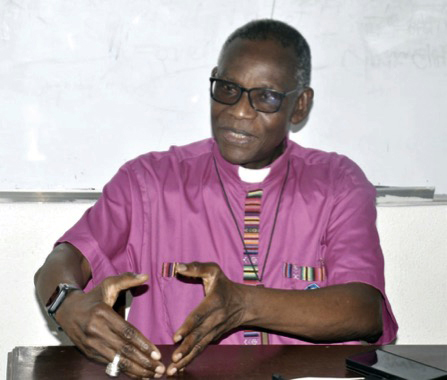
By Noah Ebije, Kaduna
Former Secretary General of the worldwide Anglican Communion and Founder and Director of the Kaduna Centre for the Study of Christian Muslim Relations, Bishop Dr Josiah Idowu-Fearon, has issued a pointed warning to Nigerian politicians and religious leaders against building their electoral strategies around religious blocs. Speaking ahead of the 2027 general elections, the respected cleric insisted that no serious political candidate can win power in Nigeria with only Muslim votes or only Christian votes.
The bishop told both President Bola Ahmed Tinubu and Kaduna State Governor Uba Sani that they cannot win without Christian votes. His central proposition, that Nigeria’s religious diversity makes cooperation between Christians and Muslims indispensable to electoral success, forms the backbone of a wide ranging conversation that also touched on the ethics of political and religious leadership, the dangers of clerics growing too close to politicians, and the economic hardship he says ordinary Nigerians are enduring.
You have argued that no candidate can win Nigeria’s presidency on religious votes alone. Could you explain what you mean?
If all Christians in Nigeria decide not to vote for Tinubu, he can never be President. I immediately extend the same argument to the Muslim electorate. If only Muslims vote for a Muslim Muslim ticket, there is no way, there is no way. The mathematics of Nigerian politics makes it impossible for either major religious constituency to secure national political power entirely on its own.
Does the same logic apply at state level, for instance to Governor Uba Sani’s Muslim Christian arrangement in Kaduna?
Yes. If in Kaduna all the Muslims refused to vote for Uba Sani for taking this decision, and only the Christians voted, Uba Sani cannot win. And if only the Christians voted, he cannot win either. This is a fundamental political reality that Nigerians must understand rather than allowing religious sentiment to determine their electoral choices. Nigeria does not need a Muslim or a Christian president.
You have said Nigeria needs a president who is Christian or Muslim, rather than a Muslim or Christian president. What is the distinction?
Nigeria, honestly, this country does not need a Muslim or a Christian president. What we need is a president who is Christian or Muslim. There is a difference. We do not need a Muslim or a Christian president, governor, senator or minister. We need leaders who carry their faith with them, whose conduct reflects the ethical teachings of their religion. Neither Islam nor Christianity encourages tribalism, stealing, telling lies or exploiting people. Religious identity by itself should never be regarded as evidence of political integrity.
Why do you think some politicians and their supporters still insist on religiously balanced or religiously homogeneous tickets?
What comes to my mind is accessibility. Members of a particular religious community may want one of their own close to power because they believe it gives them easier access to leaders and government opportunities. But that thinking can reinforce division. I had direct access to the late President Buhari, and my Christian identity never prevented that. Buhari never gave me one kobo of government money, but he helped the Kaduna Centre through his personal contacts. Former Vice President Namadi Sambo, a Muslim, once agreed to provide a seventy KVA generator for the Centre. He is a Muslim, I am a Christian, and they knew what we were doing there. Political cooperation does not have to be dictated by religious identity.
What role should religious leaders play as the country heads toward 2027?
Religious leaders should educate citizens rather than instruct them whom to vote for. I appeal to Imams, Sheikhs, Emirs, Bishops and traditional rulers to encourage citizens to participate in elections and critically assess candidates. I do not subscribe to a traditional ruler, a Bishop or anyone telling members what to do. I am a Bishop, but I have no authority over any human being, only God does. We should open the eyes and minds of citizens so they can make informed decisions. We should have debates, we should encourage debates, and assess the present government. It is wrong, from the Quran and Hadith, and from the Bible, for any religious leader to tell people who to vote for. Voting is ultimately a matter of individual moral responsibility. Every Muslim vote and every Christian vote matters, and God will ask each of us how we used our franchise.
You have described Kaduna’s political terrain as supportive of the Muslim Christian arrangement Governor Uba Sani has adopted. Why?
My doctoral research examined religion, social responsibility and development in Kaduna State, and it involved studying areas with Muslim majorities, Christian majorities and communities where both groups were more evenly represented. The situation we face in this country demands decisions that reflect the realities of each state, and the political terrain in Kaduna supports what Governor Uba Sani has done. But I return to my broader argument: the ticket alone cannot deliver victory. If all the Muslims in Kaduna refused to vote for Uba Sani and only the Christians voted, he cannot win, and if the Christians did the same, he cannot win either. I pray this arrangement will strengthen understanding and cooperation between Kaduna’s three senatorial zones.
You have also warned religious leaders against growing too close to politicians. Could you expand on that?
When you begin to frequent politicians, you get corrupted. If a religious leader at whatever level regularly hobnobs with a politician, he will definitely get corrupted, and it destroys what I call the religious leader’s prophetic authority. If I give you money and make sure you are very comfortable, you cannot challenge me. You cannot. You would rather become economical with the truth. This problem exists among both Christian and Muslim leaders, and it is not a partisan warning.
There has been debate about whether Nigerians are genuinely suffering economically. What is your view?
I did not listen to the discussion between the President and the Roman Catholic Archbishops who visited him, but to say people are not suffering as a result of what is going on in our country is being economical with the truth. My assessment is based on direct contact with ordinary Nigerians through my pastoral work in Kaduna. You can see suffering, there is no doubt about that. Some church members cannot even afford motorcycle or taxi fares to attend worship, and a good number of people have just one meal a day, hardly a balanced one. A simple bathroom soap holder that used to cost about five hundred naira is now five thousand naira. Tomatoes, anything you ask for, it is thousands and thousands. What do we do? Instead of denying it, government should say, we are aware, and this is what we are doing about it.
Ultimately, Bishop Idowu-Fearon’s intervention is less an endorsement of any political party or candidate than a call for Nigerians to rethink the way they approach politics altogether. His argument is at once mathematical, political and moral. Mathematically, neither Christians nor Muslims constitute a sufficient electoral bloc to guarantee victory anywhere in Nigeria without substantial support from the other community. Politically, candidates must build bridges rather than rely on religious constituencies alone. Morally, he insists, every voter carries individual responsibility to examine character over creed. As Nigeria heads into another politically charged season, his message can be distilled into a single sentence. A candidate may need a religion, but Nigeria needs leadership that rises above religious arithmetic.