Follow Us on Google
By Romanus Ugwu, Abuja
Contenders and perhaps pretenders have all emerged across almost all the registered political parties after the conclusion of the highly tensed, cantankerous presidential primaries to nominate candidates for next year’s general elections.
While some of the presidential candidates emerged through genuine and peaceful democratic processes from hitch-free consensus or direct mode of primaries, many others were products of double nominations by their crisis-ridden factional political parties still trapped in legal battle struggling to authenticate the real candidates.
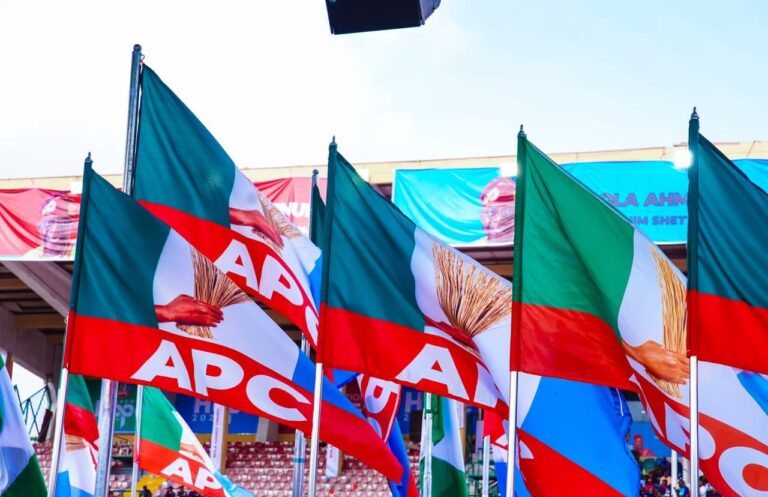
For the All Progressives Congress (APC), Nigeria Democratic Congress (NDC), Peoples Redemption Party (PRP), African Action Congress (AAC), Allied Peoples Movement (APM) Young Progressives Party (YPP), and to an extent, the African Democratic Congress (ADC), the processes adopted to produce their candidates were almost a seamless exercise.
However, for few other parties like the Nyesom Wike and Tanimu Turaki factional Peoples Democratic Party (PDP), the Social Democratic Party (SDP) among others that produced double presidential candidates, it is not yet smooth-sailing due to their entanglement in legal conundrum and intractable leadership crisis.
At the end of May 30 deadline date stipulated for the submission of the nominated candidates’ details in accordance with the timetable and schedule of activities of the Independent National Electoral Commission (INEC), no fewer than 15 nominees are authentically or deceitfully laying claims to be the rightful candidates of their political parties.
And in no particular order, some of the candidates so far nominated, according to available records, include the incumbent, President Bola Tinubu of the APC, Sandy Onor and Goodluck Jonathan of the Wike and Turaki-backed PDP respectively, Atiku Abubakar and Kachikwu Dumebi of the ADC factional leaderships.
Others are Donald Duke, PRP, Omoyele Sowore, AAC, Adewole Adebayo and Abimbola Akeem Atanda of the factional SDP, Peter Obi, NDC, Seyi Makinde, APM, Aliyu Bin Abbas, ADP, Gbenga Hashim, factional Accord Party (AP), Dr. Chibuzo Okereke, Labour Party (LP) and Mrs Anita Zugwai-Chukwu, YPP who emerged the only woman presidential candidate.
From the nominations so far, though a few of the candidates are re-contesting, there is a clear indication that the contest will be a three horse race and replay of another fierce battle among the candidates that slugged it out in the 2023 presidential election.
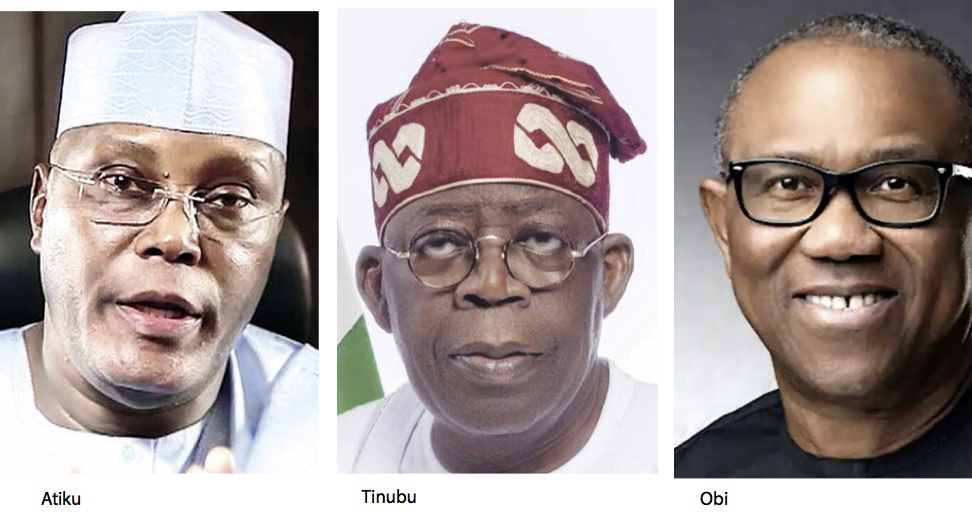
In every consideration, the battleground for the 2027 presidential election will be dominated by the trio of the incumbent, President Tinubu, former Vice President Atiku Abubakar and former Anambra State governor, Peter Obi.
It is incontrovertible that the three candidates clearly standing not only as the flagships but the real contenders ahead of other candidates like Donald Duke, Sowore, Adewole Adebayo and Abimbola Atanda among others that could be rightly regarded as make up the number candidates.
Although the duo of Atiku and Obi would be contesting under different political platforms next year having defected from the PDP and LP to the ADC and NDC respectively, many of the Nigerian electorate will perhaps be compelled to limit their choice of voting for their candidates during the poll majorly among the three of them.
As familiar foes that have tested their popularities and electoral might before the Nigerian voting publics during the 2023 presidential election, the three candidates will still bank heavily on factors like regional voting strength, power of incumbency and perhaps another possible youth wave that differentiated and worked then in favour of Atiku, Tinubu and Obi respectively.
In clear terms, while Atiku, though still facing mountainous hurdle to extricate himself and his party from the legal challenge threatening his candidacy as the authentic ADC nominee, will draw his forte from the advantageous massive voting strength of the northern region, Tinubu has been and will continue to bank heavily on the expected excessive deployment of extraneous state apparatus and other instruments of coercion to intimidate, muscle, and outsmart other presidential contestants, Obi will still lean heavily on the usual wave and momentous popularity among the youth demography ready to stake every claim and collapse their structures in his favour.
For many pundits, though the contest is clearly still wide open, the permutations tend to be in favour of Atiku who would exploit the voting strength of the northern region as the only viable and visible presidential candidate from the region boasting 50 per cent of the entire Nigeria voting population in addition to the religious and ethnic sentiment as a Fulani Muslim.
And for a candidate like Peter Obi, who has cult followingship, majorly from the disgruntled Gen Z individuals and a possible repeat of the electrifying wave he recorded during the 2023 presidential election, there is still high mathematical chances and bright prospects of his clinching the ticket and emerging victorious during the poll.
However, in the conviction of many political watchers, none of those advantageous considerations for both Atiku and Obi could be comparable to the unlimited overwhelming influence of the incumbency, especially one like President Tinubu, who has all the state resources, unlimited authority and paraphernalia of office, the security agencies, the electoral umpire, and financial warchest, at his disposal to dismantle all the favorable and vantage asset of his opponents.
Already sounding boisterous, President Tinubu, had joked that if he could win presidential election when he was not in power or when he was faced with multiple adversaries, nothing can stop him from achieving the feat again.
But, beyond his perceived arrogance, many already felt that every odd could be in his favour with certain advantageous factors like having the backing of 31 to 33 state governors across the country, directly and indirectly, backing him up, logistically, physically and financially, from the grassroots to the state levels, to ensure his grandiose victory during the presidential poll.
In the words of activist lawyer, Deji Adeyanju, the factors that will favour President Tinubu include the numerical strength of the state governors in the ruling party, apparently weakened opposition, Atiku, Obi’s desperation, inordinate ambition, favourable zoning arrangement, and northern politicians’ 2031 ambitions.
Already, there were clear manifestations of applications of frustrating legal, tactical, sentimental and psychological forces in the build-up to the primaries, to determine the emergence of certain candidates during the nomination exercise for the presidential election.
Apart from the alignments and realignments, there have been deft manipulative tendencies and evidential direct and indirect tactical maneuver to ensure that certain candidates did not eventually emerge as the flag bearers of their parties.
To put it succinctly, there have been endless scheming, claims and counter claims of the seamless efforts made for the ruling party’s flag bearer, President Tinubu, to emerge the sole presidential candidate for next year’s poll.
According to many political watchers, such scheming have come in the form of alleged frustrating sponsored litigations to deregister certain political parties seen to constitute serious threats to the incumbent, and the alleged instigation of hydra headed intra leadership crises in almost all the political parties, resulting in balkanising them into factions ahead of the conduct of their primaries, which produced double candidates.
Appraising the factors that could constitute strengths and weaknesses for the three candidates, former APC National Auditor, Dr George Moghalu, in a chat with Daily Sun, said: “In every political outing, there are aspects that are advantageous to the competing candidates. For the incumbent, his major advantage is that he has a report card to present. So, he has that advantage, which is performance-driven, and deliverables.”
“As for Atiku, he also has an advantage. He will bank on the strength of the massive votes from the North. The political equation tends to confirm that he has serious advantage as the only viable presidential candidate from the North.
“It will be foolhardy for anybody to erase tribe and religion from our polity, no matter how much effort we all put in place. Bad as nobody should encourage that, these are the realities on ground, which you cannot wave off with the left hand.
“He also has his experience to market. He has equally built some bridges across the country when he was in and out of government, across the political parties he has moved to. He has actually built bridges.
“The same thing is also applicable to Peter Obi. He also has some experience that you cannot wish away. He has the youth momentum, which we saw in the 2023 presidential election. It was clear that there was a momentum by the youths who want to make a statement.
“We saw what they rightly described as Obi wave in many parts of the country. You cannot also rule out the possibility of it recurring again in 2027. He is not a case of an unknown quantity, but a known quantity who has a constituency whose loyalty he can bank on,” he assessed.
If Dr Moghalu was objective in his appraisal, the national chairman of the All Progressives Grand Alliance (APGA), Barr Sly Ezeokenwa, was blunt in writing off the duo of Obi and Atiku, tipping President Tinubu to effortlessly emerge victorious.
While admitting that it is going to be an intense competition between Tinubu and Atiku, Ezeokenwa, told Daily Sun that; “Looking at the demographics, President Tinubu will easily coast to victory.”
“The indices are there. He has over 31 governors to work for him. Across every reasonable political space in Nigeria, what easily wins elections is the structure.”
“The second factor that will work for him will be his accomplishments, the infrastructural achievements of his administration. Other factors like religion, ethnicity will equally be a determinant. It is going to be an intense competition, particularly between the incumbent President and the ADC candidate because of the soft sentiment and voting strength Atiku shares, especially in the North East and North West with 50 per cent of the total registered voters in the country,” he argued.
Head or tail and regardless of whatever perspective political stakeholders hold about the eventual outcome of next year’s presidential election, the impact, clout and influence the vice presidential candidates will bring into the poll, could equally be another major determinant.
Still basing the appraisal on the outcome of the 2023 presidential election, the NDC candidate, Obi, opting for the New Nigeria Peoples Party (NNPP) 2023 presidential candidate, Dr Rabiu Musa Kwankwaso, with over a million voter bank could also be regarded as the tiebreaker and the game changer.
In terms of the most vibrant and influential vice presidential candidates with high electoral value for the forthcoming election, Kwankwaso arguably stands tall head and shoulders above Vice President Kashim Shettima and Rotimi Chibuke Amaechi for the APC and ADC respectively.
As for what might be the outcome of the election after their appeals and convictions embedded in their campaign slogans political watchers and stakeholders can say that only the future can tell.