Follow Us on Google

From Fred Ezeh, Abuja
President Bola Ahmed Tinubu, has approved the expansion of off-grid solar and hybrid systems to healthcare facilities in the country as part of initiative for a robust foundation for cleaner, more resilient, and more decentralised energy delivery systems across Nigeria.
The President, represented by Secretary to the Government of the Federation (SGF), Senator George Akume, stated this in Abuja, on Tuesday, at the National Stakeholders’ Dialogue on Power in the Health Sector on the theme “Powering Health Through Public-Private Synergy”.
The President also announced the decision to encourage more private sector participation through favourable regulations and fiscal frameworks; promote Public-Private Partnerships (PPPs) as vehicles for sustainable energy deployment; and also leverage blended financing to accelerate investments from development partners, international financial institutions, and local financiers.
He said: “Undoubtedly, we are faced with a persistent power supply crisis in our public health institutions. In surgical theatres, maternity wards, intensive care units, laboratories, and emergency rooms across the country, power outages often compromise safety, interrupt care, and cost lives.
“This crisis demands our immediate attention and concerted action. These outages can not continue. We are fully committed to the transformation of the health sector by targeting innovative solutions at the hydra-headed challenges bedevilling the sector, including the sub-optimal, inefficient and often uneconomical electricity supply that drives up the cost of services, disrupts care, compromises quality and increases patient dissatisfaction.”
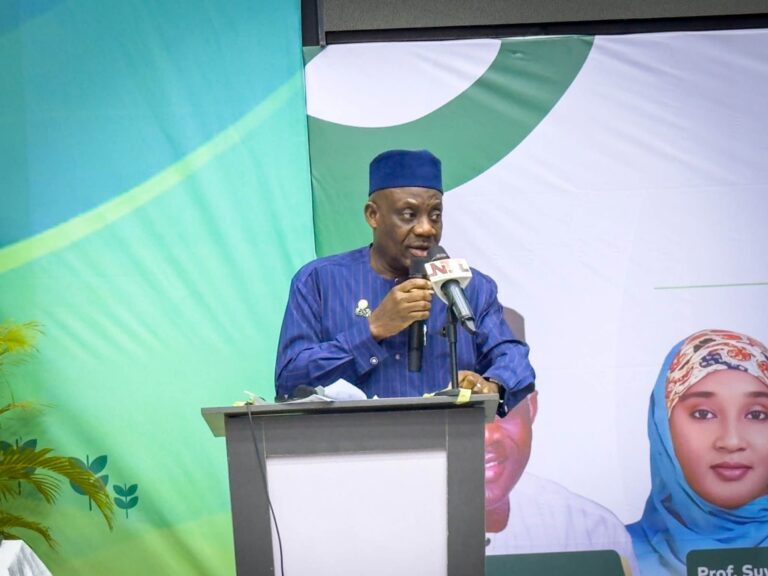
Minister of State for Health, Dr. Iziaq Adekunle Salako, in his speech, stated that “our health system are not only underpowered, they are inefficiently powered.”
He made reference to a survey conducted by Sustainable Energy for All in 2021 which revealed that 40 per cent of the functional Primary Healthcare Centre (PHC) facilities in Nigeria do not have access to electricity, with majority of the remaining 60 per cent receiving not more than 10 hours of daily power supply from various sources.
“Meanwhile, a rapid assessment carried out earlier this year shows that Federal Tertiary Health Institutions (FTHIs) require between 3 -8 MW of energy to function optimally. But the institutions receive an average of 5.3 hours of daily electricity from the national grid, have installed backup capacity of 0.8 – 3.3MW (about 50% backup deficiency) which is 80 per cent generated through diesel engines, thus spending N20 million to N180 million per month for power.
Other News
“Sadly, 20 to 50 per cent of operating expenses in FTHIs goes into fuel purchase. This situation is not different in the private sector, with 30 per cent of respondents to a survey conducted in April 2025 by the Healthcare Federation of Nigeria reporting spending N5 to N20 million on electricity monthly.
“Findings also shown limited coordination between energy and health sector actors, thereby resulting in multiple health facilities electrification datasets and duplication of interventions. This has led to sub-optimal service delivery by the healthcare system with reduced access to care, compromised quality of treatment, and poor health outcomes. Services have been disrupted, public health compromised, Nigerians subjected to hardships and many lives lost due to poor electricity supply.
“The summary is that energy supply has become a major disrupter of health services in our country, and it has become an emergency that we must address if all the healthcare reforms and investments being made will achieve the desired result. Interestingly, in attempting to solve the power issue, we are not starting from ground zero.
“The Federal Government has risen to the challenge through various initiatives, including the ongoing efforts to electrify selected PHCs in the country. The Ministry of Power, through the Rural Electrification Agency (REA), has made commendable progress, deploying 100 containerized solar hybrid systems to healthcare facilities across Nigeria
“We also have the Energizing Education Programme, which is benefiting selected teaching hospitals like the University of Maiduguri Teaching Hospital and the University of Calabar Teaching Hospital. The EU has launched the Nigeria Solar for Health Programme (NISHP), aiming to provide 24/7 power supply to 45 healthcare facilities across five states, while doctors Without Borders (MSF) have been instrumental in introducing solar power in healthcare facilities in northern Nigeria, demonstrating how solar energy can ensure stable operations for medical devices and cold chains, even in challenging environments.”
The Minister of Power, Chief Adebayo Adelabu, in his remarks, appreciated the initiative, and restated that the government can not afford the total cost of powering the country, hence he appreciated the intervention of the private sector in unleashing the potentials of the clean and renewable energy.
He renewed the commitment of the government to the cause of alternative energy for Nigerians, restating that the government is working assidiously to ensure improved power supply to Nigerians. “For eight months now, we have not recorded any case of grid failure. That’s an indication that we are achieving the desired result.”
The Permanent Secretary, Federal Ministry of Health and Social Welfare, Daju Kachollom, in her remarks disclosed that the high point of the dialogue will be the signing of a historic multi-stakeholder compact which is a commitment that unites government, development partners, the private sector, civil society, and innovators in one shared vision: to ensure that no health facility in Nigeria is left in the dark.
“This compact is not just a document; it is a pact of trust, a declaration of intent, and a blueprint for action,” she stated.