Follow Us on Google

By the time I arrived at the National Bowl in Milton Keynes with three of my sons, the reggae star Masicka was already holding court. The Jamaican singer had transformed the vast green arena into a Caribbean enclave. Everywhere you looked, Jamaica was on display.
There were food stalls carrying names that transported you instantly to Kingston rather than Buckinghamshire: Pirates From Caribbean, Jerk Village, Jamaican Street Food, Aunt Cat’s Kitchen, Jamaican Jerk, Caribbean Jerk. Long queues of people patiently waited for plates of jerk chicken and other Caribbean delicacies. The aroma drifted through the evening air, mingling with reggae rhythms that rolled effortlessly across the giant venue.
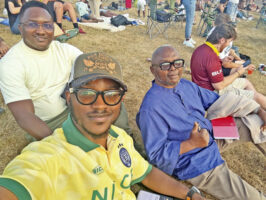
“Dad, do you want anything?” my son Taiwo asked. But all I wanted was reggae music and the music of Burna Boy which had brought us here to this filled-up arena. It was impossible not to notice the Jamaicans in the audience. They sang every Masicka lyric with evangelical conviction. They danced, waved flags and celebrated one of their own. But everyone knew the night still had another chapter. The rumours had started spreading hours earlier.
“Burna Boy may not come.”
It is the kind of rumour that travels quickly through thousands of anxious fans. Every passing minute gave it fresh life. Had his flight been delayed? Had he cancelled? Nobody knew. Then, at exactly the moment anxiety threatened to become disappointment, the darkness exploded.
Burna Boy arrived like a hurricane.
The giant screens lit up. Flames shot skywards. The thunderous sound system—the biggest I have ever experienced anywhere—roared into life. From my seat, far from the stage, the sound struck with astonishing clarity. Technology had conquered distance. The National Bowl itself fascinated me. It reminded me of an ancient Roman amphitheatre transplanted into modern England. Tens of thousands sat on the gently sloping grass facing the distant stage. From where I sat with a mixed crowd of Black and White concertgoers, the performers looked tiny. Yet the gigantic video screens brought every movement into intimate focus.
It was theatre. It was cinema. It was music on an epic scale. Then came one of the evening’s most emotional moments. Burna Boy walked onto the stage carrying the Nigerian green-white-green flag.
“Is there any Nigerian here?”
The answer came like thunder.
Other News
“Yeeees!”
For a few unforgettable seconds, thousands of miles disappeared. Milton Keynes became Lagos. Patriotism suddenly had a soundtrack. I confess I shouted with everyone else. Standing beside me were my sons. Taiwo, who lives in Milton Keynes, had bought the tickets weeks earlier—£67 each—for himself, his twin brother Kehinde, who had travelled from Lagos, their journalist elder brother Jide, and me. It became more than a concert. It became a family reunion with Burna Boy providing the soundtrack. The symbolism of the Nigerian flag was impossible to miss. Here was a young man from Port Harcourt commanding one of Britain’s biggest music festivals—not an Afrobeats festival but a reggae festival.
Some people had questioned the wisdom of asking an Afrobeats superstar to headline a reggae event. Burna Boy answered without argument. He answered with music. At one point he reminded the audience that music speaks one universal language. And that reggae and Afrobeats all came from Africa.
Looking around me, I knew exactly what he meant by universal language. The surprise of the night was not the Black audience singing along. It was the White audience. Young and old. Men and women. They sang almost every song, almost every word, with astonishing accuracy.
From Ye to Last Last, from Update to Bundle By Bundle, from Tested, Approved & Trusted to the global World Cup anthem Dai Dai, Burna Boy hardly needed backing singers. His audience had become his choir. One line in particular produced a roar of recognition.
“People just dey watch like cinema.”
Thousands completed the lyric before Burna Boy himself could finish it. That moment said something profound about modern African music. Not long ago, many African musicians dreamt of crossing over into Europe. Today Europe is singing Nigerian lyrics back to Nigerian musicians. Word for word. Accent for accent. It was one of those quiet moments when history changes direction.
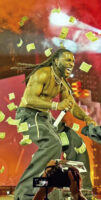
Burna Boy’s stage presence remains one of his greatest strengths. He possesses the swagger of a rock star, the confidence of a reggae icon and the command of an orchestra conductor. He moved constantly across the wide stage, engaging every section of the crowd. Halfway through the performance he removed his red singlet. With one sweeping motion he flung it into the audience. A beautiful young woman caught it. The crowd erupted again. It became another unforgettable souvenir from an unforgettable evening.
The pyrotechnics never stopped. Columns of fire erupted rhythmically. Smoke curled across the stage. The lighting danced in perfect conversation with the music. Yet nothing overwhelmed Burna Boy himself. The spectacle existed to serve the performer—not replace him. Perhaps that explains why Burna Boy has become one of Africa’s greatest musical exports. He comfortably moves between Afrobeats, reggae, dancehall, hip-hop, rock and Afro-fusion without sounding like a visitor in any of them.
He borrows. He blends. He creates something unmistakably his own. His collaboration with Shakira on Dai Dai, the official song of the 2026 FIFA World Cup, has introduced him to an even wider global audience. The multilingual anthem became one of the defining musical signatures of this year’s World Cup, reinforcing his position as one of the world’s most recognisable African performers. Watching him command a predominantly non-African audience in Milton Keynes, I realised something. Burna Boy is no longer simply Nigeria’s superstar. He belongs to the world. For one hour and fifteen minutes, Milton Keynes surrendered completely to him. There was no distinction between reggae lovers and Afrobeats lovers. No distinction between Black and White. No distinction between Britain, Nigeria or Jamaica. Music erased every border.
As we joined thousands streaming out of the National Bowl long after 10.45 p.m., I kept thinking about that opening moment with the Nigerian flag. It was more than stagecraft. It was a declaration. Africa no longer arrives at the world’s biggest stages asking for permission. It arrives carrying its own flag. And on this memorable summer night in Milton Keynes, Burna Boy planted that flag firmly in the heart of a reggae festival, proving that great music has only one nationality. The audience did not merely attend a concert. They witnessed a cultural conquest. Milton Keynes came expecting entertainment. It left having experienced a phenomenon.