Follow Us on Google
By Lukman Olabiyi
As the All Progressives Congress (APC) inches closer to its primary elections ahead of the next general elections, political activities within its Lagos State chapter have intensified, revealing a contest that is less about open rivalry and more about intricate political calculation.
Beneath the surface of consultations, endorsements and mobilisations lies a familiar but evolving system where structure, loyalty and strategic alignment often outweigh mere popularity.
With the timetable already set, the process has entered a decisive phase. The sale of nomination forms, which commenced on April 25, closed on May 2, 2026, while the submission deadline was fixed for May 4.
Screening of aspirants across all categories, slated for May 6 to May 9, culminating in the publication of results on May 11.
Thereafter, the party will proceed to the primaries beginning with the House of Representatives on May 15, Senate on May 18, State House of Assembly on May 20, governorship on May 21 and the presidential primary on May 23.
However, as is typical of Lagos APC politics, the formal timetable only tells part of the story. The real contest, party insiders insist, is being decided through a complex web of influence, negotiations and long-standing political relationships that often predate the primaries themselves.
At the centre of Lagos APC’s political architecture remains President Bola Ahmed Tinubu, whose influence continues to shape outcomes within the state chapter despite his elevation to the presidency.
Widely regarded as the architect of modern Lagos politics, his network of loyalists, protégés and institutional allies forms the backbone of decision-making within the party.
For aspirants, alignment with Tinubu’s political vision is not merely advantageous, it is often decisive. In Lagos, an ambition that is not tempered with deference to the established hierarchy rarely survives the internal selection process.
Those who understand and navigate these dynamics effectively position themselves as frontrunners, while those who miscalculate risk political isolation.
Closely linked to this influence is the role of the Governance Advisory Council (GAC), the apex political body in Lagos APC. Made up of seasoned party elders and power brokers, the GAC functions as a stabilising force, often guiding consensus-building and conflict resolutions.
Its decisions, though sometimes informal, carry significant weight in determining who emerges as the party’s standard-bearer. Lagos APC has long been defined by a disciplined party structure that prioritises organisation over spontaneity.
From ward executives to local government leaders and state-level stakeholders, the party’s internal machinery plays a decisive role in shaping outcomes.
Unlike more fluid political environments, where public sentiment can easily sway candidate selection, Lagos operates a delegate-driven system in which influence over party structures often translates directly into electoral success at the primaries.
Aspirants who have spent years cultivating relationships within this system typically enjoy a clear advantage.
This reality underscores a critical point: popularity among the general electorate does not necessarily guarantee success within the party. Some of the most visible aspirants may struggle if they lack deep-rooted connections within the APC’s internal framework.
Another key determinant in the emergence of winners and losers is zoning, both formal and informal. Lagos State’s political landscape is shaped by a delicate balance of senatorial districts, ethnic considerations and religious sensitivities. While not always codified, these factors often influence candidates’ selections in subtle, but decisive ways.
Should the party choose to rotate positions or prioritise underrepresented groups, it could dramatically alter the dynamics of the race. In such scenarios, lesser-known aspirants who align with these balancing considerations may find themselves elevated above more prominent contenders.
This unwritten principle of inclusion reflects the APC’s broader strategy of maintaining internal cohesion, while maximising electoral appeal across diverse constituencies.
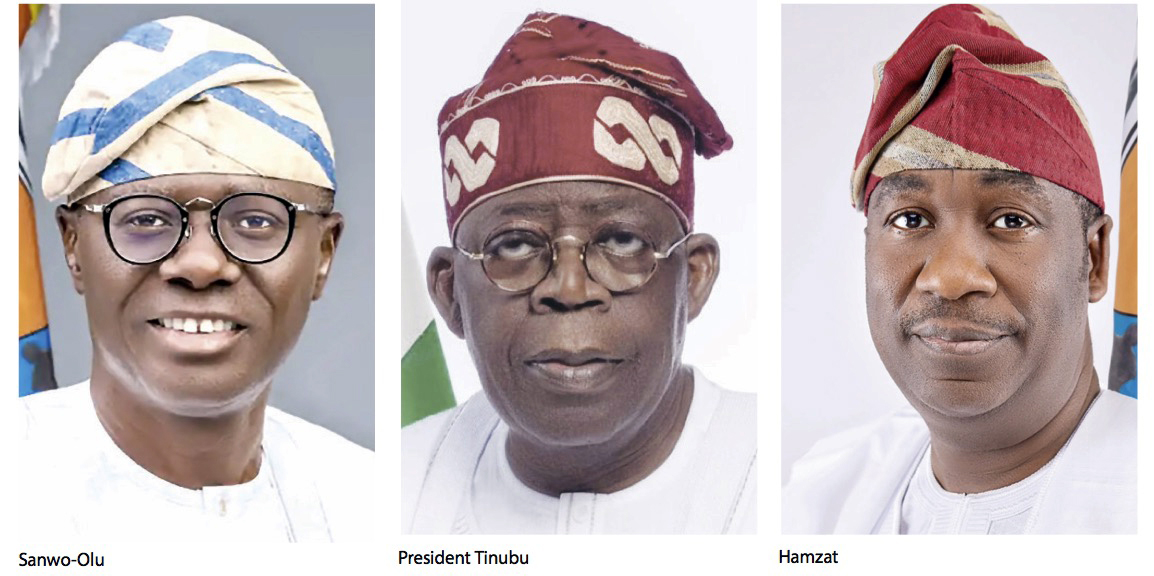
Among all the contests, the governorship race appears to be the least contentious. Obafemi Hamzat has emerged as the consensus candidate, with his candidacy receiving widespread endorsement from across the party’s power structure.
Backed by Babajide Sanwo-Olu, the GAC, and other influential stakeholders, Hamzat’s position has been further strengthened by support from organised labour groups, including the Nigerian Labour Congress and the Trade Union Congress.
His emergence has also triggered a wave of political realignments. Former governor Akinwunmi Ambode has publicly congratulated him, while former governorship aspirant, Olajide Adediran stepped down from the race in his favour.
Further consolidating his position, Hamzat’s nomination form was purchased by the GAC, led by Tajudeen Olusi, and endorsed by over 120 party leaders across the state’s 20 Local Government Areas and 37 Local Council Development Areas, including President Tinubu.
Taken together, these developments suggest that the governorship primary may be more of a formality than a contest, barring any last-minute political surprises.
Other News
In contrast to the uncertainty surrounding other positions, the senatorial races appear relatively settled. The incumbent trio-Adetokunbo Abiru (Lagos East), Oluranti Adebule (Lagos West), and Wasiu Eshinlokun (Lagos Central), are widely expected to retain their tickets.
Attempts to disrupt this status quo have largely failed. Notably, Mudashiru Obasa reportedly explored a bid to challenge Adebule for the Lagos West senatorial ticket but later abandoned the effort, opting instead to pursue a seat in the House of Representatives.
This outcome shows the strength of incumbency within the APC’s Lagos structure, where sitting office holders often benefit from established networks and institutional backing.
If the governorship and senatorial races appear predictable, the same cannot be said for the House of Representatives contests. Here, the terrain is far more volatile, with several incumbents facing credible challenges from within the party.
Multiple factors are driving this uncertainty. Zoning considerations, shifting alliances and the interests of key party leaders are all expected to influence outcomes. In some constituencies, grassroots dissatisfaction with sitting lawmakers could further complicate the picture.
As a result, the House of Representatives primaries are likely to produce a mix of continuity and change, with some incumbents retaining their seats while others are edged out by more strategically positioned challengers.
A similar pattern is expected to unfold in the State House of Assembly races. At this level, local dynamics play an even more pronounced role, with ward-level structures and community relationships often determining the outcome.
While some incumbents may benefit from their visibility and track record, others could fall victim to shifting political calculations or internal party disagreements. The interplay between local interests and state-level strategy will be critical in shaping these contests.
While internal party dynamics remain central to candidate selection, the broader electoral environment cannot be ignored.
The 2023 general elections marked a turning point in Lagos politics, with opposition parties making significant inroads and challenging the APC’s dominance in key areas.
This shift reflects a growing unpredictability among voters, particularly in urban centres where issues such as governance, service delivery and economic opportunity resonate strongly.
For the APC, this presents a strategic dilemma. Candidates who secure tickets through internal processes must still contend with an increasingly discerning electorate.
Those perceived as disconnected from grassroots concerns may struggle to translate party backing into electoral victory.
In broad terms, the profile of likely winners within Lagos APC can be distilled into three key attributes:
First, loyalty to the party’s established leadership and structures remains paramount. Aspirants who have consistently aligned themselves with the APC’s core leadership are more likely to secure support.
Second, strategic positioning within the party’s internal networks provides a significant advantage. Control or influence over delegates and key stakeholders often determines success at the primaries.
Third, alignment with zoning and balancing considerations enhances an aspirant’s viability, particularly in a politically diverse state like Lagos.
Conversely, those likely to emerge as losers in the contest often share certain characteristics. Aspirants who lack deep roots within the party structure may find themselves sidelined, regardless of their public appeal.
Similarly, established figures who misread the internal dynamics of the party risk being outmanoeuvred by more politically astute rivals.
In Lagos APC, experience alone is not enough, what matters is the ability to navigate the party’s intricate power structure.
Finally, candidates who rely heavily on popularity without securing delegate support may struggle to convert their visibility into victory at the primaries.
As Lagos APC moves closer to its primaries, one thing is clear: the emergence of candidates will be shaped as much by internal negotiations as by formal voting processes. In many cases, the real decisions may already have been made behind closed doors.
Yet, securing the party ticket is only the first step. The ultimate test lies in the general elections, where candidates must engage a broader electorate that is increasingly assertive and less predictable.
For the APC, the challenge will be to balance internal cohesion with electoral competitiveness. For aspirants, the path to victory will require not only political loyalty and strategic acumen but also the ability to connect with voters beyond the party’s traditional base.