Follow Us on Google
Irony! The very crises which have prompted Nigeria’s turn towards STEM are not technical crises at all… not crises of insufficient engineering, inadequate mathematical modelling, insufficient laboratory science … They are crises of meaning, narrative, identity and moral community −humanistic and social.–G.S. Ibileye, Vice Chancellor, Federal University of Lokoja.
By Victor C. Ariole
In this era of Artificial Intelligence (AI) over 6000 mother tongues in Africa needed to overwhelm extant epistemic process with that of Africans as Africans remain more humanistic and mindful of human interaction with seen and unseen realities than other sub-human races. There is only One Human Race and the knowledge processes coming from humans must be inclusive and helpful for the existence of the race, not detrimental to it. The languages spoken by humanscontain knowledge processes yet unexplored and Nigeria with over 500 languages should map-out what it takes to harvest such knowledge contents to assuage current danger of looming human extinction caused by excessive, dehumanistic arsenals in the hands of the “wicked”. Harvesting humanistic knowledge contents comes with exploring the values of African languages.
Neuroscientists agree that human brain is operating at barely 10% of its capacity and that every child is capable of acquiring at least five languages at earlier stages of life, hence a firm foundation to allow for tolerance, creativity, openness to others, innovation and peaceful behaviour for a better humanity. Stopping wars, insurgency, greed, insatiable political turbulence are challenges that are proactively nipped in the bud by a great dose of humanistic knowledge, and as well, speaking and creating narratives in the languages of the weaker ones to woo them to accept terms of governance and social contract that make them give their best in nation building like it is done in Ethiopia and closer to Nigeria, Chad.
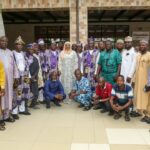
Nigerian Academy of Letters (NAL) in its 28th Convocation, Induction of New Members and Investiture of Regular and Honorary Fellows, chaired by its President Prof. Andrew Haruna, and in which 46 new members were inducted and 10 Fellows were crowned, and Honorary Fellow was bestowed on the El-Kanemi of Borno, HRH Shehu of Borno, Humanistic Practice Award to TundeKelani and Distinguished Life Fellow to Professor Emeritus Femi Osofisan, appeal was made to the Federal Government of Nigeria not to abolish the Mother Tongue (MT) Policy but to re-design it and re-position it as “A SecondGeneration Mother Tongue Policy” so as to see it serve as “Path To Nation-Building” as it is seen in Ethiopia, Senegal, South Africa and Chad.
For Professor Imelda Udoh who anchored her presentation on “The First Pathway To Nation-Building”, MT draws attention to the mooring infrastructure of a nation like stated by Prof. Ishaq Oloyede- cultural consciousness, linguistic heritage, functional literature consumption of the young ones from the homes where mother tongues are used, to ground them and induct them into human beings distinct from animals. Like mother tongue like mother suckling – very humanistic and resourceful; and leads to human optimisation pathway in the labyrinth of pathways.
For Professor Vicky Sylvester, who anchored her presentation on “Policy and Practice Mismatch”, Federal Government was ignoring the fulcrum of mother tongue practice as enunciated by UNESCO in 1953 − not as cultural idealism but as an intellectual boost for the young ones who must still face colonial languages as well as the Nigerian pidgin. Hence, the need to fund it so as to gratiate the self-esteem of the Nigerian child into well-rounded adult. Developing contents in this age of AI could be very original and greatly universalisable if mother tongue practice is well planned, and that is where Professor Yinusa Salami brings in what he calls epistemic order and pluriversalism− that is, no matter the number of mother tongues in Nigeria or Africa, their epistemic values and contents must be isolated and uploaded into a universal data base. It takes research, and producing good curricula to do that. It must not be just a translation from European languages to the mother tongue or vice-versa. Here linguists will tell you that semantic unit of African proverbs or expressions cannot be rendered word by word.
Epistemic order could as well create semantic units specific to mother tongues and model, to be appreciated by universalisation. Just like Professor Muhammed Sulaiman Audu mentions in his paper about Twi and Ga in Ghana. Two languages well developed by the Ghanaians to upload their own knowledge process notwithstanding the official English in Ghana and the official French in Togo. Ga has helped to create harmony between Ghanaians and Togolese, albeit as exhibited in Aflao border. This seems not obtainable in Nigeria, Cameroon and Chad borders–Fulfude, Kanuri and Hausa seem on centrifugal drive. How to reconcile them for centripetal purposes beckon; and it is humanistic and social. At the induction ceremony, The EL-Kanemi mentioned 1500 years of existence, museum and unconquered state, and it should matter in nationhood building.
In Ethiopia, the official languages are Ethiopian languages with a dominant one known as Amharic. It is expected that each of the official languages take care of its region of origin and educate its citizen along the local needs of Ethiopia, and that expectation to work at federal level must be the knowledge of Amharic – not federal character quota basis. Just like in Canada where you must speak and write French and English to aspire to be a confederal worker in Ottawa, most people in British Columbia, Prince Edward Island, Newfoundland, Labrador, Alberta do not care about speaking French and prefer staying and working within their provinces, thereby localising their development drive and keeping the provinces relevant and active. Unlike in Nigeria where people rush to the center Abuja, Lagos, Kaduna, Port Harcourt, neglecting or leaving the rural areas to non-state actors.
In Ghana or Senegal, the concept of Town and Krom(it is a town, it is my ancestral home) make Twi and Wolof greatly relevant in the development of the rural areas, slow it may be though, it is not left to insurgents or Boko Haram-type of activities.
Nigeria, nay Africa, needs a good dose of humanistic education capable of uploading the epistemic pathways embedded in mother tongues that drive Ubuntu philosophy – I am because you are.
Like G.S. Ibileye mentioned, Africa’s problem for now and in near future is more of humans and their environment cohesion than deep science and technology. According to him, “what does a camera see that a historian cannot name, and what does a drone detect that a linguist cannot read… if the spokesperson of the armed forces’ life could not be preserved (Major General Rabe Abubakar) what precisely are we asking five thousand cameras to do?”
So, in effect, for a nation building process, where inclusiveness and brotherhood counts and where insurgents are banished, re-design mother tongue policy to look like what obtains in Ethiopia or Senegal.
• Ariole, Ph.D, FNAL, is Professor of French and Francophone Studies, University of Lagos.