Follow Us on Google
From Sola Ojo, Abuja
The Nigerian Institute of Quantity Surveyors (NIQS) has renewed the push for stronger professional structures to improve cost management, accountability and value for money in Nigeria’s construction industry.
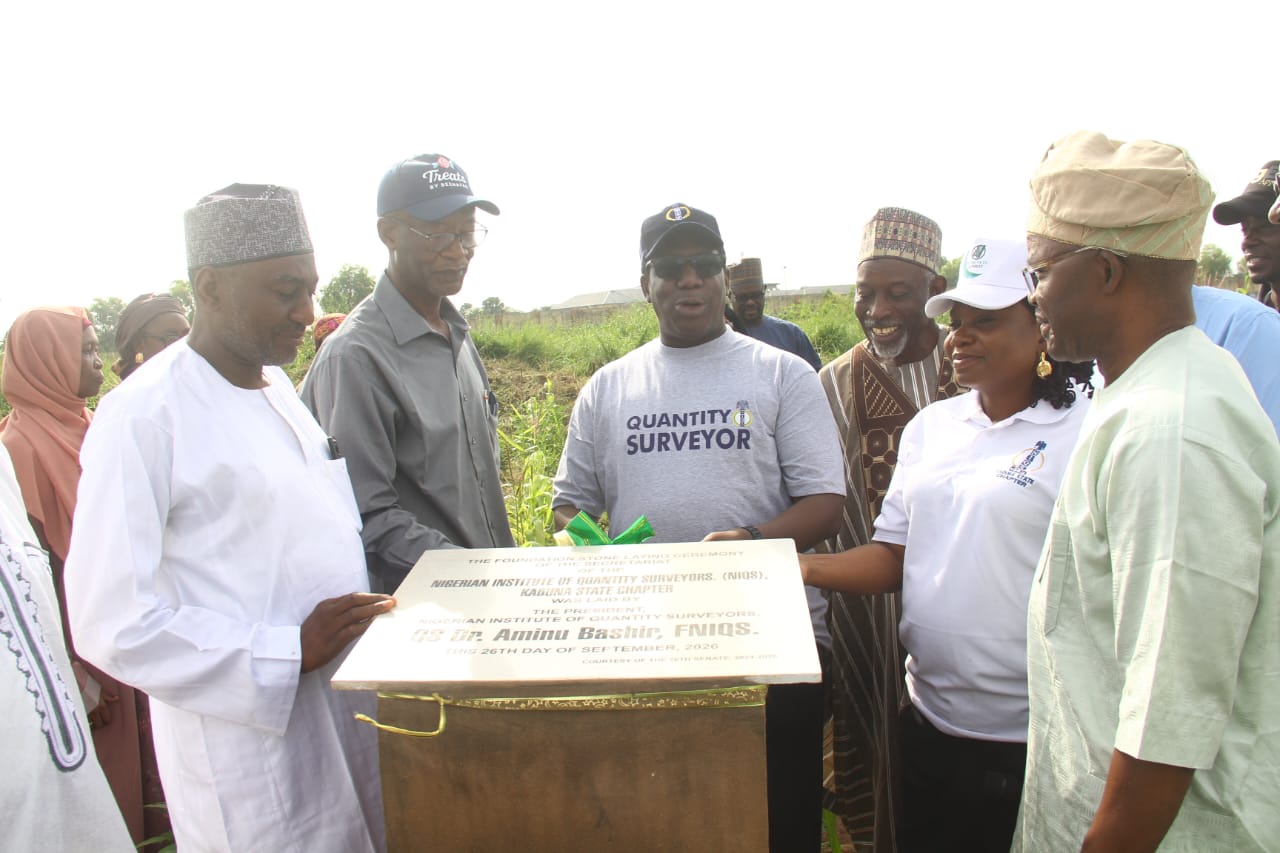
The call was made in Kaduna as the NIQS Kaduna State Chapter commenced the construction of a permanent secretariat at Baban Saura, Millennium City, Kaduna, said the project would strengthen professional development and its capacity to contribute to the construction sector.
The President of NIQS, QS Dr Aminu M. Bashir, who laid the foundation stone in the presence of quantity surveyors, construction industry professionals, past leaders, and other stakeholders
According to the President, quantity surveyors play a critical role in the construction process, providing expertise in cost planning, budgeting, procurement, contract administration, and expenditure control.
He noted that “stronger professional capacity in these areas is therefore central to ensuring that projects deliver value for money, particularly in an environment where governments and private investors commit substantial resources to infrastructure and building projects.”
The Kaduna Chapter’s project, being implemented under the leadership of its Chairperson, QS Dr BuKola Aluko-Olokun, and the 16th Senate, was designed to provide a permanent base for administrative activities, professional development, meetings and engagement with members and other stakeholders.
Speaking on the development, the chairperson said, “The secretariat was not merely an office project but an investment in professional growth, institutional continuity and the future of quantity surveying.
The chapter also acknowledged the contributions of the NIQS national leadership, members, past leaders and stakeholders whose support had made the project possible.
“Beyond Kaduna, the development shows the importance of building stronger professional institutions capable of supporting the standards, skills and accountability required to manage Nigeria’s expanding construction needs.
“It will also ensure that public and private investments translate into quality and sustainable infrastructure,” she added.