Follow Us on Google

From Fred Itua, Abuja
In a modest flat in Karu, outskirts of Abuja, a father sits before a pile of school resumption bills he cannot make add up. His two children, one in Junior Secondary School and the other newly admitted to Senior Secondary, need books, uniforms and levies whose totals have doubled since the last academic year. He has already sold the small generator he once hired out to neighbours. He does not know, as the school gates open, whether both children will walk through them this term or whether one will have to wait at home while he finds the balance.
Not far away, in a general hospital waiting room in Kubwa, also in the nation’s capital, a woman clutches a folded referral letter for surgery her husband needs urgently. The quoted cost has climbed far beyond what she saved, because the price of nearly everything the hospital must procure, from fuel for its generators to the diesel that moves supplies across the country, has followed the same relentless curve. She has begun asking relatives for loans she is not certain she can repay, and praying that her husband’s condition does not worsen before she finds the rest.
On the Abuja to Lagos expressway, a young trader boards a night bus he would once have avoided, because the fare on the safer, better lit route has become impossible to justify against his shrinking margins. He knows the road has grown notorious for kidnappings along its lonelier stretches, and he knows too that the cost of fuel has pushed transporters onto cheaper, riskier routes and later departures to save money. He travels anyway, because the alternative, staying home with no goods to sell, frightens him more than the road does.
In another instance, the despair has taken takes other form. A young graduate in Ibadan has stopped updating his CV, having concluded that the jobs he trained for either do not exist or do not pay enough to survive on. A civil servant in Minna cannot say with certainty what his family will eat for dinner, since his salary now stretches across barely half the month it once covered. In a modest compound in Benin City, a man has begun making enquiries about selling the small plot of land he inherited from his father, not to invest it elsewhere in Nigeria, but to fund his family’s relocation abroad, one more household added to the country’s swelling exodus of the disillusioned.
The aforementioned scenarios, though fictional, are not isolated misfortunes. They are the lived texture of an argument now playing out at the very top of Nigerian politics, where the African Democratic Congress (ADC) presidential candidate, Atiku Abubakar, has built a sustained campaign around the claim that petrol subsidy removal, whatever its theoretical merits, is the single policy decision most responsible for the hardship families like these now carry. Atiku’s claim, and the fierce defence it has provoked from President Bola Ahmed Tinubu’s government, has become one of the most consequential political arguments of the last two years.
The numbers Atiku has placed before Nigerians, meant to explain exactly why families like these are struggling, are stark. In a statement issued through his aide Phrank Shaibu, he noted that fertiliser had risen from roughly N9,000 to about N fifty thousand naira, that petrol had climbed from around one hundred and ninety nine naira to roughly one thousand four hundred naira per litre, and that cement had moved from about four thousand naira to thirteen thousand five hundred naira, all while the naira slid from around four hundred and fifty to the dollar to nearly one thousand four hundred. Those figures form the backbone of his case that subsidy removal has translated into precisely the lived hardship described above.
Atiku has gone further beyond criticism. He has pledged to reintroduce a subsidy if elected in 2027, though he has taken pains to distinguish his proposal from the old, discredited import subsidy regime. His plan, which his campaign calls a Production Subsidy, would direct support toward domestic refining rather than imported fuel, moving what he describes as subsidy from importation to production, from middlemen to Nigerian refineries, and from unverifiable claims to verifiable barrels. He has invited the Independent Petroleum Marketers Association of Nigeria into what he calls his 2027 policy coalition, after the association itself called on government to work with domestic refiners to bring prices down.
The government’s response has been anything but muted. President Tinubu personally dismissed Atiku’s pledge as evidence of serious ignorance of governance and economics. However, opposition figures have seized upon Tinubu’s response as proof that the issue has struck a nerve. The presidency has also pushed back on the figures themselves, with reports suggesting that officials floated a projection that subsidising petrol back down to roughly N600 a litre could cost the country in the region of N19 trillion. The ADC has publicly rejected the figure as what it called a phantom number, insisting that the presidency’s arithmetic sidestepped the actual question of affordability.
Atiku’s camp has also pointed to NNPC’s own audited accounts to challenge Tinubu’s repeated claim that subsidy has been fully abolished. Citing the corporation’s 2024 audited financial statements, which recorded some N7.1 trillion under a heading described as energy security costs, up from roughly N4.8 trillion the year before, Shaibu argued that subsidy in some form persists, only now it flows toward what he called rich friends rather than ordinary Nigerians, through mechanisms such as production tax credits available under the Deep Offshore Oil and Gas Projects Incentives framework.
Where the government has been most consistent is in redirecting attention to the states. Tinubu’s argument, echoed by allies, is that the savings from subsidy removal have been transferred to state governments, and that any failure of those funds to reach ordinary Nigerians is a question for governors rather than the presidency. For pundits, it is a defence that exposes an uncomfortable silence. Beyond a handful of voices, most sitting governors have avoided wading directly into the subsidy restoration debate, leaving the argument to be fought largely between the presidency and the opposition.
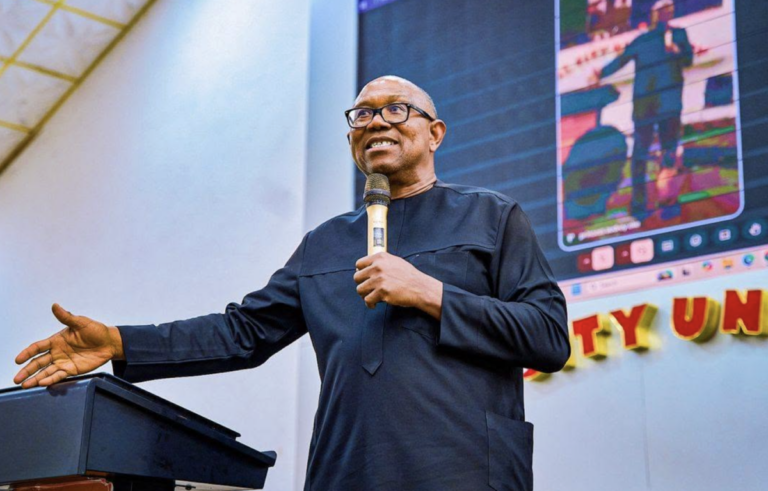
Not every opposition figure agrees with Atiku’s prescription, which complicates any simple narrative of a united front against the government. Peter Obi, the Nigeria Democratic Congress (NDC) candidate, broke publicly with Atiku on the question at a Nigerian Bar Association conference in Port Harcourt, arguing that while the federal government had indeed mismanaged the savings from subsidy removal, that mismanagement was not sufficient reason to bring the subsidy back. Rotimi Amaechi, the former Rivers State governor now standing as Atiku’s vice presidential candidate, has taken a more combative line, warning Nigerians bluntly that a vote for Tinubu was a vote to die of poverty, while pointing to his own record in Rivers State as evidence of what competent governance could deliver.
The sharpest pushback has come from within the ranks of those closer to government. Kayode Fayemi, the former Ekiti State governor, compared Atiku’s subsidy pledge to the APC’s own Muslim Muslim ticket gambit in 2023, describing it as a political strategy rather than a genuine economic construct, and noting that the Nigerian Governors Forum had in fact worked with the federal government and the World Bank to design a safety net strategy intended to cushion the impact of removal on the most vulnerable. Atiku’s response was sharp in turn, challenging Fayemi to engage with the economics of targeted, transparent support for domestic refining rather than dismiss the proposal as mere politics, and crediting himself with forcing the APC to debate an issue it would otherwise have preferred to avoid.
Analysts tracking the exchanges have noted that the scale and speed of the presidency’s response, ministers weighing in, aides issuing rebuttals, the president himself breaking from studied indifference to previous attacks on his person, suggests that the subsidy question has touched something the government would rather have left settled. The demand now being made, not only by Atiku but by a wider chorus of commentators, is for a transparent public accounting of exactly how much was saved from subsidy removal, which state and federal projects absorbed those savings, and what ordinary Nigerians have to show for the sacrifice they were asked to make.
It is unclear if the argument will become the defining issue of the 2027 campaign. It will depend on factors beyond the debate itself. The economic hardship underlying it, transportation costs, food prices, school fees and the price of basic imports, is not disputed by either side, only its causes and remedies are contested. That gives the subsidy question a durability other campaign issues often lack, since it is anchored in something voters feel directly rather than something argued only in the abstract.
Observers believe that if Atiku can sustain the pressure and force a genuine accounting from the states as well as the centre, the issue could indeed dominate the run-up to next year’s polls. If, however, the debate remains confined to dueling statements between the presidency and the opposition, with governors continuing to sit largely on the sidelines, it risks becoming one more heated but ultimately inconclusive argument in a political calendar that lacks for those.
For now, the contest over subsidy has done what few other issues managed in the early stages of the 2027 race; it has narrowed the frame of the contest, sharpened Atiku’s profile as Tinubu’s most persistent challenger, and forced a presidency that prefers to talk about macroeconomic stabilisation to instead defend, litre by litre and naira by naira, what Nigerians are actually paying for the choices made in its name.