Follow Us on Google
• “No more declarations – accelerate now!” Sulaiman-Ibrahim’s urgent CSW70 plea for women’s action
__________________________________
From Juliana Taiwo-Obalonye, New York
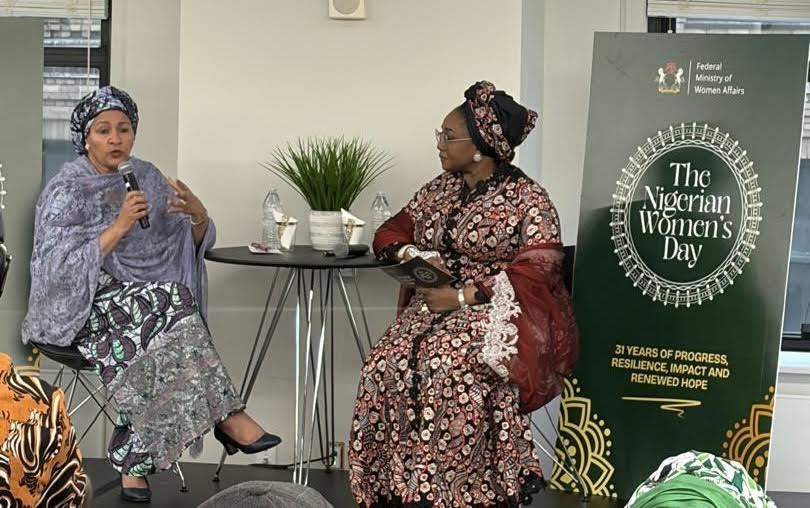
With just five years until the 2030 Sustainable Development Goals (SDGs) deadline, UN Deputy Secretary-General Amina Mohammed issued a stark warning at Nigerian Women’s Day in New York: without prioritising gender equality, half the world’s potential – and Nigeria’s progress – will be lost forever.
Organised by Nigeria’s Federal Ministry of Women Affairs and Social Development under the theme “31 years of progress, resilience, impact and renewed hope,” the event, held on the sidelines of the 70th session of the Commission on the Status of Women (CSW70), highlighted how economic shocks, conflicts and climate crises threaten women’s gains, dooming the broader development agenda if equality stalls.
Mohammed stressed that gender equality, SDG Goal 5, is the “docking station” for all 17 goals. “Without women, that’s half the world population. It means that half of us will be missing. It means that the ambitions, the possibilities, the potentials of the world will only be half met,” she stated. “There’s no SDG that is not attainable when you want to end poverty, inequalities, access to education, your health, water and sanitation… You need economies to be inclusive.”
She criticised growth that leaves populations behind: “It’s no good telling everybody that your economy is growing when you’re leaving the population behind. It means you’re not investing in the systems to deliver the health and the education that they need.” Conflict, out-of-school children and lack of health access will persist without women fully engaged, she added, tying Nigeria’s challenges to global stakes.
Mohammed insisted that budgets across all ministries must centre on women, not just Women’s Affairs. “The whole budget should see women throughout it. It’s not just your budget, it’s their budget. You want half of as well,” she urged. On health, she asked: “How many women have accessed health, how many women have been able to deliver, go into a hospital, not thinking that they will come out in a coffin, but they’ll come out with a baby?”
On energy transitions and clean cooking, she reflected personally: “Every energy transition strategy that is done in a country must include women… Will you take that cooking stove and cook on it for yourself? It’s okay for the poor, but it’s not okay for me.” For agriculture, she emphasised full value chains: “From production to the table… We want to see ourselves through the back-breaking job of being a farmer to participating in business and earning those profits.”
Without women in decision-making, institutions will fail to deliver on the SDGs, Mohammed argued. Nigeria flies “on half of the bird’s wings” without justice for women, who hold up “more than half the sky.” She pushed for reserved seats for women at the National and State Houses of Assembly: “You have oversight over the budget… and the opportunity to make laws that uplift our women.” On diluted bills, she demanded action: “Make the life of every man uncomfortable… We all need to get on the streets to fight for it.”
She stressed that local foundations matter too: “It is not just the president… It is the local government chairman. It is the governor.” She praised initiatives such as LPG credits and agro programmes, but stressed that success must be measured by women’s access.
During the Question and Answers session, on closing the gender digital divide, she said: “Make the policies open up the spaces for women… Ensure that half the country has access to technology.” On parliamentary capacity, she urged: “Put in a line in the budget that talks about building the capacity of women legislators… Partner with the Minister of Women Affairs.” Innovators must integrate with policy for SDG acceleration, she added, noting that Nigeria’s FinTech rise shows what is possible when access is provided.
Nigeria’s Minister of Women Affairs and Social Development, Imaan Sulaiman-Ibrahim, used her keynote at the second Nigerian Women’s Day event in New York – on the sidelines of CSW70, themed “31 years of progress, resilience, impact and renewed hope” – to launch the Restored Hope Social Impact Intervention 77.4 (RHSII 77.4). Described as “one of the most ambitious gender-responsive development frameworks in the history of Africa,” it targets women in all 774 local government areas, shifting empowerment from urban elites to grassroots realities.
Nine pillars to transform women’s lives
Sulaiman-Ibrahim detailed nine pillars tackling structural barriers to economic independence, leadership and dignity. On energy access via the Women’s Initiative for National Growth through SOLAR, she said: “Nigeria is a key market access to clean energy solutions, solar power systems, and productive energy assets for women entrepreneurs and households. For the Nigerian woman, this means more than electricity. It means the ability to run a business after sunset, to power agro-processing equipment, to reduce time spent drawing by a wheel, and to transform energy access into economic opportunity.”
Agriculture’s WAVE programme empowers 70% female smallholders producing 82% of food: “Women make up a significant portion of Nigeria’s agricultural workforce, yet they remain largely confined to the productivity segment of the value chain. Through the WAVE programme, we are supporting women farmers with inputs, technology, extension services, and market integration. For the Nigerian woman farmer, this means moving from subsistence farming to commercial agriculture.” She shared a pilot success: “We had over a hundred women, gave them a million. We were able to increase it to almost 1.2 million. One of those is my own auntie, who went and got two to four acres of land, and she planted rice… She had got over 100 bags of rice… The extra she’s going to feed her community. The other 100 she was able to sell.”
Digital Harmony fights exclusion: “Digital transformation is shaping economies across the world. Yet millions of women remain excluded from digital finance, digital skills, and online economic opportunities. Our Digital Harmony Initiative has funded digital literacy for our women, digital entrepreneurship, and access to financial technologies.” Health in Black addresses violence: “No society can prosper where women live in fear of violence and lack of access to essential health care services… This includes psychosocial support care… Expanded sexual assault and violence centres.”
On leadership, she said: “Women’s representation in leadership remains one of the most consistent global gaps… Investing in leadership training, mentorship, networks… For the Nigerian woman, this means not just the seat at the table, but the confidence, the capacity, institutional support to influence policy.” On Child Advancement, she noted: “Our National Child Policy was that of two… Child Rights Act of 2019 is outdated. They’re all undergoing review… Emergence of a dedicated child agency.” On family, she added: “Strong families are the bedrock of a strong society… Unpaid care work, long ignored in economic planning, is finally being recognised as a critical component of national productivity.”
President’s backing, budget surge
Other News
Sulaiman-Ibrahim thanked President Bola Tinubu for declaring 2026 the Year of Families and Social Development: “This declaration is strategic. It reaffirms… that the strength of any nation is rooted in the stability of its families and that women, children and growth folks must be placed highly at the centre of economic policy.”
On funding, she said: “When I came to the ministry in budget 2004, it was $3.5 billion. In 2025, our budget was almost $100 billion… The proposed budget now is one hundred and forty-something million… This is unprecedented.” She hailed a “government that is very, very supportive… A crop of he-for-she’s in Nigeria,” urging: “We can’t do it alone without the men… Thank you so much, he for she.”
Six urgent calls: invest, rally, act
The minister issued six actions: “First… significantly increase investment in the women’s empowerment programs… It’s non-negotiable… What is a hundred million going to do? You see, twenty million for sanitary intervention. You see 50 million for clean cooking. How many clean cooking stoves can we get with that?”
On mobilisation, she said: “We must continue the women’s movement through a thousand-street-by-street solidarity movement… We’re going to do a big rally… Chances are 100% we’ll get them because we’re going to promise them 20 million votes… We’re all in the APC now… Mr President, we’ll give you 20 million votes.”
On combating violence, she stressed: “Intensify grassroots advocacy… A 12-year-old girl who was raped by a 16-year-old… After her surgery, they could not sew her up. They couldn’t. This is real life. And it must stop.” She further called for harmonising efforts, expanding girls’ education and pursuing “incremental change… The time for progress is short. The time for argument is now.”
“Anything without us is against us… If you are not on the team, you are the menu,” she rallied, calling women “discourseful… enterprise… dependable,” and vowing transformation 31 years post-Beijing.
Declaring an end to empty promises 31 years after Beijing, Sulaiman-Ibrahim again demanded action over words at the Nigerian Women’s Day side event during CSW70 on 12 March 2026. “While preparing for CSW70, one question continued to occupy my thoughts: how do we move from decades of global commitments on women’s rights to measurable transformation in the daily lives of women and girls?” she challenged. “Thirty-one years after Beijing, the aspiration is clear, the evidence is overwhelming, and the urgency is undeniable. The world no longer needs more declarations; it needs accelerated implementation, bold investment, and systems that place women at the centre of national development.”
Sulaiman-Ibrahim unveiled the Renewed Hope Social Impact Interventions 774 (RH-SII-774), under President Bola Tinubu, describing it as a groundbreaking initiative reaching every one of Nigeria’s 774 Local Government Areas to empower grassroots women. “This initiative represents one of the most ambitious gender-responsive development frameworks in Africa,” she said. “It is designed to reach women across all 774 Local Government Areas, ensuring that empowerment is not confined to urban centres but reaches the grassroots where the majority of Nigerian women live, work, and raise families.”
She added that RH-SII-774, structured around nine pillars, dismantles barriers to economic independence, leadership and dignity.
She explained each of the pillars, saying that energy access via WINGS and PowerHer774 breaks productivity chains: “Through the Women’s Initiative for National Growth through Solar (WINGS) and PowerHer774, Nigeria is expanding access to clean energy solutions… For the Nigerian woman, this means more than electricity. It means the ability to run a business after sunset, to power agro-processing equipment, to reduce the time spent gathering firewood, and to transform energy access into economic opportunity.”
The WAVE programme revolutionises agriculture, where women dominate smallholder farming: “Through the WAVE programme, we are supporting women farmers with inputs, technology, extension services, and market integration. For the Nigerian woman farmer, this means moving from subsistence to commercial agriculture, reducing post-harvest losses, and securing higher incomes that strengthen household food security.”
Digital Harmony bridges the tech divide: “Our Digital Harmony initiative is expanding digital literacy, digital entrepreneurship, and access to financial technologies. For the Nigerian woman, this means access to markets beyond her immediate environment, the ability to participate in the digital economy, and greater control over financial resources.”
Health Safeguard combats violence and health gaps: “Through our Health Safeguard pillar, Nigeria is strengthening systems to address gender-based violence, maternal health challenges… For the Nigerian woman, this means stronger protection systems, expanded Sexual Assault Referral Centres, improved access to health services.”
Creativity thrives in Women’s Resource and Innovation Centres: “Through the Women’s Resource and Innovation Centres, we are investing in innovation ecosystems… For the Nigerian woman, this means turning ideas into enterprises, creativity into income, and talent into sustainable livelihoods.”
SheLeads boosts political power: “Through the SheLeads initiative, we are investing in leadership training… For the Nigerian woman, this means not just a seat at the table, but the confidence, capacity… to shape the future of her nation.”
Education and enterprise build skills: “Nigeria is expanding access to skills development, enterprise support… to break cycles of poverty across generations.” Child Advancement (CAAP) protects the future: “For the Nigerian girl, this means access to education, protection from exploitation.” Families First (FFI) values care work: “Unpaid care work – long ignored in economic planning – is finally being recognised as a critical component of national productivity.”
Six urgent actions: implementation over promises
“Women’s empowerment is not a social programme; it is an economic strategy, a security strategy, and a development imperative,” Sulaiman-Ibrahim asserted, calling for “She for She” solidarity and coordination. Her six actions: ramp up investments; build women’s movements; eliminate duplication; fight gender-based violence; prioritise girls’ education; and act now – “because the time for promises has passed; the time for action is now.” Nigeria, she pledged, will partner for “measurable transformation in the lives of women and girls.”