Follow Us on Google
By Moses Akaigwe
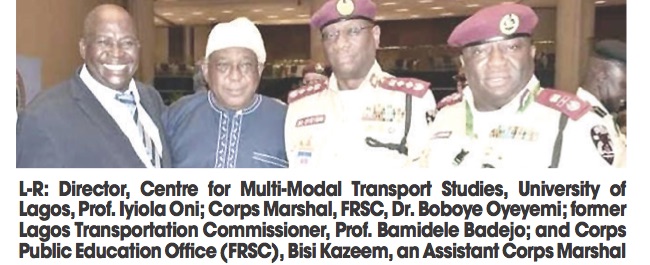
The importance of multimodality, safety, reliable data base, modern technology and workable policy, have been identified by experts as salient features of a modern transportation system that is efficient and environment-friendly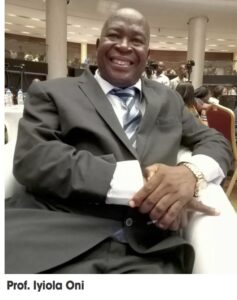
The stakeholders in the transportation sector brainstormed at a two-day National Transport Technology Conference and Exhibition in Victoria Island, Lagos, under the theme Multimodality And Interconnectivity: Achieving An Efficient and Greener Transport System in Nigeria.
At the forum was organised by the Nigeria Transport Commissioners’ Forum in conjunction with the Lagos State Ministry of Transportation, the participants affirmed that effective policies for sustainable accessibility and mobility in urban areas is very necessary.
This, they emphasised, is because effective and efficient multimodal transport system is a stimulant to economic development.
Setting the tone for the conference in a keynote address, a Professor of Transport Planning and Management, Prof. Iyiola Oni, submitted that a multimodality would promote accessibility, thereby reducing carbon footprint for a greener transportation system.
Drawing from his vast knowledge and wealth of experience on the subject-matter, Oni, who is the Director, Centre for Multi-Modal Transport Studies, University of Lagos, explained that development of effective policies is required for sustainability, accessibility and mobility in urban areas of Nigeria.
He, however, recommended that policies should be matched with necessary infrastructure, investment and political will in order to achieve the goal of restructuring the public transport system.
Oni further identified one of the strategies for efficient, intelligent transportation systems as strong base of high value-added transportation to encourage the applications of technologies that should be established and maintained.
The Director advocated for a strong partnership among government agencies, universities and private companies, to accelerate the development, diffusion and implementation of new ideas and knowledge.
A legal and regulatory framework, according to him, should also be put in place to enhance innovation.
The Professor of Transport Planning and Management recommended that, to achieve a sustainable greener transportation, there must be a framework to support policy makers to formulate broad base greener transportation policies.
Nigeria, Prof Oni stressed, needs to adopt a sustainable transport system with efficient fuel usage- eco buses, eco-boats, and light electric trains.
In his Corps Marshal, Federal Road Safety Corps, Dr. Boboye Oyeyemi, said the multimodal transport operation in Nigeria is still largely under-developed, because of the following factors; lack of guaranteed scheduled services; lack of cargo information systems; lack of modern cargo handling equipment and methods; poor road/rail links to ports; poor state of transport infrastructure, paucity of funds, technological gaps, among others.
Oyeyemi said the multimodal transport concept has to be recognised as an important component of the global logistics.
For instance, the enactment of the Nigeria Cabotage Act 2003, development of Inland Container Depot, dredging of River Niger, as well as seaports terminal concessioning and railway reinvestment and reforms, are practical demonstration of the commitment of the Federal Government towards the realisation of multimodal transport in the country.
He said mobility is a critical factor in the advancement of humanity and society. Currently, according to him, the transportation industry, has become one of the most dependable industries in the world.
Oyeyemi said the state of the transportation system in any clime reflects its development, observing that today; the Nigerian transportation system is made up of air, rail, road and waterways.
Accounting for about 204,000-kilometre network and an estimated 12.5 million vehicular volume as at 2021, the road remains the most interconnected and predominant mode of transportation used for facilitating trade, investments and other services, is relied on for over 95 per cent of all mobility needs, he disclosed. This is also due to its affordability and ease of accessibility.
However, he said this has led to increased road traffic crashes with attendant fatalities and injuries.
For instance, in 2021 alone, 13,027 crashes were recorded leading to 6,205 deaths, which account for three per cent loss of the country’s GDP ($15.3b nominal GDP).
The Corps Marshal listed other adverse effects of road transportation to include infrastructure decay and Greenhouse Gases Emission (GHE), which constitutes a global threat to living as emissions of hydrocarbons by vehicles is viewed as a major contributor to GHE.
He stated that for the transportation system in the country to improve, a functional inter-modal transport system must be activated at all levels. Mobility is a critical factor in the advancement of humanity and society.
Oyeyemi further observed: “Today, the transportation industry, which deals with the movement of people and products, has become one of the most dependable industries in the world. The relationship between transportation and development has moved from linear to exponential levels as demand and supply of services across different geographical spaces expand.
“There is no doubt that the state of the transportation system in any clime reflects its development.
“The advent of transportation activities in Nigeria was occasioned by the growth of commerce and trade which resulted in the construction of rail lines in 1916 to connect some parts of the country with Port Harcourt for easy movement of palm oil, cocoa and coal.
“Over time, the expansion of economic activities in the country fast-paced development and increased the quest for mobility.
“Today, the Nigerian transportation system is made up of air, rail, road and water ways. The road with about 204,000 kilometres m network and an estimate 12.5m vehicular volume as at 2021, remains the most interconnected and predominant mode of transportation used for facilitating trade, investments and other services in Nigeria accounting for over 95 percent of all mobility needs. Affordability and ease of accessibility makes the mode heavily relied upon above others.
However, this has led to increased road traffic crashes {RTC}with attendant fatalities and injuries. In 2021 alone, 13,027 crashes were recorded leading to 6,205 deaths which account for 3 percent loss of the country’s GDP (USD15.3b nominal GDP).
“Other adverse effects of road transportation include infrastructure decays and Greenhouse Gasses Emission (GHE) which constitutes a global threat to living as emissions of hydrocarbon by vehicles is viewed as major contributor to GHE. The fact remains that for the transportation system in the country to improve, functional inter-modal transport system must be activated at all levels.
The Corps Marshal said the increased demand for Liquefied Natural Gas (LNG) and Liquefied Petroleum Gas (LPG) has further necessitated the quest for safety of pipelines and speedy transportation of hydrocarbons.
This mode, according to him, is designed to enhance safety in the transportation of petroleum products to major distribution channels in the country. However, the pipelines in the country are almost at the lowest rate of utilization for the transportation of petroleum products.
He said there has not been a balanced development of the country’s transportation system. High priority has been devoted to a particular sector against others bringing about uneven development across sectors.
Lagos State Commissioner for Transportation, Dr. Frederic Oladeinde, urged the Federal Government to develop a transportation fund for the development of transport infrastructure across the country.
Oladeinde, who spoke on a panel session, stressed that the Federal Ministry of Transportation should champion the fund by introducing the right policies.
He said, “The Federal Government should develop a policy that allows everybody to contribute to the transport fund. So it should start with the Federal Government, and then the state government. The policy would help states and everyone to develop their own transport fund.”
He noted that though private sector players would also play their part, the Lagos State government, with a commuting population of 15 million, should enact more transportation policies.
In her remarks, the out-going Chairperson of the Nigeria Transport Commissioners’ Forum, Rahmatu Muhammed, observed that technological innovations have made a profound impact on the effectiveness and development of
“However, the transportation sector has only scratched the surface of the rapidly emerging technologies which could enhance the primary objective of safety and security, as well as revenue generation at both State and Federal levels: Hence this bespoke conference to showcase these products, to adopt these services and to improve our sector starting at the grass root level,” Rahmatu Muhammed stated.
Among the highpoints of the conference were panel discussions, one of which had Prof. Samuel Adewunmi of the Lagos State University, Ojo, as the moderator, and Dr. Oyeyemi as a participant.
One of the discussants and Managing Director of the Lagos Metropolitan Area Transport Authority (LAMATA), Abimbola Akinajo, confirmed that the implementation of the Lagos Strategic Master Plan, which is the core guideline for development of public transportation in the state, is on course.
Akinajo, who is an engineer, disclosed that apart from road procuring suitable sundry modern vehicles to boost road transportation, emphasis is also being placed on the development of water transportation.
She informed he guests that as contained in the transport policy, non-morised transportation is also being accommodated.