Follow Us on Google
By Merit Ibe
Stakeholders have called for stronger collaboration, innovation and targeted investment to accelerate Nigeria’s transition toward renewable energy and sustainable power access for all.
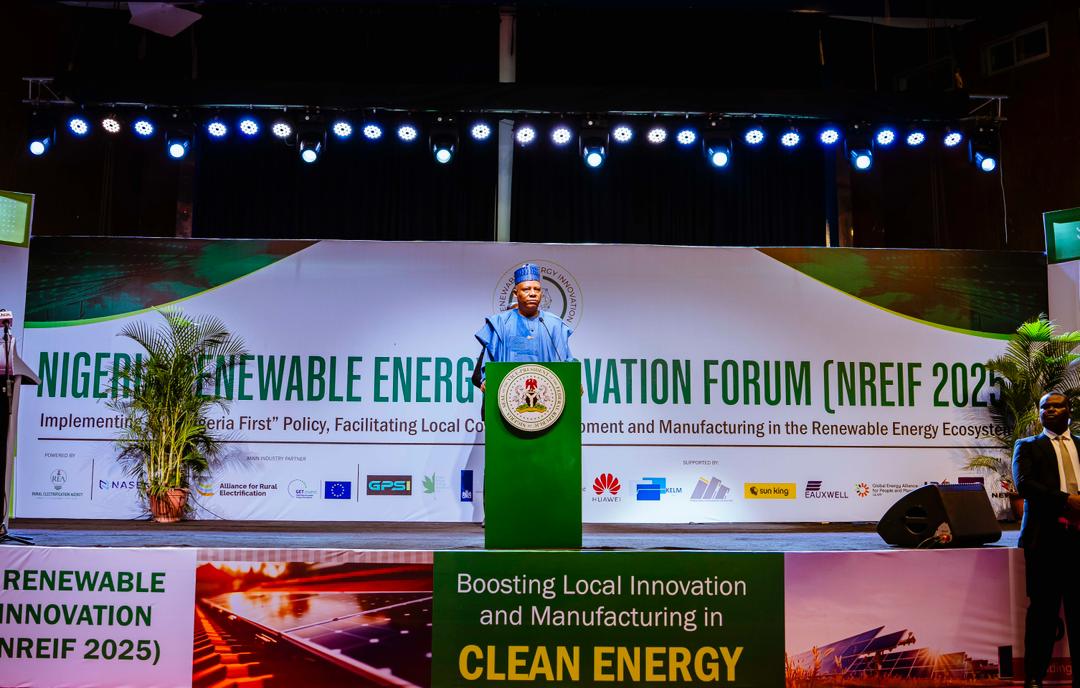
They made their views at the Nigeria Renewable Energy Innovation Forum (NREIF), a two-day programme, organised by the Rural Electrification Agency (REA) in Abuja, which brought together policymakers, private sector players, equipment manufacturers, and development partners to discuss strategies for enhancing renewable energy local manufacturing, financing, and distribution nationwide.
In his remarks, Vice President Kashim Shettima, underscored the importance of private sector participation in driving the nation’s energy transition. He urged stakeholders to adopt the “Nigeria First” policy by prioritising local content development and investments that promote homegrown renewable energy solutions.
“We are improving local manufacturing incentives, refining regulatory frameworks, and enhancing collaboration with state governments and investors to help de-risk private capital and accelerate the growth of a sustainable renewable energy market,” the Vice President stated.
Reinforcing this point, Abba Aliyu, REA’s Managing Director and ChiefExecutiveOfficer, noted that Africa should not be overlooked in global energy transition discussions. He stressed that Nigeria’s abundant renewable resources, particularly solar, must translate into tangible industrial and economic gains.
“Africa has nearly 60% of the world’s best solar resources but attracts less than 3% of global renewable energy investment. The task ahead is clear: we must transform this advantage into a competitive edge by building industries, fostering innovation, and creating local value,” he said.
Adding a private sector perspective, George Ogbonnaya, Divisional Head of Business Banking at First City Monument Bank (FCMB), highlighted the critical role of financial innovation and public-private collaboration in scaling renewable energy adoption.
“Nigeria’s renewable energy transition demands shared commitment. Unlocking over $400 million in investment will require strong government and private sector collaboration to expand access, accelerate local manufacturing, and strengthen energy infrastructure. At FCMB, financial innovation enables this collaboration and delivers reliable power to unserved and underserved communities.”
FCMB has supported the renewable energy value chain through project financing and capacity-building initiatives for developers and end-users. The Bank recently entered into a strategic collaboration with the REA to provide a N100 billion loan facility to deliver power to 2 million households in unserved and underserved communities across the country. The intervention is under the REA’s Distributed Access through Renewable Energy Scale-Up (DARES) program.
The bank understands the impact of energy costs on small businesses and has committed to solving this problem by providing energy finance loans of up to N30 million for small businesses to acquire clean energy equipment such as solar panels, batteries, and inverters, with repayment plans of up to three years. This amount can significantly go up for larger SMEs.
The Nigeria Renewable Energy Innovation Forum (NREIF) aims to position the country as a key player in the global clean energy economy while supporting the Federal Government’s broader “Nigeria First” policy. Participants reaffirmed their commitment to bridging Nigeria’s energy access gap, strengthening local manufacturing, and unlocking new investment opportunities within the renewable energy sector.