Follow Us on Google

By Chinyere Anyanwu
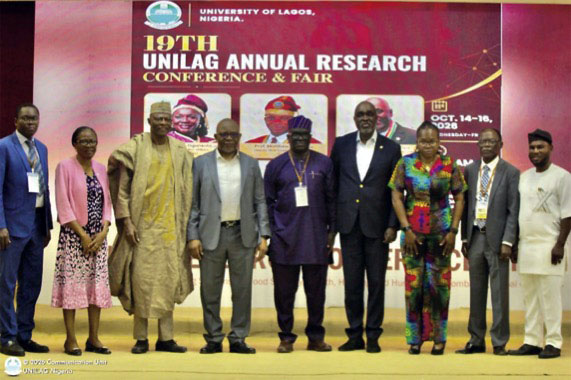
Experts have called on academic professionals, researchers and industry leaders to form greater synergy that will ensure the results of academic research impact industrial growth. The call was made during the three-day 19th University of Lagos (UNILAG) Annual Research Conference and Fair themed: “Sustaining Frontiers, Integrating Systems Food Security, Health, Housing and Humanities for Combating Global Challenges,” held at the institution’s premises between October 14 and 16, 2026.
The experts, who decried the current situation where results of academic research end up on library shelves, insisted that for the country to join the league of industrialised nations, the gap between the gown and the town must be bridged.
Citing the examples of the US and China where the academia and industry have sustained strong partnerships that have turned the two countries into global economic powers, the experts maintained that the relationship between Nigeria’s academia and industry could not afford to remain on the path of nonchalance.
They insisted that commercialisation of academic research results holds the key to Nigeria’s economic and industrial growth. One of the experts, Ife Oyedele, the National/Global President of UNILAG Alumni Association, said the academia must begin to produce research that is tailored to industrial goals.
Oyedele stated that, “the relationship between the academia and industry is what builds the economy.”
Other News
In her welcome address, the Vice Chancellor of UNILAG, Prof. Folasade Ogunsola, represented by the Deputy Vice Chancellor (Management Services), Prof. Muyiwa Falaiye, lauded participants comprising, scholars, researchers, industry leaders, policymakers and practitioners for seeing the importance of the conference and identifying with it.
She said this year’s conference theme “is apt and devoted to socio-economic development. It captures the complex and interconnected challenges confronting societies today, and highlights the urgent need for innovative, interdisciplinary and sustainable approaches to addressing them. universities play a pivotal role in generating knowledge, fostering innovation and providing evidence-based solutions to contemporary global issues.”
Ogunsola stated that, “to combat these intersecting global challenges, we must intentionally create pathways to build a resilient future through our research, policy and practices.”
Earlier in his address, the Deputy Vice Chancellor, Academics and Research, Prof. Matthew Ilori, said the conference theme speaks directly to current realities, noting that, “the challenges confronting humanity are increasingly complex and interconnected, demanding solutions that transcend disciplinary boundaries. Food systems, security, health, housing, and the humanities are not isolated concerns; they intersect in ways that shape the resilience, sustainability and quality of life of communities and nations.”
Ilori said the conference, therefore, “provides a vital intellectual space for researchers, academics, professionals, industry stakeholders, and knowledge actors to interrogate these intersections and chart pathways toward sustainable solutions.”
He hoped that the outcome of the conference would contribute to “sustainable interventions, informed policy, technological innovations and improved human wellbeing.”