Follow Us on Google
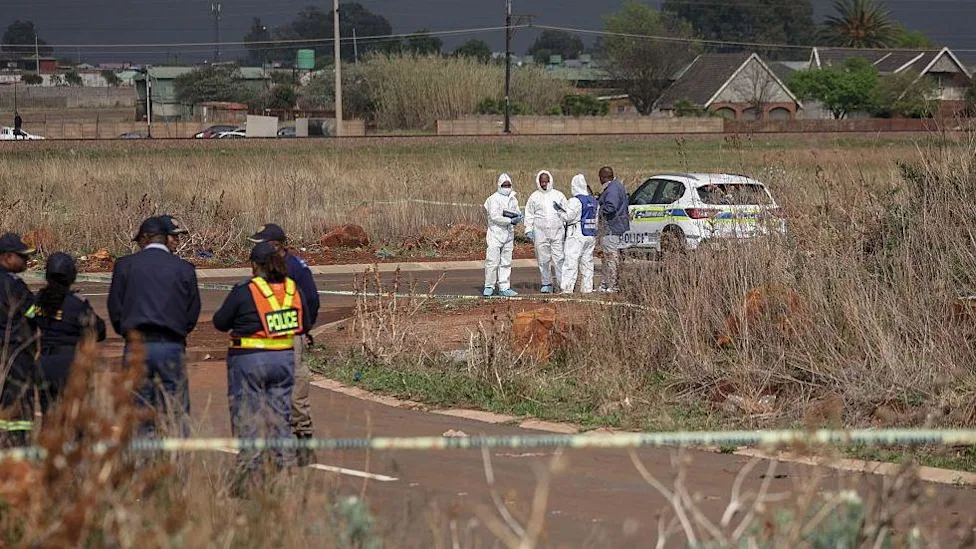
South African police have recovered the body of a ninth woman in the Ekurhuleni area, east of Johannesburg, as a series of killings over the past two months continues to fuel fears of a possible serial killer or group of killers.
The latest discovery on Thursday came after three women’s bodies were found in the area this week, prompting authorities to intensify security operations and impose a lockdown in parts of Kempton Park.
Police cordoned off the area where the latest victim was found as forensic officers in protective suits examined the scene, while residents gathered nearby to watch the investigation.
Deputy police chief Tebello Mosikili said authorities were concerned by the growing number of bodies being recovered.
“We cannot continue picking up bodies,” Mosikili told journalists at the scene.
The circumstances surrounding the latest death were still under investigation, with police examining whether the killing was connected to the previous cases or represented a separate incident.
Mosikili said investigators would determine whether the latest discovery was part of the same series or possibly the work of a copycat.
The killings have heightened anxiety among residents, particularly women and families living in communities where the bodies have been discovered.
Patience Masa said the incidents had made residents increasingly fearful.
“This is very scary… because you can say us as woman and children are no longer safe,” Masa said.
Another resident, Zanele Vilakazi, said the circumstances had made her question her safety even during daylight hours.
“I told someone on the phone that, I don’t feel safe, for this to happen in the morning, so we are not safe,” Vilakazi said.
The latest cases have generated widespread concern because several of the victims were found partially naked or with signs of physical trauma.
However, police have yet to establish that all the killings were committed by one person or group.
Authorities have offered a 400,000-rand ($25,000) reward for information that could help identify and arrest those responsible for the killings.
The Democratic Alliance has also announced a separate reward of $31,000 for information leading to an arrest.
Police have mounted roadblocks and increased operations around affected communities as investigators work to establish links between the cases.
The investigation has also drawn attention to South Africa’s broader gender-based violence crisis.
Other News
According to the United Nations, one in three women in the country experiences physical or sexual violence during her lifetime.
Among the victims was 38-year-old Elizabeth Moselakgomo, who left home for a jog and did not return.
Her body was discovered on September 12 behind a hotel after fellow runners launched a social media campaign to help locate her.
Her death subsequently drew renewed public attention to other cases involving women whose bodies had been discovered in the area.
Police said the first victim, a 37-year-old woman, was found naked and bound with cable ties on July 15. A suspect was arrested two days later and appeared in court on Wednesday.
Mosikili said the suspect was a foreign national but did not disclose his country of origin.
A second woman, aged 32, was found partially clothed on August 24, while another woman was discovered naked and in an advanced state of decomposition on September 10.
The growing number of deaths has prompted calls for urgent action from government, civil society organisations and other groups.
Gauteng Premier Panyaza Lesufi said authorities would not relent in their efforts to identify those responsible.
“Someone has declared war against us, and we will push back, we are not going to surrender,” Lesufi said.
President Cyril Ramaphosa also pledged that authorities would pursue the investigation, saying:
“No stone will be left unturned.”
Ramaphosa acknowledged that the killings were creating widespread concern, particularly among women.
“These incidents are causing fear and uncertainty in our communities, and especially among women,” he said.
The cases have renewed calls for stronger measures against gender-based violence in South Africa, which has previously declared the issue a national emergency.
With a population of about 62 million, South Africa continues to record high levels of violent crime, while UN Women has identified the country as having particularly serious levels of violence against women and children.
For now, investigators are still working to determine whether the nine deaths form a single pattern or involve separate perpetrators.